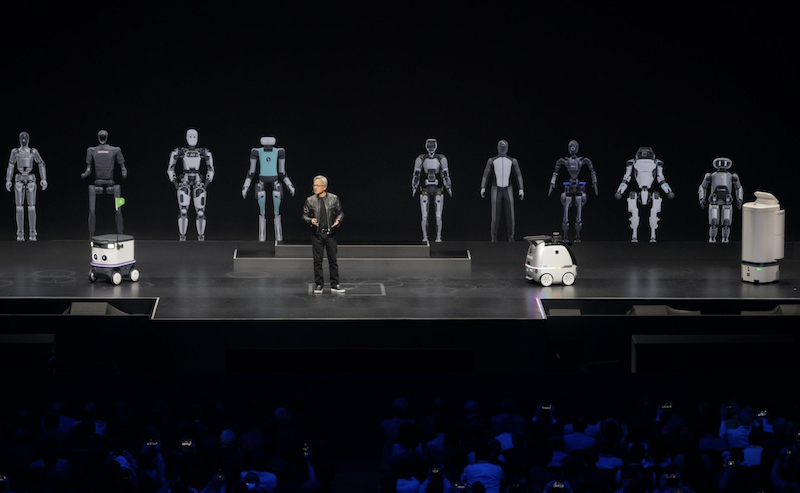
Jensen Huang keynote at CES 2025. | Credit: NVIDIA
Days before Christmas in 2023, Serve Robotics was on the verge of bankruptcy. A major investor pulled out of a committed funding round, leaving the developer of sidewalk delivery robots unable to make payroll and just days away from running out of cash.
With few options remaining, Serve Robotics co-founder and CEO Ali Kashani reached out to NVIDIA co-founder Jensen Huang. “We spoke at 6 a.m. the next day, and later that day I was having dinner with his executive team to find a way to bridge the company,” recalled Kashani. “Within days, they led a financing round that brought us back to life.”
Four months later, Serve Robotics was ringing the bell at Nasdaq to celebrate its public listing.
“I have heard similar stories from many other founders, as well as current and former NVIDIA employees, whose lives Jensen’s actions have changed,” Kashani said.
Over the past several years, few people outside the robotics industry have done more than Huang to elevate its profile.
Clad in his signature black leather jacket, Huang routinely dedicated portions of his marathon keynotes to robotics. He showcased humanoids on stage, introduced development tools, highlighted startups, championed open models and research, and made the case that robots would transform the world.
He also put NVIDIA’s money behind that vision.
Now, one of robotics’ most influential advocates is gone. NVIDIA’s board accepted Huang’s resignation on Nov. 12, and CFO Colette Kress is serving as interim CEO while the company searches for a permanent successor.
A large stage for robotics
For an industry that spent decades fighting for mainstream recognition, Huang provided something few robotics executives could: one of the biggest stages in technology.
“Jensen was fantastic in painting the vision,” said Yaro Tenzer, co-founder and CEO of RightHand Robotics.
Tenzer said Huang helped expand investors’ imaginations about what robotics could become.
NVIDIA said during its third-quarter earnings call that its physical AI revenue nearly tripled year over year and is on track to exceed $25 billion in fiscal 2027. While that represents a sizable and rapidly growing business, it still accounts for only about 6% of NVIDIA’s projected annual revenue of more than $400 billion. And physical AI encompasses more than robotics.
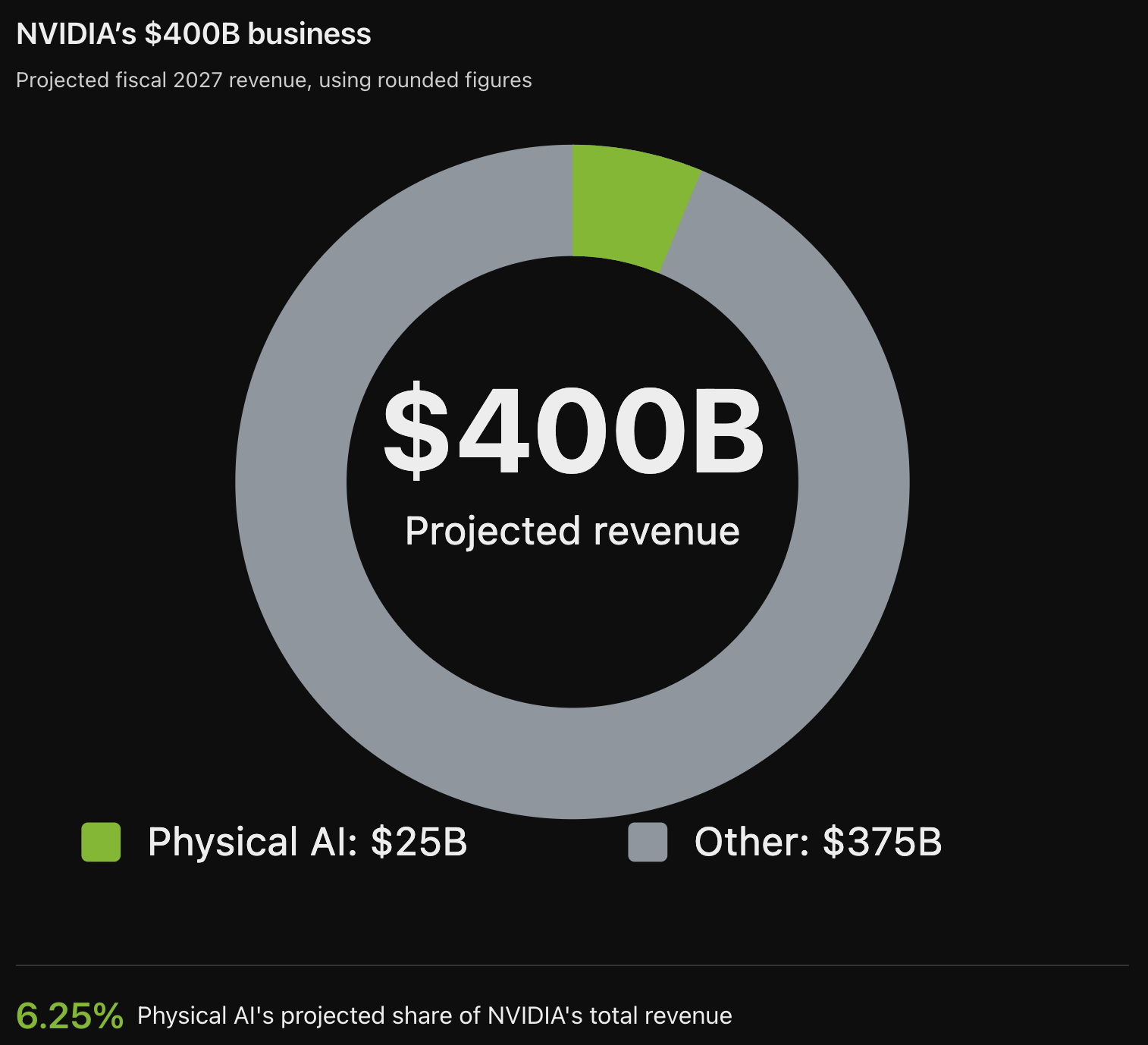
The attention Huang afforded robotics was disproportionate to its short-term commercial contribution.
“NVIDIA introduced its Isaac robotics platform back in 2017, and Jensen kept robotics in his keynotes and in the company’s long-term story year after year,” said Deepak Jayaraj, vice president of hardware engineering and manufacturing at agricultural robotics developer Four Growers. “I think that steady attention made it easier for founders to make the case to investors.”
Unlike Tesla CEO Elon Musk, whose robotics advocacy is largely centered on his own company’s products, Huang promoted an ecosystem of developers, many of whom compete directly with one another.
NVIDIA stood to benefit financially regardless of which robotics companies succeeded. But that business model also positioned Huang to become an advocate for the broader industry.
Providing infrastructure
Perhaps NVIDIA’s lasting contribution to robotics will be the development infrastructure it built under Huang. Its portfolio spans much of the robotics development stack, from GPUs and CUDA for AI training to Omniverse and Isaac Sim for simulation, Isaac Lab for robot learning, GR00T and Cosmos foundation models, Isaac ROS software, and Jetson embedded computing.
Jan Zizka, co-founder and CEO of warehouse robotics developer Brightpick and co-founder of machine vision specialist Photoneo, experienced NVIDIA’s impact firsthand. Zizka said Photoneo participated in an early-access program for NVIDIA’s Jetson TX1 computing platform.
“He was almost pushing the market to make it happen,” Zizka said, pointing to Huang’s willingness to invest in emerging markets before demand fully materialized.
NVIDIA’s investments in open research and software helped lower barriers to entry for developers. Zizka noted that its efforts in embedded computing also encouraged competitors, including AMD and Qualcomm, to pursue robotics opportunities.
Under Huang, NVIDIA became one of robotics’ most prominent strategic investors, backing companies including Figure AI, NEURA Robotics, Skild AI, Wayve, Waabi, and Serve Robotics. Beyond capital, an investment from NVIDIA provided an endorsement that could help startups attract additional investors, employees, and customers.
“Jensen’s style will be hard to copy,” said Jayaraj. “I’d judge whomever it is by which robotics programs they keep funding.”
“NVIDIA has a business reason to stay in, since many robot companies train and simulate on its compute long before they ship at scale,” he added. “The keynote time and the early bets on young teams are the parts that could fade.”
Losing an advocate inside NVIDIA
Huang’s enthusiasm for robotics was perhaps just as valuable inside NVIDIA as it was outside the company. Its robotics teams had an advocate at the highest level of the organization. Having earned considerable credibility with investors through previous long-term bets, Huang enjoyed a latitude his successor might not.
NVIDIA’s next CEO will also inherit growing competition in its core data center business and potentially greater political and regulatory scrutiny following the Democrats’ strong performance in the midterm elections.
Robert Little, co-founder and former CEO of ATI Industrial Automation, is particularly concerned about how opposition to data center construction could affect NVIDIA’s ability to fund its longer-term investments.
“Robotics is being propped up from the money that’s being created in the data centers for NVIDIA that affords NVIDIA to have a team of people developing product for robotics,” Little said.
If growth in that business slows, NVIDIA’s willingness to fund robotics research, product development, and strategic investments could be tested.
“What’s the first thing you do when you start to see a negative financial situation? You cut anything that’s not making money,” Little said.
Conversely, those pressures could make diversifying NVIDIA’s business even more important.
One early indicator of NVIDIA’s strategic priorities could be its pending $12.9 billion acquisition of Hugging Face, whose LeRobot initiative has become an important resource for robotics developers. Whether NVIDIA follows through on the deal will be worth watching, although regulatory hurdles could also influence its outcome.
NVIDIA has not responded to multiple requests for comment from The Robot Report about its robotics strategy following Huang’s departure. If we hear back, we will update this story. Huang’s son, Spencer, remains at NVIDIA, where he has worked for the past four and a half years. He has served as director of product management for robotics for the past 9 months.
The robotics flywheel is already spinning
Despite his concerns about NVIDIA’s data center business, Little believes the robotics industry has enough momentum to withstand the departure of any individual.
“The flywheel has been created and it is spinning now,” Little said. “We’re too far in. The momentum has been created, and now it’ll just carry itself through.”
Google DeepMind, Physical Intelligence, Generalist, Skild AI and many others are developing their own approaches to robot intelligence. Semiconductor companies are looking to challenge NVIDIA in embedded computing. Little argued that a less aggressive NVIDIA could benefit competing technology providers. And if robotics researchers and engineers were to leave NVIDIA, their expertise would likely find its way to other companies.
Tenzer similarly believes the physical AI movement has established considerable momentum.
“The foundations are there,” Tenzer said. “I think that things are really accelerating, and you can clearly see it.”
Zizka is more cautious, particularly about the potential ripple effects of disrupting the relationships and trust Huang helped build across the technology ecosystem.
“The best possible case is that it will continue,” Zizka said. “But I think this is a negative.”
Putting humanoids to the test
The bigger test, according to Tenzer, might come 12 months from now. Many humanoid developers have raised substantial funding based on expectations that advances in AI will unlock multi-purpose humanoids for industrial use.
“I think for the next year, maybe it will be fine,” Tenzer said. “But then I think a lot of these companies will struggle with showing actual use cases and real business.”
As companies return to investors seeking additional capital, Tenzer expects some of the enthusiasm surrounding humanoids to dissipate if commercial progress falls short of expectations.
“Somebody needs to get on that stage and show some of the cool things that are happening and have this charisma and have the ability to do it,” Tenzer said. “I think this is where Jensen will be missed.”
As with the autonomous vehicle investment boom, even failed humanoid startups could leave behind advances in manipulation, actuation, sensing, and robot learning that benefit the broader industry.
“Funding is where I’d watch first, especially for humanoid companies whose business case depends on breakthroughs that are still years out,” said Jayaraj. “Jensen’s advocacy gave those bets a lot of credibility.”
“Founders should ask how much of their plan rests on informal support or tools that haven’t shipped yet, because that kind of support can walk out the door with one person.”
Huang helped give companies such as Serve Robotics a chance to prove what was possible. With robotics enjoying unprecedented attention and investment, the industry’s next challenge is turning that attention into sustainable businesses.


Tell Us What You Think!