
In mobile robotics, software, safety, and fleet management are becoming just as important as the robot itself, according to an OMRON project manager.
General Robotics is betting on modular intelligence, not one robot brain

Rather than training one model to do everything, General Robotics composes specialized capabilities—helping robots adapt across tasks and form factors.
The picks-and-shovels strategy behind the robotics boom

The real robotics opportunity isn’t a humanoid in every home—it’s packaging robots for the jobs businesses need done today.
One brick at a time: How Monumental uses robotics to build walls

CEO Salar al Khafaji introduces podcast listeners to how Monumental is using robotics to build walls.
How FPGAs become the gatekeepers of physical AI security

Eric Sivertson, vice president of security business at Lattice Semiconductor, explains how FPGAs can act as deterministic guardrails for robotic systems.
From teach and repeat to SelfPath AI: The next robotics leap
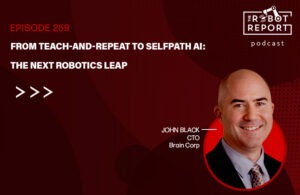
John Black, chief technology officer at Brian Corp, shares insights on how to build trust for robotics fleets and AI.
How software-defined manufacturing fits into real factory operations

Roby Lynn explains how R2 Labs bridges PLCs, robots, and AI to unify fragmented manufacturing systems.
How Protolabs turns CAD files into parts in under 24 hours

Protolabs CTO Marc Kermisch explains how AI, simulation, and design for manufacturing turn CAD files into production parts faster.
Building robots that survive the warehouse

Nomagic says its real moat is production data, because the messiness of real warehouses is where robots either prove themselves or fail.
FCC robot ruling shines a spotlight on U.S. policy; how next-gen AI can help warehousing

OSARO’s Derek Pridmore says warehouse robots are advancing, but real-world safety and reliability still depend on specialized, layered AI systems.
How time series databases unlock real-time data for robotics

Discover how time series databases help robotics teams manage high-volume sensor data, power AI insights, and keep systems running at scale.
Founder of Maximo discusses how robotics is accelerating solar construction

Maximo founder Deise Yumi Asami discusses the process of automating solar construction with robotics.
How Path Robotics uses AI to optimize robotic welding

CEO Andy Lonsberry explains how Path Robotics applies AI to welding, and UC San Diego professor Michael Yip discusses robot learning.
Automate 2026 show recap

Editors Steve Crowe, Mike Oitzman, and Sarah Wynn review Automate 2026, analyzing key trends in physical AI, humanoids, and software orchestration.
Insights behind Kinisi’s acquisition by Bear Robotics

Brennand Pierce, founder and CEO of Kinisi Robotics, discusses the company’s approach to physical AI and its acquisition by Bear Robotics.
Deep dive into Arm’s physical AI and robotics strategies with Drew Henry

Arm EVP Drew Henry discusses the future of physical AI, robotics, and autonomous systems built for real-world constraints.
AI in warehousing: Akash Gupta’s vision for the future

Explore how GreyOrange’s software revolutionizes warehouse automation with AI, transforming logistics into dynamic, predictive ecosystems.
Why deterministic real-time systems are more critical than ever in robotics

Winston Leung discusses the role of QNX in robotics and AI, focusing on safety, innovation, and industry trends.
2026 Robotics Summit & Expo recap

Listen to the podcast this week as The Robot Report editorial staff recaps the recent Robotics Summit & Expo from Boston.
Exploring PLC and robot integration with YRG Robotics’ Chris Elston

Chris Elston discusses PLC integration, Yamaha Robotics, and AI’s role in advancing automation accessibility and innovation.
Why the world’s most successful robotics founders are systems thinkers

Join Ajay Agarwal as he reveals how systems thinking in robotics unlocks massive productivity and multibillion-dollar markets.
Why traditional robotics data collection is obsolete and what replaces it

Eric Chan discusses Rhoda AI’s innovative approach to robotics using video data for scalable, efficient learning.