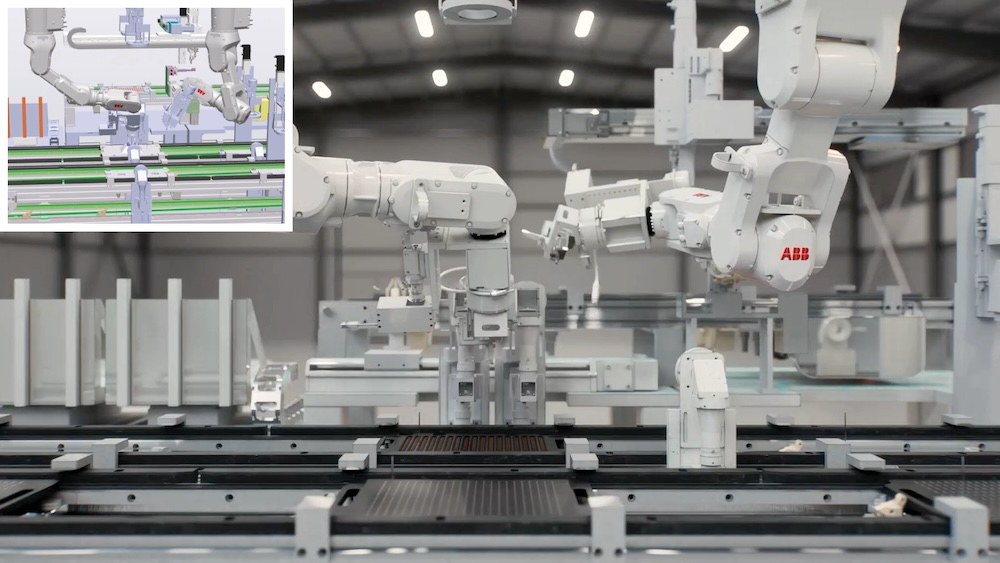
ABB Robotics has integrated NVIDIA Omniverse libraries into RobotStudio. Source: ABB Robotics
Yesterday, ABB Robotics confirmed to The Robot Report that China’s Office of the Working Mechanism for Foreign Investment Security Review has blocked SoftBank Group Corp.’s planned acquisition of ABB Robotics. Regulators had expressed concern that data for training artificial intelligence models could be transferred overseas.
ABB Robotics is already a significant manufacturer and provider of robotics in China. The Zurich-based company stated that it and SoftBank are “in close dialogue and are working constructively on the transaction.”
Other countries are moving to protect what they view as sovereign physical AI. For instance, the U.S. Federal Communications Commission (FCC) recently banned new models of certain connected advanced devices, including legged robots and autonomous mobile robots (AMRs). Companies such as Intel and Husqvarna have already received conditional approvals.
In addition, the U.S. Department of Commerce last week determined that imports of robotics, industrial machinery, and related components pose a threat to the U.S. economy and national security. This could lead to tariffs.
Government investigations can directly affect major robotics and AI companies. European antitrust scrutiny of Amazon’s proposed acquisition of iRobot was one reason why that deal was terminated, with iRobot subsequently entering bankruptcy proceedings. The robotic vacuum pioneer has since been picked up by Shenzhen, China-based Picea Robotics Co.
ABB Robotics as focused on automation and AI
ABB Robotics claimed that it is the only company whose integrated portfolio includes industrial automation, software, force- and power-limited cobots, and AMRs. The company said its “autonomous versatile robotics” help businesses of all sizes in industries including automotive, electronics, and logistics.
ABB Robotics has installed more than 500,000 robots around the world and employs about 7,000 people. Its U.S. headquarters are in Auburn Hills, Mich. In October 2025, parent company ABB said it had agreed to sell its robotics division to Japan-based SoftBank Group Corp. for $5.3 billion.
“Considering the intensive competition in traditional robotics, established manufacturers like ABB will need to lead the charge in AI-driven robotics to protect their margins,” said Samantha Mou, a senior analyst at Interact Analysis. “However, achieving this will require significant investment. The substantial long-term R&D costs may be a key factor behind ABB’s decision to sell its robotics business.”
“Compared with the other Big 4 vendors [FANUC, KUKA, and Yaskawa], ABB was already quick in combining AI with its products, which is an area where it can have synergy with SoftBank,” Mou told The Robot Report. She said that companies in Europe, Asia, and the Americas are hoping that AI, which has already been used for ease of programming, monitoring, and predictive maintenance, can be generalized to more processes.
“AI gives ABB Robotics considerable potential,” said Robert Little, a business development advisor and former chief of robotics strategy at Novanta Inc, on LinkedIn. “But turning that potential into commercially useful systems requires sustained investment. In my humble opinion, backing that investment within ABB becomes a harder decision when robotics has to compete for funding against higher-margin businesses. ABB also saw limited synergies between robotics and the rest of the company.”
“SoftBank made sense,” he added. “ABB brings robot manufacturing, application expertise and established customer relationships. SoftBank could bring additional investment and a clear focus on AI.”
Sovereign physical AI becomes a strategic concern
“Post Astra, robotics data has become more strategic,” posted Financial Times reporter Zijing Wu, in reference to the GPT-6 model that OpenAI released in September and that Chinese AI firms used to train their models.
“The NDRC [China’s National Development and Reform Commission] had been concerned about robotics data being transferred overseas, where it could be used to train AI models, including those developed by OpenAI, in which SoftBank is a major investor, sources say,” said Wu on X.
Countries have become increasingly aware of the competitive advantage promised by the convergence of automation and AI.
“What makes this particularly significant is that industrial robotics is increasingly being viewed not simply as manufacturing equipment, but as strategically important technology at the intersection of automation, data, and AI,” Ash Sharma, managing director of Interact Analysis, told The Robot Report.
“China is a critical market for ABB Robotics, so separating the Chinese operation from a global transaction of this scale would be extremely challenging,” he added. “More broadly, this highlights how robotics data, intellectual property, and local manufacturing capability are becoming important considerations in cross-border M&A as physical AI develops.”
Ahmed Humayun, head of go to market for defense manufacturing at Gecko Robotics, posted to LinkedIn: “This move reflects Chinese concerns about asset transfers to Japan during a time of heightened Chinese-Japanese tension, but [it] also shows concerns about robotics data generated in China being transferred abroad to train foundation models. The most recent example of China flexing its economic muscle and demonstrating that it has many levers to prevent intellectual property and assets from leaving its soil — even when developed by foreign companies.”
“I was worried this might happen,” said Little. “Over the years, I have seen ABB‘s strength in China grow. Where do we go from here?”
“My take: ABB has built a strong presence in China, but heavily subsidized Chinese robot makers are becoming stronger competitors at home and expanding into Europe,” he wrote. “That creates more pressure on pricing and margins that were not that great to begin with fall even further.”
“There may still be negotiations that find a way forward,” concluded Little. “For now, ABB is in a pickle.”
 Submit your innovation now!

Tell Us What You Think!