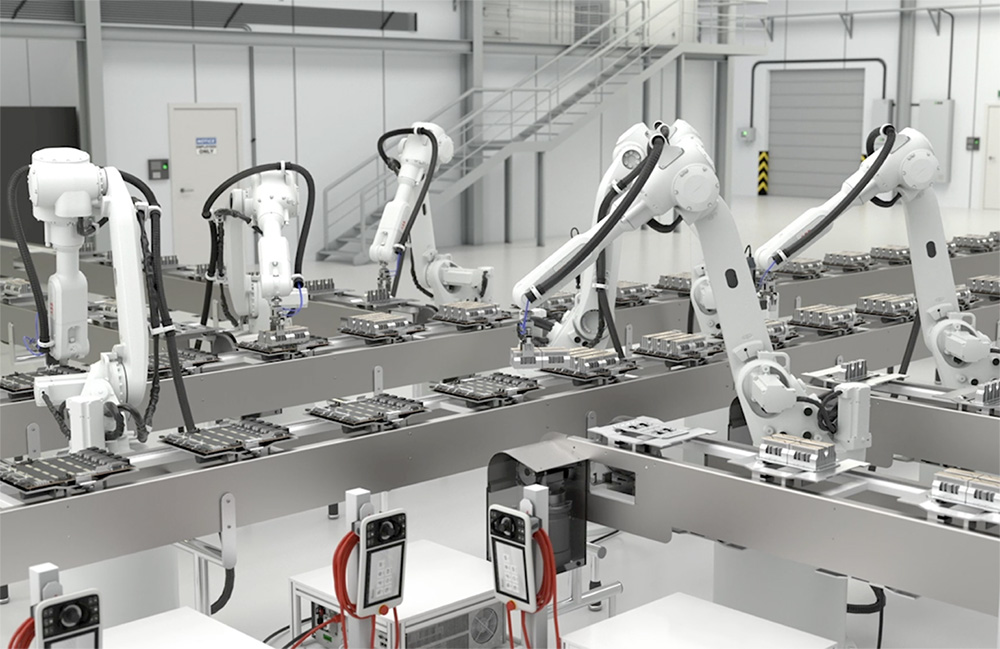
ABB Robotics has about 7,000 employees, and its U.S. headquarters and factory are in Auburn Hills, Mich. | Source: ABB Robotics
It has been more than a year since ABB announced it singed an agreement to sell its robotics division to the Japanese tech giant SoftBank Group. The $5.375 billion deal is now being blocked by Chinese regulators, ABB confirmed to The Robot Report.
China‘s Office of the Working Mechanism for Foreign Investment Security Review has prohibited the acquisition in the country. Authorities expressed concerns about robotics data being transferred overseas and used to train AI models, according to The Financial Times, which first reported that the deal was blocked.
You may be wondering why Chinese regulators have so much say in a Japanese company acquiring a Zurich-based industrial automation provider, but China makes up a major portion of ABB’s revenue. For the entire FY 2025, ABB Robotics saw $928,000 in orders from China, an increase from the $662,000 in orders it brought in from China in 2024.
This is a growing region for ABB. In Q3 2026, ABB Robotics saw a 32% increase in business in China alone.
ABB also manufacturers a significant number of robots in its Shanghai factory. About 90% of its machines built for Chinese customers are manufactured locally, employing thousands of people in the country.
Looking ahead, ABB said it and SoftBank are “in close dialogue and are working constructively on the transaction.”
Is the robotics industry becoming a new political battleground?
This news comes as global politics becomes increasingly important in the world of robotics. This isn’t the first time China has blocked an international deal citing national security concerns. In April, the country prevented Meta from acquiring Manus, an AI startup that was founded in China but then relocated to Singapore, for $2 billion.
Here in the U.S., the federal government has taken steps to slow down foreign robot suppliers within the country. Just last week, U.S. President Donald J. Trump said the secretary of commerce had submitted a Section 232 report about the national security effects of imports of robotics and industrial machinery, as well as related parts and components.
The Section 232 statement specifically cited “advanced robots — such as autonomous robots, humanoid and quadruped robots, and autonomous ground vehicles” as providing direct support to the U.S. military. While it’s unclear right now what this will mean for the robotics industry, it could lead to tariffs on foreign-made robots.
Already, the U.S. Federal Communications Commission (FCC) has banned new foreign-made advanced robotic devices, including mobile robots such as humanoids and quadrupeds. The FCC said these machines could create create supply chain vulnerabilities and pose a cybersecurity risk to American critical infrastructure.
Editor’s note: The Robot Report has reached out to sources for more comment, which we will publish.
 Submit your innovation now!


Tell Us What You Think!