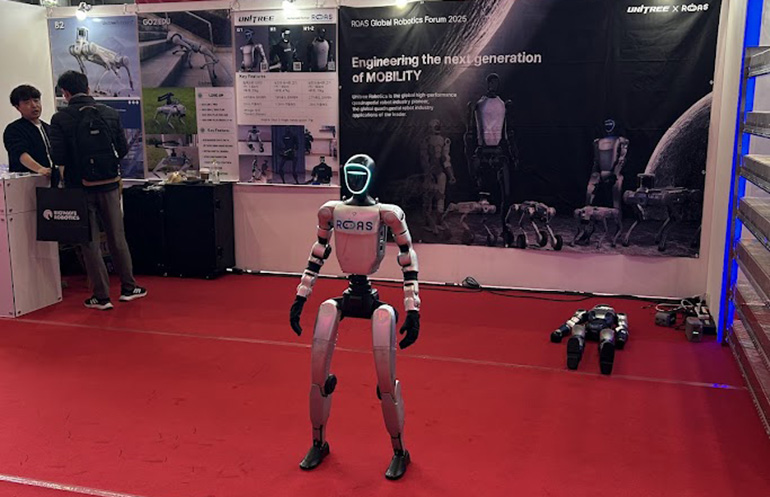
A Unitree humanoid robot at the China Humanoid Robot Conference in Seoul. Credit: Eugene Demaitre
As competition in next-generation robotics and AI intensifies, the U.S. government is restricting imports of certain robots and connected power inverters produced in foreign countries. The Federal Communications Commission, or FCC, yesterday said a White House-convened executive branch interagency body has determined that such products “pose unacceptable risks to the national security of the United States.”
The FCC said it has determined that foreign-made “advanced robotic devices,” including mobile robots such as humanoids and quadrupeds, could create supply chain vulnerabilities and pose a cybersecurity risk to American critical infrastructure.
At the same time, the commission provided an exemption for advanced robots and power inverters that receive conditional approval from the U.S. Department of War or Department of Homeland Security. The ruling does not affect sales, marketing, or use of devices already acquired or models that have already received FCC equipment authorization.
In addition, the ban on new devices does not apply to federal purchases. Software updates for foreign-supplied systems can get approval with a waiver.
The FCC cited similar actions it has already taken regarding uncrewed aircraft systems (UAS) and critical components for drones, where the U.S. has been rebuilding production capability after losing most of it to China about a decade ago.
Cybersecurity is a major concern
“This is one of the strongest technology-security actions in modern U.S. history,” wrote Evan Beard, CEO of Standard Bots, on LinkedIn. “The message is unambiguous: Robotics is a technology America must lead and own — and foreign-subsidized robots will not be allowed to unfairly dominate U.S. robotics as they did solar.”
“As America’s largest AI-native industrial robot manufacturer by units shipped, Standard Bots strongly supports this move,” he stated. “We have advocated for exactly this kind of action in recent sessions with the White House and in Congressional testimony.”
Glen Cove, N.Y.-based Standard Bots last month raised $200 million in Series C funding to expand U.S. manufacturing. Salem, Ore.-based humanoid robot developer Agility also testified before Congress about the need for a unified U.S. robotics policy.
The prohibition on inverters would affect only mobile robot joints with wireless access, focusing on grid cybersecurity and not industrial robots, Beard told The Robot Report.
“It became clear to me that cybersecurity had become a major issue when researchers found a backdoor in Unitree robots and later discovered that some models were transmitting data back to servers in China without the owner’s knowledge,” said Robert Little, a business development advisor, former chief of robotics strategy at Novanta Inc., and a 2026 Joseph F. Engelberger Robotics Awards honoree.
Unitree filed for a $610 million initial public offering in China in March.
“Some ask, ‘Why not just ban those individual companies instead of all Chinese brands?’ The answer appears to be that the administration believes the risk extends beyond any one company because of the Chinese government’s authority over companies operating in China,” Little told The Robot Report.
“There are other concerns, including the massive subsidies that have created unfair competition,” he added. “But in my view, nothing is more important than cybersecurity. These robots are mobile, connected computers with cameras, microphones, and sensors. Once they enter factories, warehouses, and eventually our homes, protecting the data they collect becomes a national security issue.”
How should U.S. robotics companies compete with China?
The FCC claimed that the ban on certain mobile robots and power inverters is country-neutral. The U.S. Department of Commerce is also considering tariffs on imported robotics, industrial machinery, and personal protective equipment.
However, several industry observers said it targets China, which has more than half of the world’s industrial robot installations and has shipped 80% to 90% of humanoid robots to date. A bill introduced in November 2025 would prohibit the federal government from buying humanoids with AI from military suppliers to China, Iran, North Korea, and Russia.
Protectionist policies also pose risks while encouraging domestic robotics production. Leading manufacturers, including ABB, FANUC, Yaskawa, KUKA, and Teradyne Robotics, have expanded their U.S. presence in recent years.
“In the near term, the measure could slow U.S. physical AI innovation by cutting startups and researchers off from future low-cost Chinese platforms before comparable Western alternatives exist,” said Georg Stieler, a global robotics advisor and managing director for Asia at STM.
“It also opens opportunities for U.S. suppliers and allied manufacturers able to localize production in the U.S. or obtain conditional approval,” he told The Robot Report. “Yet excluding foreign products is not the same as building a competitive industrial base.”
“Key dependencies remain upstream: actuators, reducers, batteries, sensors and rare-earth permanent magnets,” Stieler observed. “China accounts for more than 90% of global magnet-rare-earth refining and sintered permanent-magnet production, creating a potential lever for countermeasures.”
“America’s experience with DJI is cautionary. Despite years of restrictions on Chinese drones, the U.S. still lacks a competitive mass-market consumer-drone producer, and Skydio exited the consumer market in 2023,” he said. “Restrictions can reduce security exposure, but they do not by themselves create a competitive domestic ecosystem.”
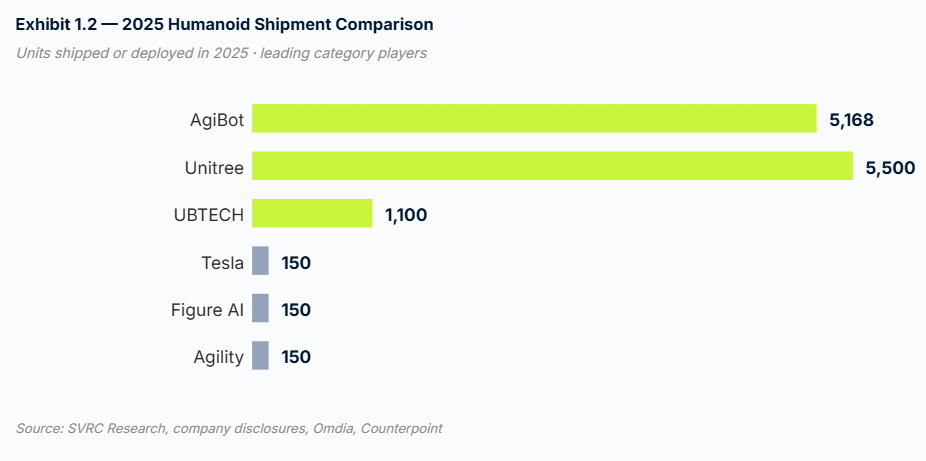
A comparison of humanoid shipments from China versus the U.S. Source: International Federation of Robotics
FCC ban could hit U.S. innovation more than global humanoid market
The trade restrictions are unlikely to affect the race to develop humanoids and enabling AI, according to one market researcher.
“In the short term, the impact even on Chinese companies is likely to be limited, as most Chinese humanoid robot companies have not yet entered the U.S. market,” stated Rueben Scriven, senior research manager at Interact Analysis. “Given the AI and physical data competition behind humanoid robots, many industry players have already anticipated such risks for robots intended for real-world deployment, and their near-term overseas expansion efforts are focused more on the Asia-Pacific region.”
“While the ban reduces direct competition from Chinese manufacturers, it may also hinder U.S. manufacturers seeking to produce robots in China or other countries,” he said. “Should the ban persist over the long term, it would demand that U.S. domestic humanoid robot makers rapidly cut costs and scale up production; otherwise, it could slow the commercialization of humanoid robots.”
“This announcement is more likely to inhibit the U.S. humanoid robotics industry, as the presence of low-cost Chinese humanoid robots has been helping educate the U.S. market through promotional and entertainment use cases — an effect this policy risks undermining,” said Scriven.
The Robot Report will continue its coverage of evolving U.S. policy and humanoid robotics development, which will be among the topics discussed at RoboBusiness in October in Santa Clara, Calif.
 Save the date for RoboBusiness 2026


Tell Us What You Think!