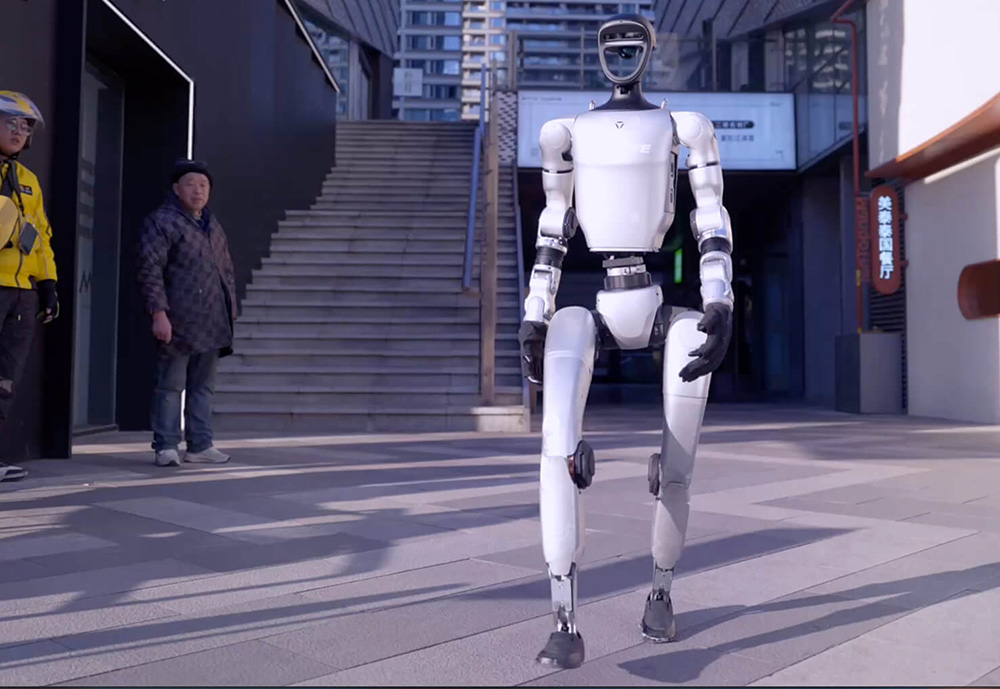
The G1 humanoid robot from Unitree. | Source: Unitree
Unitree Robotics has filed for a STAR Market IPO in Shanghai, seeking to raise about $610 million. The filing matters because it points to something more concrete than a typical humanoid story. It shows a robotics company that appears to have built real manufacturing leverage.
The headline numbers are unusually strong for hardware. Bloomberg reported that Unitree generated about $248 million in revenue in 2025. The harder question is what kind of business investors are actually being asked to value. Reuters previously wrote that Unitree was targeting a valuation of up to $7 billion, though that should be treated as a reported valuation, not a settled fact.
My read is simpler than that. The filing supports the case for Unitree as a serious hardware company. However, it does not yet fully support the broader industrial humanoid case.
The most important signal is not revenue
The most important signal in the company’s filing is the combination of lower humanoid robot selling prices and higher gross margins. According to the company‘s prospectus, the average selling price fell from about $85,000 (¥593,400) in 2023 to about $25,000 (¥167,600) in the first nine months of 2025.
Over roughly the same period, companywide gross margin rose to 59.8%. In most hardware businesses, that is not what you expect to see. When prices fall that much, margins usually come under pressure. Here, they improved. That points to a real cost advantage somewhere in the system.
The actuator economics
This is where the hardware lens matters. McKinsey estimated that actuation typically accounts for 40% to 60% of the humanoid bill of materials cost, making it the largest cost block in many systems. If the biggest cost bucket is getting materially cheaper, the margin story starts to make sense.
Unitree argues in its filing that self-developed and self-produced core components, along with greater scale, are central to its cost advantage. That does not make every reported gross margin point perfectly comparable across robotics companies.
In vertically integrated businesses, the boundary between cost of goods sold and operating expense is not always clear. But directionally, the filing points to something real. Unitree appears to be reducing cost faster than it is reducing price.
Humanoid revenue growth is real
One thing the filing clearly shows is that humanoids are no longer a side business. In the first nine months of 2025, humanoids accounted for 51.5% of core revenue, while quadrupeds accounted for 42.3%. That is a major shift from 2023, when humanoids were only 1.9% of the business. Whatever one thinks about the long-term market, humanoids have already become commercially meaningful inside Unitree.
The quadruped line also deserves more attention than it usually gets. It appears to have built much of the manufacturing base that Unitree’s humanoid line now benefits from. The humanoids may be driving the story. The quadrupeds likely built much of the operating system behind it.
That is very different from saying the humanoid case is already proven.
Who is actually buying matters
This is where the market story outpaces the revenue mix. According to Unitree’s exchange response materials, 73.6% of humanoid revenue came from research and education in the first nine months of 2025. Another 17.4% came from commercial consumption uses such as demonstrations and display environments. Only 9.01% came from industrial applications.
That does not make the revenue weak. Education and research are real markets, and they can be useful early markets for a new robotics platform. But it does mean the current customer base is still much closer to institutional adoption than to broad industrial deployment. That gap matters if investors are underwriting a much larger factory automation outcome.
Sell-through is a good signal, but not the final answer
The Unitree filing shows strong sell-through. In the first nine months of 2025, the company said it produced 3,701 humanoids and sold 3,551, or 95.95% sell-through. That is a healthy operating signal. It suggests that Unitree is not simply filling channels or building inventory without demand.
But it does not answer the full demand question. A 95.95% sell-through rate tells you something about inventory discipline and production matching. It does not tell you how deep the market really is if capacity expands much further.
Unitree looks more mature than the autonomy case
The Unitree research and development profile tells a similar story. According to its prospectus, R&D spending as a share of revenue fell from 31.39% in 2023 to 7.73% in the first nine months of 2025. But absolute R&D spending still rose from about $6.9 million to about $12.5 million over that span. That suggests revenue is outrunning R&D, not that development has stopped.
The more important point is what spending is trying to support. Bloomberg reported that the IPO proceeds are intended for robotics model research, new product development, and manufacturing expansion. In plain terms, the company is still building out the platform.
Geography has shifted fast
The geographic mix also moved quickly.
According to the Unitree filing, mainland China rose to 60.8% of revenue in the first nine months of 2025, up from less than half in prior years. That is a sharp reversal in a short time. The filing flags tariff and export-control risk, but the shift may also reflect stronger domestic demand and better visibility in China.
 Register now and help us celebrate 20 years of RoboBusiness!
Unitree is a real hardware business
The filing makes a credible case that Unitree is already a real hardware business. Lower prices, better margins, meaningful humanoid revenue, and strong sell-through all deserve attention. Those are not the numbers of a science project.
But the current revenue mix does not yet support treating the industrial humanoid outcome as already proven. Only 9.01% of humanoid revenue came from industrial applications in the first nine months of 2025. The customer base is still weighted toward institutions, and the business looks further along in manufacturing than in proven industrial deployment.
That does not make Unitree weak. It means that its hardware case is further along than the full humanoid-at-scale case.
That gap is the real point of the filing.

About the author
Deepak Jayaraj is the vice president of hardware engineering and manufacturing at Four Growers, an agricultural robotics company based in Pittsburgh. With over 15 years of experience spanning space robotics, medical devices, and AgTech, he specializes in guiding robotics companies through the critical transition from prototype to scaled deployment and the economics of hardware business models.


Tell Us What You Think!