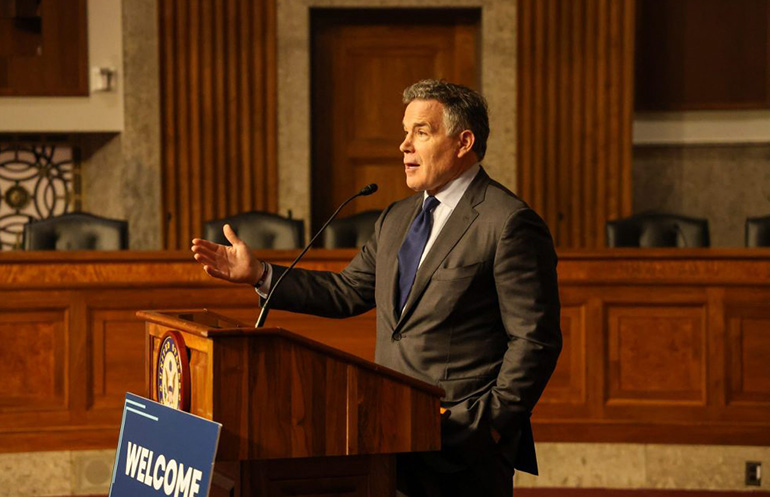
Sen. Dave McCormick (R-Pa.), who co-sponsored a bipartisan bill to establish a National Commission on Robotics.
Robotics can support U.S. economic and military interests, but unified federal policy has been slow in coming. That may be changing, as Senators Dave McCormick (R-Pa.), John Hickenlooper (D-Colo.), Todd Young (R-Ind.), and Martin Heinrich (D-N.M.) last week introduced a bill to create an independent commission to evaluate U.S. competitiveness and recommend policies to strengthen its leadership.
“Advancements in robotics are rapidly changing how we live and work,” stated Sen. Hickenlooper. “If America is going to lead the future, we need a better understanding of the opportunities and challenges ahead—from supply chains and national security to workforce development.”
“Pennsylvania, and Pittsburgh especially, is an incredible hub of robotics talent and demonstrates that American leadership in robotics creates high-paying jobs, strengthens domestic supply chains, and drives long-term growth,” added Sen. McCormick. “The Commission on American Leadership in Robotics will bring together leading experts to help ensure the United States maintains its technological edge over our adversaries and builds the workforce needed to succeed in a technology-driven future.”
National Commission on Robotics would assess U.S. priorities
Representatives Jay Obernolte (R-Calif.), Jennifer McClellan (D-Va.), and Bob Latta (R-Ohio) introduced the companion National Commission on Robotics Act in the U.S. House of Representatives as H.R. 7334 in February. They are members of the recently revived Congressional Robotics Caucus.
The commission would assess and make recommendations on:
- U.S. competitiveness in robotics and the strength of the domestic marketplace
- Whether the U.S. has the means to assert and maintain a technological advantage across industrial, retail, and commercial sectors
- Foreign actions and policies to advance robotics.
- Whether certain strategic partnerships in robotics with industry, the public, and academic institutions could enhance economic competitiveness and manufacturing
- Workforce incentives and programs to attract and recruit leading talent in robotics and associated STEM (science, technology, engineering, and mathematics) fields
- Supply chain risks and policies to increase domestic manufacturing of robotics
Both orders for industrial automation and robot density, or the number of robots per 10,000 employees, rose in North America since 2024, according to the International Federation of Robotics (IFR) and the Association for Advancing Automation (A3). But competitive pressure from China, which has reportedly deployed more robots than the rest of the world combined, continues to increase.
 Submit your session idea for the 2026 RoboBusiness
Industry leaders support proposed legislation
“Robotics is becoming critical infrastructure for modern economies,” Aaron Prather, director of the Robotics & Autonomous Systems Program at ASTM International, told The Robot Report. “Like many other nations, the United States could benefit from a national strategy that aligns research, workforce, standards, and deployment efforts.”
“My advice is simple: if we are serious about reshoring manufacturing, we have to be just as serious about strengthening robotics,” said Robert Little, chief of robotics strategy at Novanta Inc. and a 2026 Joseph F. Engelberger Robotics Award honoree. “America has the talent, universities, companies, and manufacturing base to lead.”
“But we need better coordination between industry, government, academia, and the public sector,” he added. “Without that, we risk rebuilding factories while depending on others for the critical technology that makes those factories competitive.”
Source: Sen. Dave McCormick (R-Pa.).
“We’re very excited about the prospect of a National Robotics Commission, which could be the first major step on the road to a U.S. National Robotics Strategy,” said Jeff Burnstein, president of A3. “I hope the bill will pass soon. Every day without a national strategy risks putting the U.S. further behind in its goal of establishing leadership in robotics, which is one of the most important technologies of the 21st century.”
“Not having a strategy also slows down our efforts in artificial intelligence, since robots are the ‘physical’ in physical AI,” he told The Robot Report. “While there are many other actions needed in addition to the Robotics Commission, this would be a major step forward.”
“Pittsburgh has been at the forefront of robotics innovation for decades, which is why Agility has made a meaningful investment in its footprint there,” stated Peggy Johnson, CEO of Agility. “Sen. McCormick and Sen. Hickenlooper’s introduction of the National Commission on Robotics Act reflects a clear understanding of the strategic importance of U.S. leadership not only in developing, but in deploying robotics, including humanoids, at scale. We hope the Senate will move swiftly on a bipartisan basis to advance this critical legislation.”
“This is a crucial time for robotics, as artificial intelligence unlocks rapid development and advanced applications,” noted Brendan Schulman, vice president of policy and government relations at Boston Dynamics. “A congressional commission is a key step in the process of developing the national robotics strategy that Boston Dynamics and others have called for.”
Other policy efforts continue
Last year, the U.S. Department of Commerce opened investigations into whether tariffs should be levied on imported robotics, industrial machinery, personal protective equipment, and medical devices. The comment period for the Section 232 investigation closed in October, but it has not officially made any conclusions.
In the meantime, a June 1 presidential proclamation has specified duties on metals by U.S. content and temporarily reduced rates for mobile industrial equipment and machinery.
The Special Competitive Studies Project (SCSP) last year sent an open letter to the White House recommending national-level technology goals. This year, the Arlington, Va.-based organization launched a National Security Commission on Robotics for Advanced Manufacturing.
Also this year, Senators Bill Cassidy (R-La.) and Chris Coons (D-Del.) introduced the Humanoid Robotics Oversight and Blocking of Obtainment from Totalitarians Act of 2025 (S. 3275). It would would prohibit the federal government from acquiring humanoids with integrated AI from military suppliers to China, Iran, North Korea, and Russia.
There are also signs of investment in U.S. robotics manufacturing, such as FANUC America‘s March announcement of a $90 million investment in a new facility in Pontiac, Mich.
Last month, Robots for America launched in response to a call from the Office of Science and Technology Policy, the Department of Commerce, the Small Business Administration, and the U.S. Senate.
The industry coalition’s founding members included Formic, Machina Labs, Standard Bots, Dexterity, Medra, Path Robotics, AMP Sortation, Chef Robotics, GrayMatter Robotics, Mytra, Mujin, CreateMe, and Viam. Its goal is to establish robotics as a recognized pillar of U.S. industrial policy, create representation for American factory operators in Washington, address public fears of automation, and open access to automation technology for mid-market manufacturers.
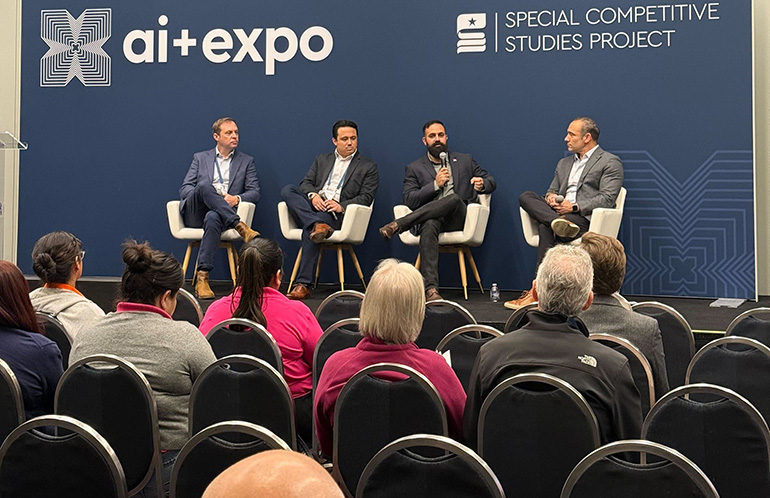
Robots for America founding members at AI+ Expo, from left to right: Micah Murphy of New American Industrial Alliance, Nick Ayala of GrayMatter Robotics, Edward Mehr of Machina Labs, and Dean Banks of Formic. Source: Business Wire




Tell Us What You Think!