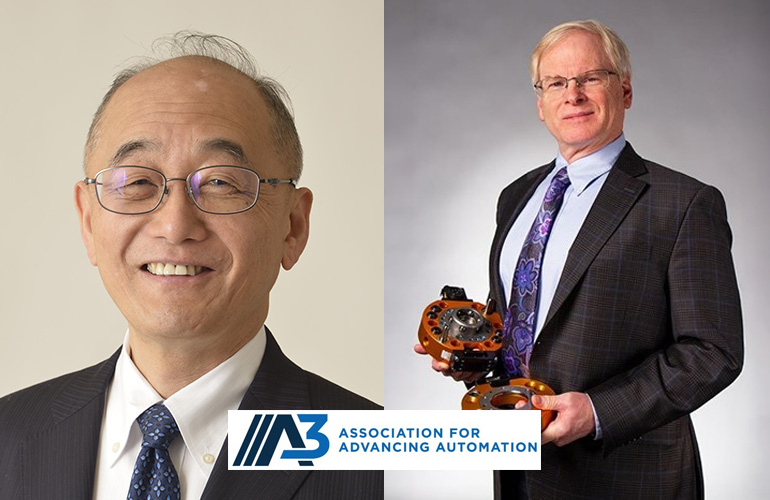
Hiroshi Fujiware (left) and Robert Little (right) are the 2026 Joseph F. Engelberger Robotics Award winners. | Credit: A3
The Association for Advancing Automation, or A3, has named Hiroshi Fujiwara and Robert Little as the recipients of the 2026 Joseph F. Engelberger Robotics Awards, which recognizes excellence in leadership and application.
Fujiwara, executive director of the Japan Robot Association (JARA), was honored for his decades of strategic policy work and international collaboration, while Robert Little, co-founder of ATI Industrial Automation, was named for his transformative contributions to robotic end-effector technology.
The pair will be celebrated as part of the Automate 2026 show, joining an elite roster of visionaries who have defined the trajectory of modern automation. The awards will be presented during a special dinner and ceremony on Wednesday, June 24, at McCormick Place in Chicago.
“Robotics has always advanced because of people who could see what was possible and then do the hard work to make it practical, useful, and scalable,” stated Jeff Burnstein, president of A3. “Hiroshi Fujiwara has helped strengthen one of the world’s most important robotics ecosystems while building collaboration across industry, government, and international markets.”
“Robert Little has spent his career helping manufacturers put robots to work more effectively, giving companies the tools and technologies needed to automate with greater flexibility and confidence,” he added. “Together, they reflect the purpose and spirit of the Engelberger Awards, and both are highly deserving of this recognition.”
Little expands practical robotics adoption in manufacturing
Little has more than 40 years of experience in robotics, automation, and manufacturing. In 1989, he co-founded ATI Industrial Automation and helped grow the company from approximately $1 million to more than $100 million in revenue.
Under Little’s leadership, ATI became a global leader in robotic tool changers, force/torque sensing, and other end-effector technologies, expanding the practical use of robots in manufacturing.
Following Novanta’s acquisition of ATI in 2021, Little served as president of Novanta‘s ATI business group and later as chief of robotics strategy. He now supports the robotics industry through Robert Little Robotics, where he advises companies on business strategy focused on robotics and automation markets. He also serves on the A3 Robotics Technology Strategy Board.
The Engelberger award winner told The Robot Report that he will use his new prominence and “soapbox” to argue that reliability, reshoring, and physical AI will determine whether North America regains its industrial edge—or cedes the future to others.
“Now there is pressure to reshore,” Little said. “There’s pressure to build locally, whether you’re building in the U.S. for the U.S. market, or you’re building in France for the European market. Those customers — they need automation to succeed.”
“We have a labor shortage. It’s not going away; it’s going to get worse,” he said. “The government isn’t necessarily always helping us, but we do see that the A3’s push to bring about a robotics policy from the government is a great thing we need to do in the meantime. More customers means more work for the robotics market, and more work for the robotics market means more development for new technologies.”
Little said he is bullish on the future for robotics in the U.S.
“Robots were invented and first manufactured in the U.S.,” he noted. “I credit Japan greatly for how they embraced robotics. They had a government policy where they said, ‘This is a great technology. We’re going to be No. 1 in the world.’ And they were, and they are.”
“In the U.S., we were skeptical, and robots were not embraced, so we lost that market in manufacturing and development,” recalled Little. “But we didn’t lose all of it. For example, FANUC still makes its paint robots here for the world. The company actually ships paint robots from the U.S. to China.”

Fujiwara advances robotics through global collaboration
Fujiwara has served as executive director of JARA since 2009, where he leads strategic operations and policy advocacy for Japan‘s robotics industry. In that role, he has helped foster collaboration among industry leaders, government agencies, and international partners to support innovation in industrial and service robotics.
Before joining JARA, Fujiwara worked at Japan’s Ministry of Economy, Trade and Industry (METI). He retired in 2009 after nearly three decades in leadership roles spanning industrial policy, technology development, economic security, small business support, and international trade.
Fujiwara’s experience also includes leadership roles with the Japan External Trade Organization (JETRO), the National Institute of Advanced Industrial Science and Technology (AIST). In addition, Fujiwara worked at the Ministry of Land, Infrastructure, Transport, and Tourism and the Tokyo Institute of Technology, where he helped support collaboration among industry, academia, and government.
About the Joseph F. Engelberger Robotics Awards
Named after Joseph F. Engelberger, who is widely regarded as the father of robotics, the Engelberger Awards have recognized robotics leaders since 1977 for excellence in technology development, application, education, and leadership.
Each winner receives a $5,000 honorarium, a commemorative medallion, and a plaque. Winners are selected by a panel of industry leaders based on current and past nominations and are voted on by past chairs of A3 and the Robotic Industries Association (RIA).

Tell Us What You Think!