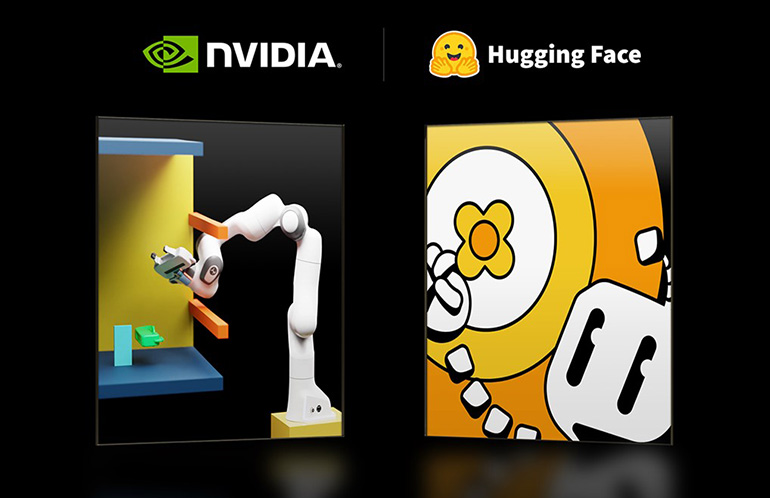
NVIDIA and Hugging Face have collaborated on AI and robotics development. Source: NVIDIA
After a few weeks of anticipation, NVIDIA Corp. today said it is acquiring Hugging Face Inc., an open platform for AI developers, for $12.9 billion. Founded in 2016, Hugging Face provides an open platform for AI developers.
“Ten years after starting Hugging Face, open-source AI is at an inflection point,” Clément Delangue, co-founder and CEO of Hugging Face, posted on X. “Thanks to the community, we’ve shown that it can be a complement, and even an alternative, to closed-source APIs. But for it to happen at larger scale, it needs more compute, more support, more collaboration and more visibility. That’s why we went to talk to Jensen, who offered to do exactly that with us.”
In May 2026, Brooklyn, N.Y.-based Hugging Face launched an agentic AI toolkit for its Reachy Mini desktop platform. In July, the company and NVIDIA added Isaac GR00T 1.7 and the NVIDIA Isaac Teleop framework to the LeRobot open-source library for training, running, and sharing robot datasets, models, policies, and workflows.
Also in July, AI agents in an OpenAI cybersecurity experiment coordinated an attack on Hugging Face. Since then, the companies have worked together to strengthen safeguards, and Delangue noted that an NVIDIA version of a Chinese model helped Hugging Face address the incident.
“We couldn’t defend ourselves with proprietary closed-source APIs, so we had to use open models to defend ourselves. So, it did show the importance of open-source,” he told CNBC.
When it announced passing 1 million datasets last month, Hugging Face noted that open models from Chinese labs had surpassed those of U.S. labs in terms of size and performance. The company also said that NVIDIA and AMD were the leaders in publishing the most new open models and that attention and usage are not the same.
Hugging Face received multiple acquisition offers, but Delangue declined to identify other bidders. The company’s founding team said it expects to stay after the acquisition.
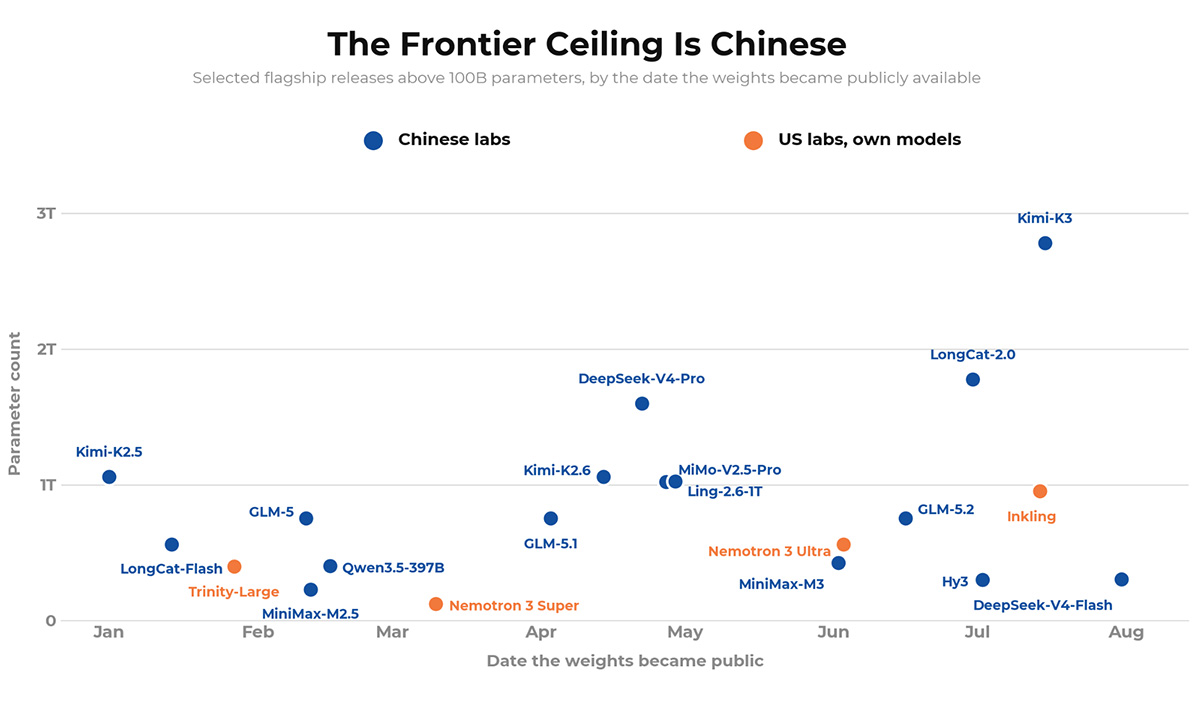
Frontier models from China have surpassed U.S. models in parameters. Source: Hugging Face.
Huang reiterates commitment to open weight models
“Hugging Face will remain an open platform for the entire AI ecosystem,” stated Jensen Huang, CEO of NVIDIA. “Developers will choose the models they want, the frameworks they want, the clouds and inference service providers they want, and the computing platforms they want. NVIDIA compute will not be required to build on or deploy through Hugging Face.”
“More than 18 million developers, researchers and creators use Hugging Face to share more than 3 million models, 500,000 datasets, and 1 million applications,” he added. “More than 200,000 companies use the platform to discover, evaluate, customize and deploy AI.”
“Hugging Face will continue to support open-source and open-weight models from across the ecosystem, from every model builder,” wrote Huang. “It will continue to support multi-cloud and multi-accelerator development and deployment, so builders can use the hardware and infrastructure that best fit their work.”
NVIDIA remains committed to open-source platforms to broaden access to advanced AI across research institutions and businesses, according to Huang. “That is how AI can advance safely, strengthen cybersecurity and sovereignty, accelerate innovation, and reach factories, hospitals, farms, classrooms and Main Street businesses around the world,” he said.
The company believes that “having a healthy ecosystem of closed models and open models leads to a world where you’re going to continue to train these models and run these models at scale,” said Justin Boitano, vice president for enterprise AI at NVIDIA, in a media call.
NVIDIA asserted that it is the largest contributor of data and open models to Hugging Face and that it has released more than 500 models and 250 open datasets on the platform. The Santa Clara, Calif.-based company has built its own open models, libraries, and tools to allow developers to modify, use, and build on top of them.
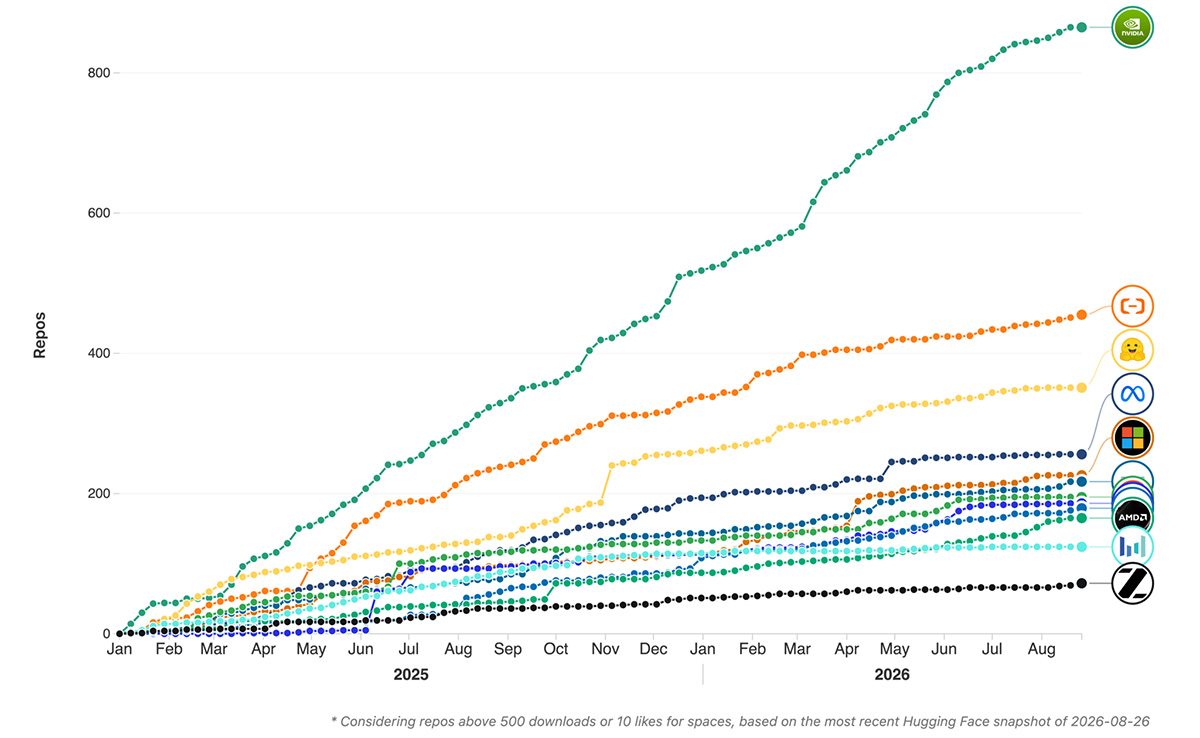
NVIDIA has the most repos and the second-most homegrown models on Hugging Face. Source: Hugging Face, AI World
Hugging Face part of NVIDIA’s software, hardware play
By supporting the open-source software community, NVIDIA is trying to ensure demand for its AI processors and architecture. At its GPU Technology Conference (GTC) in March, the company announced the Vera Rubin chip architecture and touted its expanding robotics partner ecosystem.
Last week, the company reported quarterly revenue of $96 billion, doubling sales year over year. NVIDIA also announced Jetson Orin Nano 2, which reportedly doubled inference performance over the prior entry-level computer for edge AI.
The acquisition could also help NVIDIA re-enter the cloud computing market and help Hugging Face, which has already raised $400 million, be competitive in the growing AI infrastructure market, noted TechCrunch.
“Cloud service providers represents only half of NVIDIA’s business, and yet the other half of our business are really largely driven by open models,” Huang told CNBC. “And so NVIDIA’s growing in both directions, and … our fundamental goal is just to make sure that AI advances as quickly as possible.”
Editor’s note: Physical AI will be among the session track topics at RoboBusiness 2026, which will be on Oct. 20 and 21 in Santa Clara, Calif. Register now to attend.
 Register now and save on your pass to RoboBusiness 2026




Tell Us What You Think!