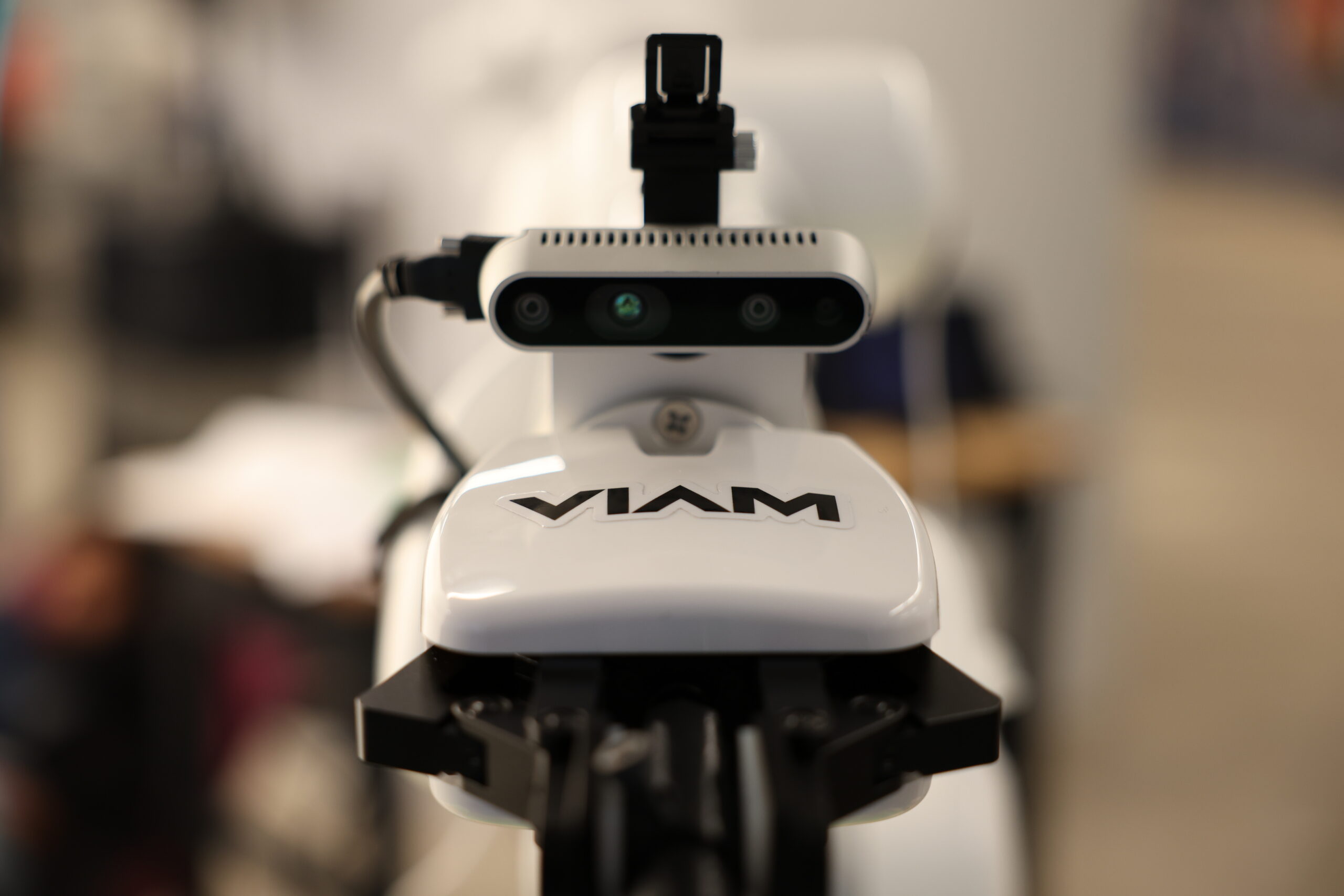
Viam provides a software platform to ease robotics development. Source: Viam
Returning from RoboBusiness and RobOpsCon, I have never felt more optimistic about the robotics — I mean the physical AI — industry. Billion-dollar valuations and groundbreaking technology continue to outpace yesterday’s innovations at warp speed.
At the same time, too many brilliant entrepreneurs are languishing in taking their ideas from the lab to market. These startups, led by domain experts, are on a mission to automate their industries. However, they get stuck in ROS purgatory, unable to turn pilots into revenue-generating bots.
In 2020, Eliot Horowitz set out to create a better way to build and deploy smart machines. Drawing on his experience as co-founder and chief technology officer of MongoDB, Horowitz created Viam, a universal software abstraction layer for building and deploying hardware systems across enterprise fleets, or, as the company describes it, “The harness for physical AI.”
“In the past, robotics startups needed years of R&D and were faced with building a huge amount of infrastructure to make a project something more than a science experiment,” said Horowitz. “What we see with Viam is that a small team starting from zero can prototype in weeks or months, iterate, deploy, and capture real business with incredible velocity by leveraging Viam’s tools and harness for physical AI. We’re incredibly excited to be providing the ingredients needed to grow this new wave of robotics.”

From left: Florian Pestoni of InOrbit, Oliver Mitchell of Arkenstone Capital, Tiq Chapa of Google Cloud, and Betsy Mulé of F-Prime, at RobOpsCon’s VC panel. Source: Oliver Mitchell
Gambit gets a boost toward robotic kitchens
Since launching Viam, the platform has enabled numerous startups to launch and reach customers quickly, including Gambit, Tennibot, and Canyon Runner.
Horowitz and entrepreneur Nicole Maffeo co-founded Gambit. Now, Maffeo is taking her computer vision-based cooking guidance platform into a fully automated kitchen, complete with two robot arms located in the range vent to mix and stir an array of gourmet recipes.
Maffeo recently shared her experience working with Horowitz’s platform: “Partnering with the Viam engineering team over the last couple of years has truly catapulted Gambit forward. By pairing robust, enterprise-grade infrastructure with adaptable custom modules, the architecture empowers our team to transition seamlessly from initial hardware prototypes to real-world deployments. From telemetry and remote debugging to fleet management in field operations, Viam delivers the essential building blocks that allow us to move at incredible velocity.”
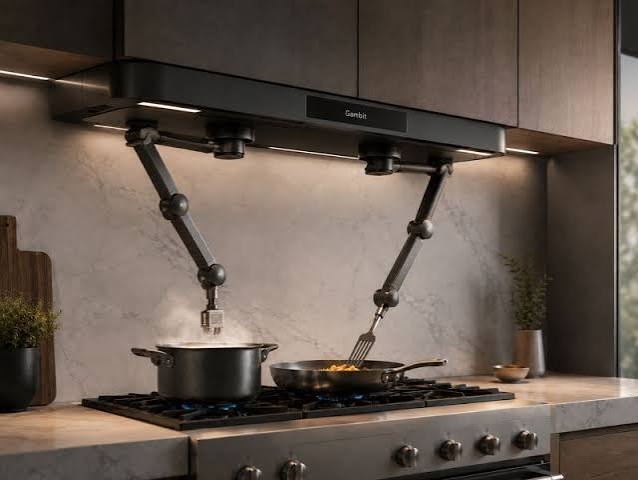
Conceptual design of Gambit’s robotic kitchen built on Viam’s software. Source: Gambit
Viam Launchpad provides immersive startup support
Now, Horowitz aims to build on top of Maffeo’s experience by establishing the Viam Launchpad. This six-month intensive program empowers founders with the technical and business tools to take their concepts from napkin drawings to commercial implementation.
As the advising executive director of the Launchpad, I can attest that the culmination of this incubator is not demo day, but installation day. This is possible because we fully immerse teams in Viam with usage credits, engineering support, and office space in the heart of New York City.
Unlike software, robotics founders need access to hardware, and Viam has one of the most robust robotics labs in the Northeast, complete with a robot arm farm. As a professional investor and author of A Startup Field Guide in the Age of Robots and AI, I also coach founders through a structured curriculum focused on building early customer-discovery feedback loops, refining go-to-market strategies, and leveraging an extensive network of mentors and investors.
 Submit your innovation now!
RoboBuilt quickly preps for commercial deployment
Graduating from the Viam Launchpad, founders are propelled forward with a network of capital introductions, sales leads, and ultimately, purchase orders.
“Our ability to go from planning in a digital environment to physical robot actions within minutes, not days, is really incredible,” said Launchpad member Alex Gray of indoor construction robotics firm RoboBuilt. “ Viam’s modules for rudimentary actions let us focus faster on our specific tasks and avoid getting bogged down in basic setup of robot arm drivers and peripheral APIs.”
RoboBuilt co-founder Shean Rahman illustrated how the software and program are game changers. “We were working in Isaac Sim previously. It’s an incredibly deep and accurate program,” he said. “However, much of the physics, visualizations, and other components aren’t as crucial to our workflow as they may be for other applications.”
“Viam has so many basic initialization steps already mapped out; it lets us get to our core problem faster,” Rahman added. “We look forward to leaving the incubator with a working commercial deployment in time for our seed funding round.”
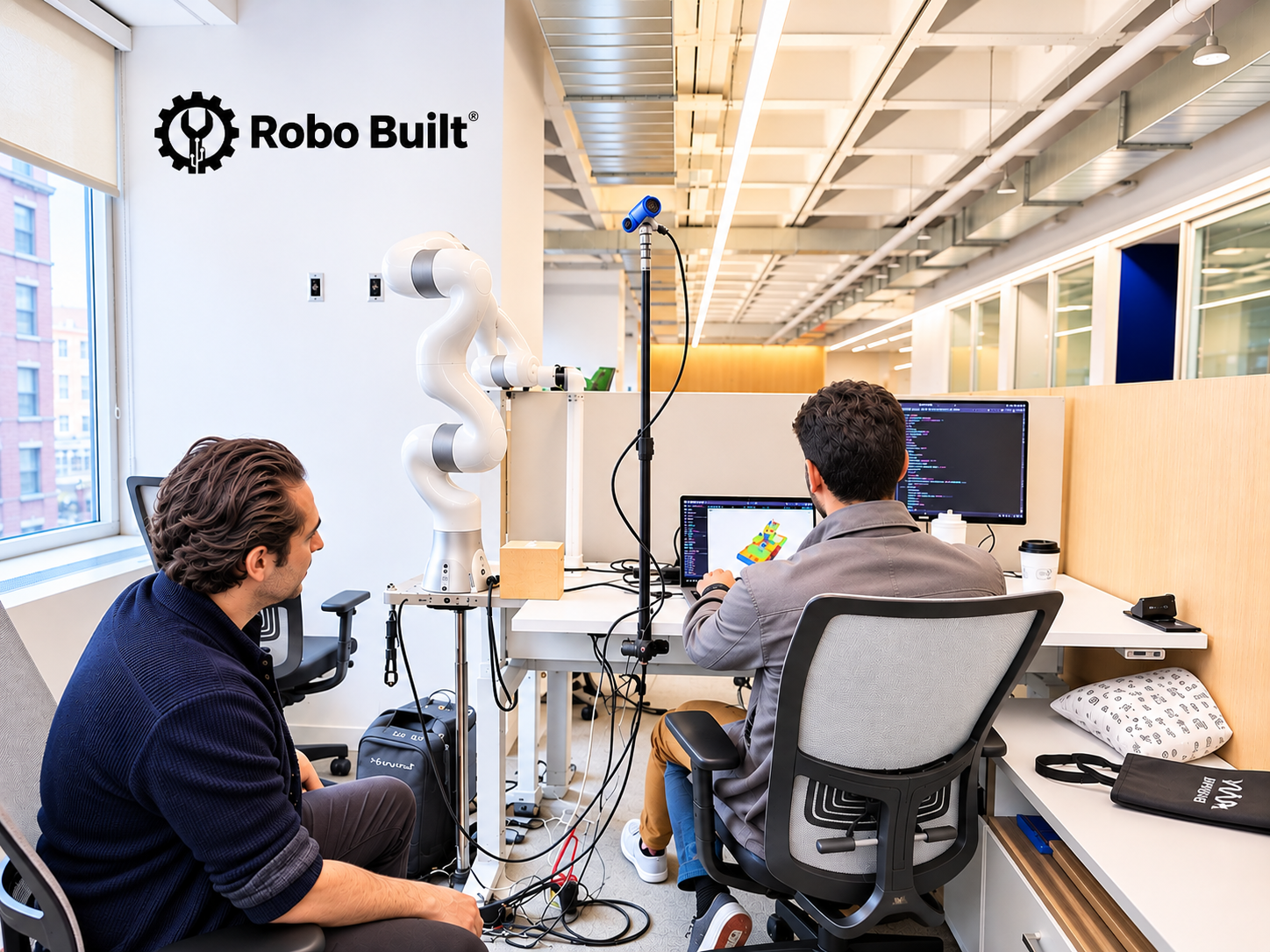
RoboBuilt founders Alex Gray and Shean Rahman at the Viam Launchpad. Source: Viam
F-Prime shares the state of robotics at RoboBusiness
At RoboBusiness last month, Sanjay Aggarwal of F-Prime Capital continued his annual tradition of presenting “The State of Robotics” report to the attendees. In essence, with so many mega rounds, the industry is very strong.
According to F-Prime’s data, automation investments this year have exceeded the past four years combined, surpassing $60 billion in just nine months. While most of this capital is still undiluted, the industry hopes the IPOs of Unitree and Agility will unleash a new spirit of unicorn exits and provide badly needed liquidity, driving a flywheel of invention for decades to come.
Avery Rosen, Viam’s technical chief of staff, asked Aggarwal, “Where do you still see opportunities for startups to innovate?”
The VC quickly answered, “Enabling technologies,” and pointed to his chart showing that only $1.3 billion is being invested in software to speed up robotics deployment. Avery, an integral part of the Viam Launchpad, noted that is exactly what Horowitz aims to disrupt.
The overall market for enabling systems is projected to climb to over $23 billion by 2031, part of a larger $78 billion robotics software market. Today, the industry is crowded with open-source options and large multinational providers racing to fill the void of seamless deployments.
Yet despite significant investment from technology giants like Google with Intrinsic and Amazon with RoboMaker, widespread adoption remains elusive. AWS shuttered RoboMaker last year after seven years of limited traction.
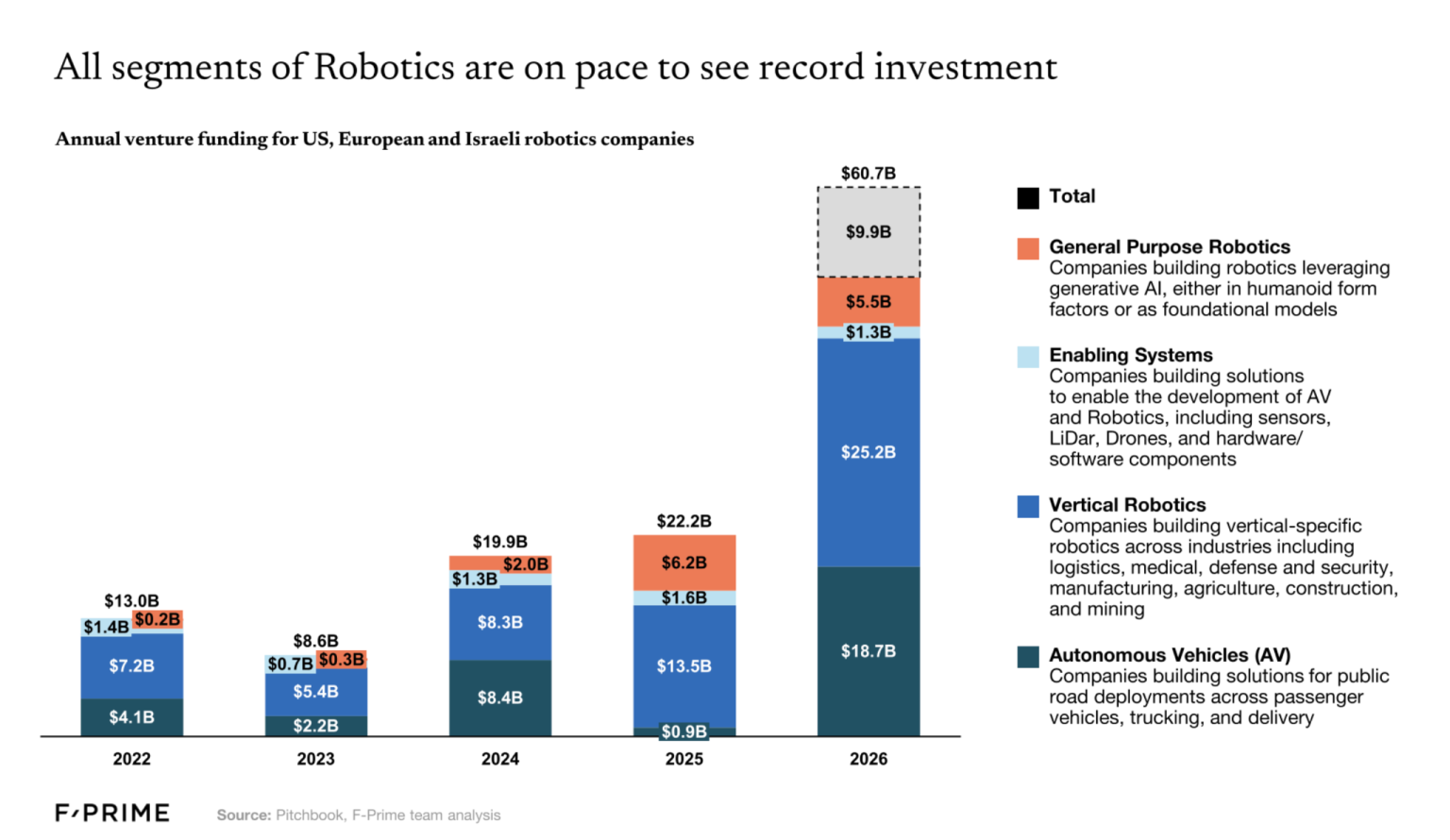
The 2026 State of Robotics Report breaks down investment categories. Source: F-Prime
ROS still requires development time
The most widely adopted open-source robotics framework remains Open Robotics’ Robot Operating System (ROS), with an estimated 1.3 million monthly users. NVIDIA’s Isaac Sim robotics simulation platform is also gaining momentum, surpassing 1 million cumulative downloads this year.
However, downloads and developers don’t necessarily translate into customer-facing rollouts. Viam recently demonstrated how its platform builds on NVIDIA’s Isaac Sim and Cosmos technologies to connect synthetic data generation and AI model training with real-world applications. This more comprehensive approach, combining hardware-agnostic software infrastructure with hands-on engineering support, is helping bridge the gap between simulation, prototype, and deployment, a critical step toward making physical AI a commercial reality.
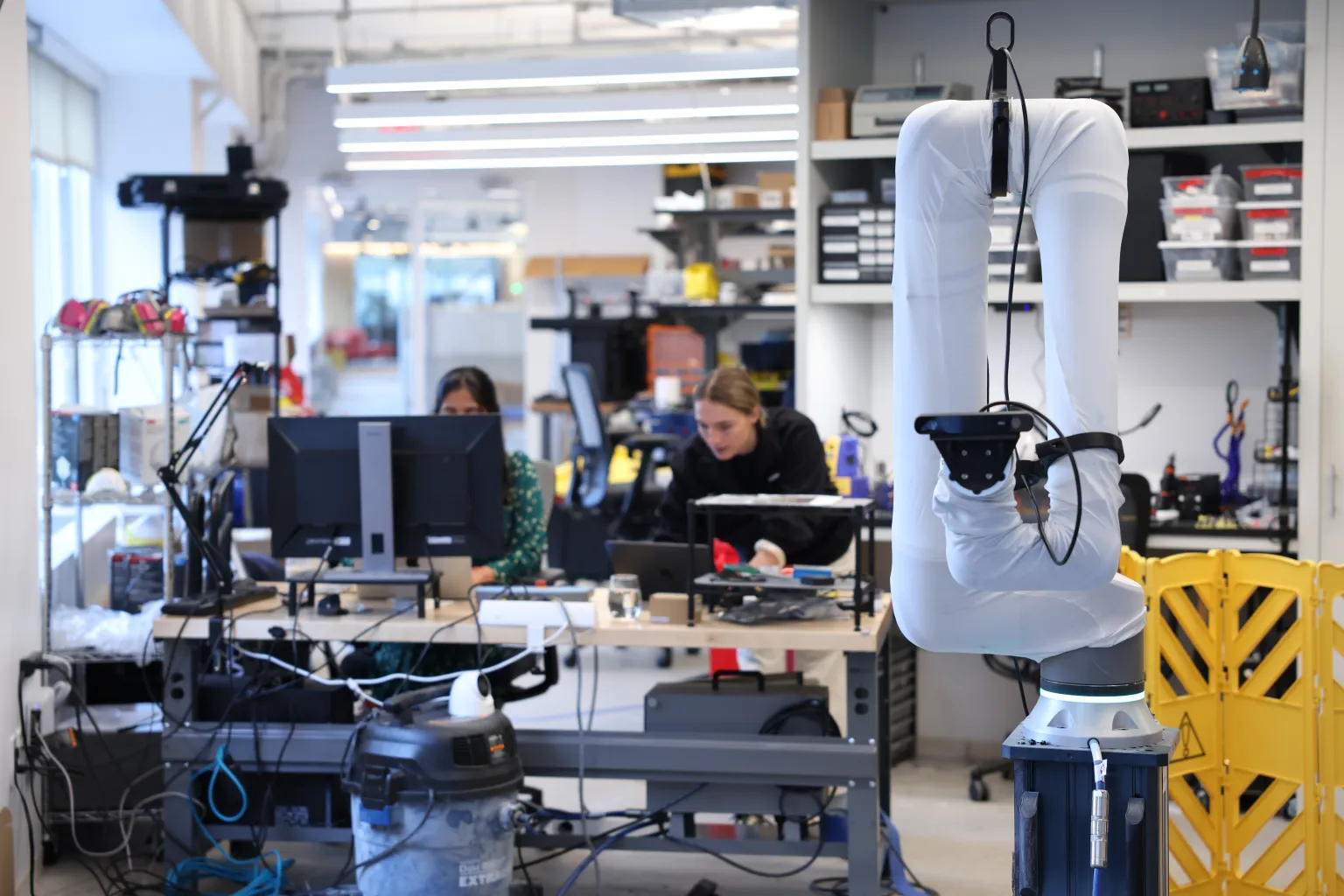
The Viam Launchpad Robotics Lab in New York. Source: Viam
Next year, ROS will celebrate its 20th anniversary, the work of Morgan Quigley and his colleagues at Stanford, followed by Willow Garage, which first developed the software. Today, the open-source platform remains a collection of independently developed modules.
While Open Robotics has provided enormous opportunities for roboticists, we have leaned on ROS as the foundation for production-grade robotics for too long, pushing it to handle tasks it was never designed to address on its own. ROS 2 is a major leap forward over its predecessor, but the capital, time, and resources required to convert prototypes into enterprise-level deployments still hold the industry back, especially for developers without mechanical engineering resources.
Just as the iPhone and App Store democratized mobile app development, Viam is helping usher in a similar moment for robotics by lowering the barriers to building and scaling hardware startups.
Over the past 15 years, accelerators have empowered disruptors to conquer markets coast to coast, from YC in California to ERA in New York. While amazing companies have thrived, robotics requires a different approach, not just office space and equipment, but also deep technical and commercial enablement.
This is the thesis behind the Viam Launchpad: empowering a new generation of robotics founders with deep industry expertise to solve real problems through automation. These problem solvers are in a hurry and don’t have time to tinker with drivers, integrations, and software modules. They demand an easier way, an abstraction layer that allows them to focus on serving paying customers.
To learn more and apply to the Viam Launchpad, click here.



Tell Us What You Think!