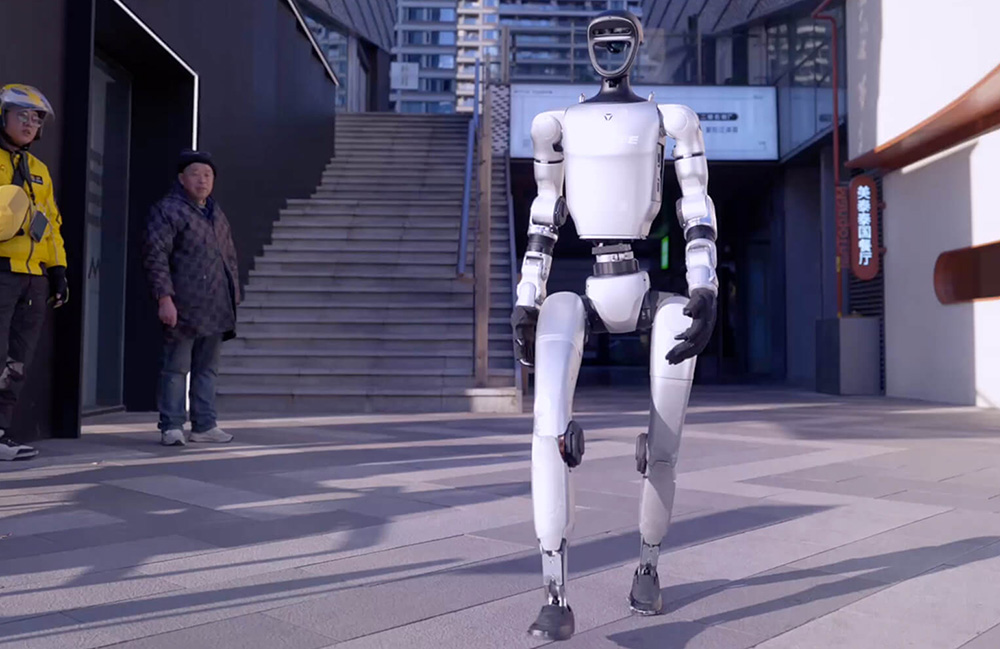
Unitree offers its G1 humanoid robot for $13.5K. | Source: Unitree
This week, Unitree Robotics made its debut on Shanghai’s STAR Market, closing its first day 460% higher. The company raised 6.1 billion yuan, around $905 million U.S., with its initial public offering. Unitree said it is the first major legged robotics company to go pubic.
Since it was founded in 2016, Unitree has made headlines for its low-cost quadruped and humanoid robots. The Hangzhou, China-based company, formally Yushu Technology Co., is best known for its humanoids, which are used in research labs around the world.
You’ve likely seen videos of Unitree’s G1 robot dancing, doing kung fu, or backflipping, among other things. In addition, the company offers robotic hands, arms, and lidar.
Unitree this week also unveiled its latest robot, which it called “Superman” and said it developed in just three months. The humanoid can perform a standing jump of over 6 ft. (2 m) and reach a top speed of around 41 ft. per second (12.6 m/s or 27.9 mph).
The IPO marked a huge milestone for Unitree, but the company still faces many challenges as it continues to grow. It also raised questions about which humanoid companies, in the U.S. and abroad, will follow in its footsteps.
Can Unitree legged robots make the leap to industrial work?
Unitree has gained a lot of momentum in recent years. It went from selling just five humanoids in 2023 to selling 5,215 in 2025, making it a world leader in humanoid robot sales.
Note, however, that around 70% of these robots went to universities and research institutions. Unitree’s robots have yet to prove they can stand up to hard industrial work.
“Volume makes a good IPO story. But fewer than 10% of Unitree’s sales are for commercial deployments. The lion’s share of their robots are in labs and lobbies,” Gavin Kenneally, CEO of Ghost Robotics, told The Robot Report. “Unitree will need to demonstrate that they can build safe, secure robots that customers can rely on in the toughest real-world environments.”
Now, Unitree is facing more challenges when it comes to gaining momentum in the U.S. In July, the Federal Communications Commission, or FCC, restricted imports of certain robots produced in foreign countries. This includes mobile robots such as humanoids and quadrupeds. The ban applies to new devices, which means Unitree could have trouble selling its future models in the U.S.
“Unitree has proven it can sell robots. It hasn’t proven their operational durability, repeat business, or a use case that warrants deployment at scale,” said Nicolaus Radford, CEO of Persona AI. “With the FCC threatening future U.S. sales, investors are being asked to take it on faith that [what appears to be] thousands of one-off sales will somehow become a sustainable business.’
Will Unitree Robotics pave the way for other humanoid IPOs?
Unitree Robotics isn’t the first humanoid developer to go public. In 2023, UBTech, a Shenzhen, China-based company, went public on the Hong Kong stock exchange. However, UBTech hasn’t seen the same momentum that Unitree has.
Last year, UBTech lost around $104 million, while Unitree made a profit of around $41 million, a jump from the $14 million it made in 2024, and the $1.6 million it lost in 2023.
Additionally, UBTech offers lawn mowers, pool cleaners, and vacuums, which make up around a quarter of its revenue. UBTech claimed that it sold 1,079 humanoid robots in 2025, while Unitree makes all of its profits from its robots.
In the U.S., a pure-play domestic humanoid developer has yet go public. Agility, the developer of the Digit humanoid, reportedly has plans to go public via a special purpose acquisition company or SPAC.
The deal would value Agility at a $2.5 billion pre-money equity valuation. The SPAC behind the deal, Churchill XI, saw a bump in its stocks this week with Unitree’s IPO.
While SPACs are a non-traditional path to going public, they’ve become a more common strategy for robotics companies. In 2021, several companies, including Berkshire Grey, Sarcos, Symbotic, and Vicarious Surgical, took the same route.
However, a SPAC, isn’t just an easy way to go public. In fact, many companies that took this route in 2021 have struggled to gain financial footing since.
Other major humanoid developers in the U.S., like Boston Dynamics (which is owned by Hyundai) or Figure AI, haven’t disclosed any plans to make a public offering.
 Register now and save on your pass to RoboBusiness 2026


Tell Us What You Think!