Robotics is advancing rapidly. New AI models and increasingly capable hardware are expanding what machines can perceive, understand and do, bringing more adaptable and general-purpose robots closer to practical use.
But greater capability does not automatically translate into commercial readiness. In supermarkets, hotels, airports and other working environments, robots must navigate changing conditions, operate alongside people, integrate with existing workflows and perform reliably over time. The challenge is not simply what a robot can do, but whether it can do it consistently and at scale.
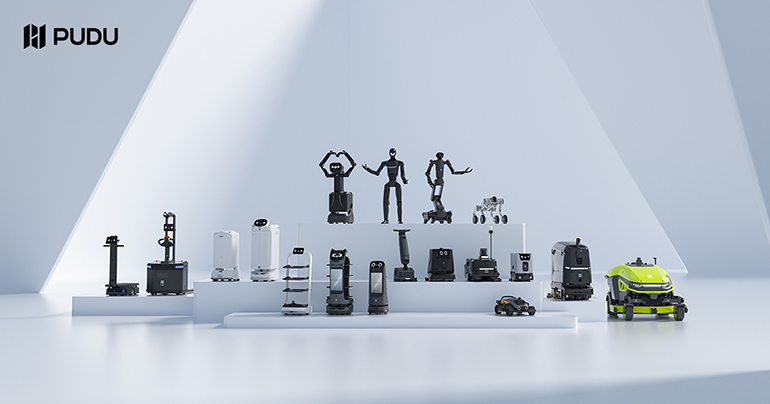
Pudu Robotics Product Portfolio
That challenge was a central theme at Pudu Robotics‘ European Partner Summit in Amsterdam on November 4. Under the theme “AI in Action: Scaling Impact Across Europe — Together,” the company brought together its six product lines, spanning commercial delivery, commercial cleaning, industrial delivery, general embodied AI, commercial lawn care and home lawn care. The portfolio reflected a broader strategic direction: connecting the company’s experience in commercial robotics with its expanding work in embodied intelligence through One Brain, Multiple Embodiments.
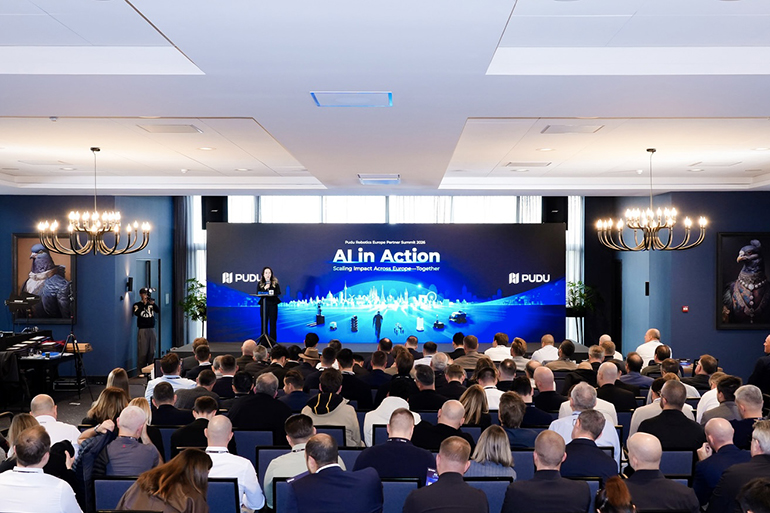
Pudu Robotics European Partner Summit
For the robotics industry, this highlights an important relationship between two developments often considered separately: the experience of deploying specialized robots at scale, and the pursuit of more adaptable intelligence across different machines.
Commercial Scale as a Foundation for Robotics
Real-world deployment exposes robots to challenges that controlled testing cannot fully capture. A supermarket cleaning robot must operate around shoppers and changing floor conditions. A hotel delivery robot needs to navigate shared spaces and interact with elevators. In manufacturing environments, autonomous mobile robots must move materials reliably within established workflows.
Addressing these challenges requires more than navigation algorithms. It involves hardware engineering, perception, fleet management, system integration and the service infrastructure needed to support long-term operation.
Pudu Robotics, a global leader in commercial robotics, has shipped more than 130,000 robots across over 85 countries and regions, serving more than 50,000 customers in over 1,000 cities. Its deployment footprint spans a range of industries, with customers including Denner, EDEKA, Albert Heijn, Carrefour, Marriott, Van der Valk and Paris Charles de Gaulle Airport.
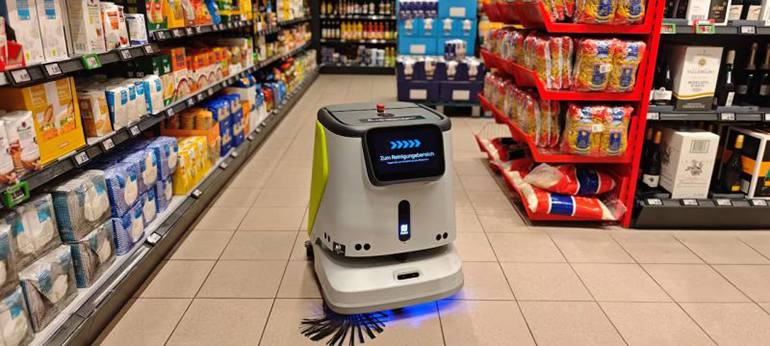
PUDU CC1 at Denner
The scale of these operations is reflected in the breadth of environments served. Denner, the Swiss supermarket chain within Migros Group, expanded its deployment of PUDU CC1 commercial cleaning robots from an initial four-store pilot to approximately 200 units. In hospitality, Pudu robots support service workflows at hotels such as Van der Valk. Across these settings, successful deployment depends not only on task performance, but also on how well robots fit into existing operations and maintain consistent performance in daily use.
Such deployments provide more than commercial validation. They build practical engineering experience in handling environmental variability, human interaction, workflow integration and operational reliability. Field experience and customer feedback also inform product refinement over time. These capabilities are difficult to develop in isolation: they emerge through the repeated process of deploying, supporting and improving robots in real working environments.
As robotics moves toward more general-purpose applications, this accumulated experience becomes an important foundation for tackling a broader range of tasks and environments.
One Brain, Multiple Embodiments: A Shared Foundation for Embodied AI
A central challenge in embodied AI is how to extend capabilities beyond individual machines. Different robot forms have traditionally required substantial hardware and software adaptation, making it difficult to reuse capabilities and scale development across platforms.
Pudu’s One Brain, Multiple Embodiments strategy is designed to address this challenge through a shared technological architecture built around two core technologies: PuduFM and PuduAgent.
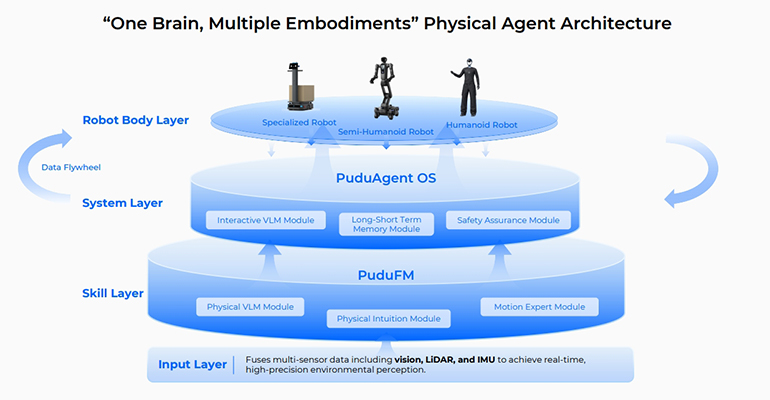
One Brain, Multiple Embodiments Architecture
PuduFM is Pudu’s embodied intelligence foundation model, developed around the concept of physical intuition. Beyond recognizing objects or following predefined instructions, it is designed to help robots understand spatial structures, reason about physical relationships and anticipate changes in the physical world. These capabilities are important to moving beyond predefined task execution toward more context-aware interaction with physical environments.
PuduAgent complements this foundation as a universal embodied AI agent platform for the physical world. It provides a framework for organizing and deploying embodied intelligence capabilities, with reusable skills and safety mechanisms that support application development across robotic platforms.
Together, PuduFM and PuduAgent underpin an architecture built around three core technology areas: Embodied Navigation, Embodied Manipulation and Embodied Interaction. The aim is to make selected AI capabilities, software modules and skills reusable across different robot forms, while allowing hardware and motion-control systems to remain optimized for specific tasks.
As Felix Zhang, founder and CEO of Pudu Robotics, put it at the Amsterdam summit, “The next stage of growth will depend not only on advancing robot capabilities, but also on making robots easier to deploy, more adaptable and commercially viable at scale.”
That perspective reflects the practical rationale behind the strategy. A cleaning robot, an industrial mobile robot and a humanoid do not need identical bodies or motion systems. What can be shared is the underlying intelligence and selected capabilities, adapted to different hardware and operating requirements. The objective is not to make every robot interchangeable, but to reduce the need to develop every capability from scratch for each new platform.
Pudu’s embodied AI portfolio includes the PUDU D5 quadruped, PUDU D7 semi-humanoid and PUDU D9 humanoid, alongside its established specialized robots. These platforms represent different approaches to mobility, physical interaction and task execution. The shared architecture provides a framework for extending capabilities across them as technology matures.
Expanding Robotics Across Applications and Markets
The same combination of specialized engineering and shared technological foundations also creates room to expand into new applications. Building on its experience in commercial delivery and cleaning, Pudu is moving beyond indoor commercial environments into outdoor and residential settings.
The recent launches of the PUDU GT series of commercial lawn care robots and the PUDU TOMO S series for home lawn care mark this expansion — extending autonomous robotics from indoor to outdoor environments, and from commercial use into the home. These are not simply new product categories. They reflect how capabilities developed through specialized robotics can be applied to an increasingly diverse range of real-world tasks.
Years of developing and deploying robots in diverse real-world environments have given Pudu experience in task-specific engineering, system integration and large-scale operations. Combined with the One Brain, Multiple Embodiments architecture, this experience provides a basis for extending its portfolio into new applications while reusing relevant technologies and development capabilities. The approach connects the company’s established commercial robotics business with its longer-term ambition to build more adaptable embodied intelligence.
Turning this broader portfolio into sustained adoption also requires a strong regional presence. Pudu operates in more than 20 European countries and has reported average annual revenue growth of over 60% across the region over the past two years. In October 2026, the company announced the establishment of its European headquarters in Neuss, Germany, bringing together sales, showroom, warehousing, training and after-sales support capabilities.
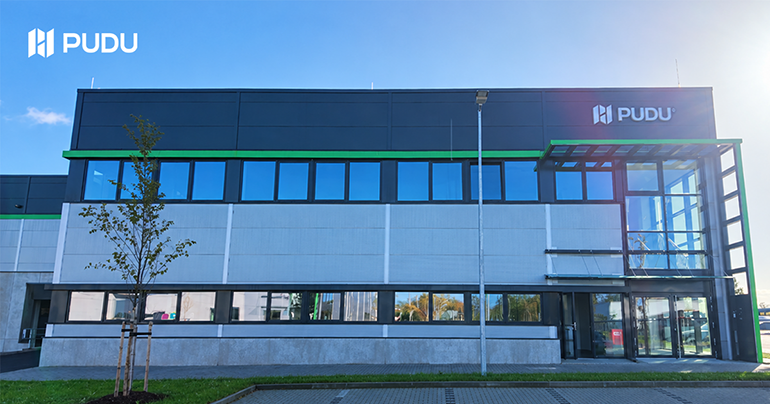
For customers considering larger deployments, local technical support, partner networks and service capabilities are essential to operational continuity. Regional infrastructure is therefore not separate from product innovation; it is part of what makes robotics deployable and commercially viable across markets.
The Next Challenge: Making Intelligence Work in the Physical World
The next phase of robotics will not be defined by AI capabilities alone, but by the ability to translate intelligence into reliable, scalable systems that work in the physical world.
For Pudu, the journey toward more general-purpose robotics builds on a foundation established through years of commercial deployment. By combining proven engineering and commercialization capabilities with advances in embodied intelligence, Pudu is working to extend robotics across more forms, tasks and environments.
The future of robotics is not simply about building machines that can do more. It is about making intelligent robots work reliably, create tangible value and become an increasingly natural part of how people work and live.
Sponsored content by PUDU Robotics

Tell Us What You Think!