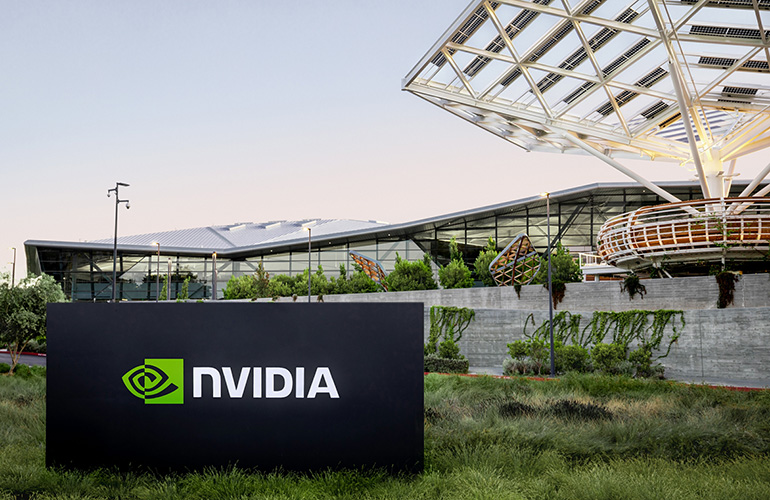
NVIDIA says it will continue to support customers amid its leadership changes. Source: NVIDIA
After a tumultuous week that saw NVIDIA Corp.’s stock drop by about 18.5%, CEO Jensen Huang has stepped down. The company today said it has appointed Collette Kress, executive vice president and chief financial officer, as interim CEO and investor Harvey C. Jones as its first board chair.
Huang, who is one of the most recognizable figures in AI, recently admitted to extramarital affairs including with Alice Huang (no relation), an executive at Megaspeed who is suspected of being a Chinese spy, and Kimberly Powell, vice president of healthcare at NVIDIA.
“To my colleagues at NVIDIA, including those I have worked alongside for decades, and to our board, partners, and shareholders around the world: you deserve better from me,” Jensen Huang wrote in a statement on Nov. 8. “Regarding the national security concerns raised in news reports, NVIDIA’s board of directors has initiated an independent investigation. I support the investigation and will cooperate fully.”
Huang co-founded NVIDIA in 1993, and it makes graphics processing units (GPUs) and software architectures that are the basis for much of advanced computing and AI today. The Santa Clara, Calif.-based company has a market capitalization of about $4 trillion, and its simulation and other technologies are used in industrial manipulators, autonomous mobile robots (AMRs), and emerging humanoid robots.
Kress and Jones to provide business continuity
Kress has served as EVP and CFO of NVIDIA since joining the company in September 2013. NVIDIA said that she has played a key role in its growth and evolution. Prior to joining NVIDIA, Kress spent nearly 25 years in finance roles at leading technology companies including Cisco and Microsoft.
“NVIDIA’s strength has always come from its people, and together with our leadership team, I am committed to building on the extraordinary foundation Jensen created over the last 33 years,” stated Kress. “We will continue advancing the work that has made NVIDIA a leader in accelerated computing and AI, and execute on the opportunities ahead. Our focus remains on serving our customers, partners, developers and shareholders.”
Jones has been an entrepreneur, technology executive, and venture investor for more than 30 years. He has served as CEO and executive chairman of Synopsys.
“Colette has helped lead NVIDIA through a period of extraordinary growth and has a deep understanding of our business, customers, operations and financial position,” said Jones about Kress. “She is supported by an experienced leadership team that has been instrumental in executing NVIDIA’s strategy and advancing its technology roadmap. The board has full confidence in Colette and the leadership team, and we expect the company’s operations, customer commitments, and product roadmap to continue without interruption.”
 Submit your innovation now!
NVIDIA to endure competitive scrutiny
China leads the world in robotics manufacturing and usage, but it still relies on U.S. AI chips and edge computing components. Amid heightened trade conflicts, NVIDIA has worked with numerous global humanoid developers, including Unitree Robotics and Alibaba Cloud. Recent revelations about possible circumvention of U.S. export controls could lead to further investigations and reputational damage.
But in the meantime, NVIDIA has continued to support the robotics industry. Just this week, NVIDIA introduced GR00T 2, an updated open frontier world action model, and Isaac Lab 3.0, the latest version of its open-source robot learning framework. Huang spoke at GTC Berlin last month (see video below).
In September, NVIDIA said it planned to acquire Hugging Face Inc.’s open AI development platform for $12.9 billion. Pollen Robotics, a Bordeaux, France-based subsidiary of Hugging Face, had developed the Microduck open-source legged robot, which uses a Chinese processor.
NVIDIA last month described how robots such as Microduck could use its Isaac Lab learning framework, Newton physical modeling, Omniverse libraries, and Isaac Sim simulation for evaluation. Its deal with Hugging Face will receive more scrutiny, and competitors such as AMD, Qualcomm, Arm, and Intel may try to position themselves are more reliable Western suppliers.
Reuters and Monrningstar noted that Huang’s departure could slow deals around AI. The departure of a prominent tech exec could also lead to greater government scrutiny of trade deals as efforts continue to build so-called sovereign AI and robotics. The Robot Report will continue tracking these developments.


Tell Us What You Think!