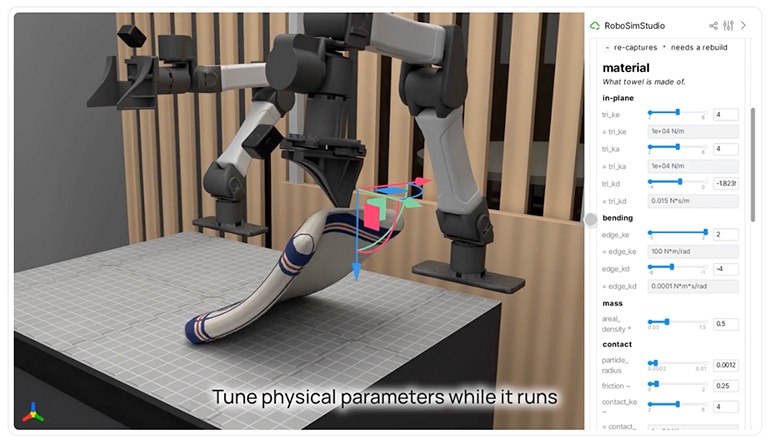
The new RoboSimStudio is an open-source project that enables agentic AI coding of robotic simulation environments. | Credit: UC Berkeley
UC Berkeley and NVIDIA have released open-source tools for a new approach: enabling teams of AI coding agents to write, simulate, and refine readable robot programs.
Since the early days of industrial robots, programming, tuning, and troubleshooting robotic workcells has taken weeks to months. New research coming out of UC Berkeley has demonstrated that new agentic AI programming tools could change how industrial robots are coded and maintained.
Why is this important? As anyone who’s programmed an industrial workcell knows, implementing the code has to wait until the end of the design and fabrication process. The robot needs to be installed in the workcell; all of the feeders, conveyance, and other elements also need to be installed. The pressure to get this done all falls on the software team, often when the project deadline is looming.
The new toolset goes beyond the idea of “vibe coding” a robot application. While it generates code with large language models (LLMs), what’s novel is the use of AI agents to manage the coding, testing and deployment.
“Agentic robotics is a fundamental shift in how robots are programmed,” said Ken Goldberg, the William S. Floyd Jr. Distinguished Chair in Engineering at UC Berkeley. “Instead of collecting massive amounts of data and hand-tuning every behavior, teams of agents can quickly generate, test, and refine robot programs that allow human engineers to interpret how the programs work for fine-tuning and verification.”
Researchers introduce GaP and VABAR
- Graph-as-Policy (GaP) is a modular framework that splits a task into skills — perception, grasp planning, collision-free motion — which agents generate, connect and rehearse in simulation.
- Variational Automation Benchmark for Agentic Robotics (VABAR) is a benchmark of six tasks: tool sorting, tool hanging, gear meshing, syringe packing, cable insertion, and cable routing. It is built built on Isaac Lab-Arena and Newton, with standardized variations and difficulty tiers.
- The UC Berkeley and NVIDIA team presented the concept at CoRL 2026 this week in Austin, Texas.
How the toolset works
Dr. Goldberg described the research to The Robot Report. In September, Eric Chen, one of his graduate students, give GPT-6 Astra Eric’s new RoboSimStudio tool to see if it could generate not just a graphic model, but also a full 3D simulation of a scene. And that’s exactly what happened.
According to Goldberg, Chen gave the model a video and this new tool, and within an hour, it had generated a Newton simulation that was incredibly similar to the video.
“When a new frontier model came out in early September, they gave it the tool and a video,” said Goldberg. “Within about an hour, it produced a Newton simulation closely matching the video, by iterative trial and error.”
“And Newton [simulation] is really wonderful,” he added. “The problem is Newton is very complicated. It has a lot of parameters, hundreds of parameters. So generally, people didn’t really use it that much because it’s just too complicated, too many dials and switches.”
Goldberg praised Chen for pulling this together. Initially, Chen built the tool just for himself.
“I want my student Eric to get credit for this,” he said. “He basically sat down and built a new interface for Newton called RoboSimStudio. It is basically just an interface that makes you have sliders on the right-hand side of your screen, and you have a visualizer on the left. … You can tune all these parameters much easier than you could before, so he built that just for himself to make the simulation part easier.”
But simulation alone isn’t enough, according to Goldberg. Simulation matters to the whole approach of using agents to code robots.
“The agent needs a simulator to be able to basically iterate and see how to improve this code,” he said. Goldberg noted that the existing tools “were not very reliable and had a lot of problems.”

The harness converts a VA task specification into a computation graph, optimizes it via self-learning in simulation, and hands G* to an edge-based interpreter that drives the robot — sim and real feedback close the loop. | Credit: UC Berkeley
Agents write and test code
Agentic robotics operates in a loop: Agents write robot code, test it in simulation, see where it fails, and revise. That loop is only as good as the simulator behind it.
Newton Physics, the open-source physics engine that UC Berkeley chose, is powerful but exposes hundreds of parameters, which has kept many developers from using it.
RoboSim Studio made those parameters tractable, and that turned the simulator from a bottleneck into something an AI agent could tune on its own.
UC Berkeley developed the VABAR benchmark suite with NVIDIA Isaac Lab-Arena open-source policy-evaluation framework and the Newton physics engine. It includes a detailed physics-based simulation for contact-rich robot-object interactions.
VABAR evaluates how robots perform on practical manipulation tasks ranging from tool sorting and handing to cable insertion and routing. The tool facilitates comparisons and measures progress across realistic industrial tasks, changing conditions, and increasing levels of difficulty.
Each task includes standardized variations, difficulty tiers, and success metrics, allowing researchers to measure progress, compare approaches, and evaluate whether systems can handle the demands of industrial operation. At the same time, Isaac Lab-Arena enables large-scale systematic evaluations across changing task conditions.
Spencer Huang, director of product for robotics at NVIDIA (and son of CEO Jensen Huang), has worked with Goldberg’s lab at UC Berkeley to interface with the NVIDIA product teams.
The partners listed some of the new capabilities:
- Graph structure: Each node (perception, grasp, motion planning) can be assigned to its own agent, so agents work in parallel without “stepping on each other’s toes.”
- ROS equivalence: The graph turns out to be equivalent to a ROS graph and can be converted to ROS 2.
- Output: Python that calls existing vendor modules (such as KUKA) for low-level drive control. It does not replace robot controllers.
- The harness: Thousands of prompts and structures constrain the agents.
How do agents change robot programming?
When asked how this new approach differs from straight “vibe coding” of an app, Goldberg responded that the magic is in the harness provided by GaP. The graph structure organizes the agents.
The code produced by “vibe coding” is already mature and well understood, he explained. The use of AI to write code is accepted in software engineering today. But rarely does an application function as intended in the first pass.
This is true for software from human engineers, and it’s equally true for software development developed with AI. Testing and iteration are needed to optimize the application, said Goldberg.
When applied to robotics, the best practice now is to test in simulation before deploying the code on a real robot. With agentic AI, a robotics engineer can enable the agent to iterate on both the simulation environment and then the subsequent code to more efficiently develop the robotic application.
For instance, Bosch is evaluating agentic robotics for diverse industrial automation scenarios. “Agentic robotics holds great promise because it generates interpretable code that engineers can thoroughly analyze before production deployment,” said Liu Ren, senior vice president and AI fellow at Bosch Research. “Bosch Research is actively collaborating with Goldberg and Huang and their teams.”
“AI-powered industrial robots must continuously improve reliability and performance,” said Jeff Mahler, co-founder and chief technology officer of Ambi Robotics. “Agentic robotics converted production data into robot behavior updates, increasing throughput across our U.S. fleet while keeping engineers in control.”
Goldberg is also an advisor to Ambi Robotics.
 Submit your innovation now!



Tell Us What You Think!