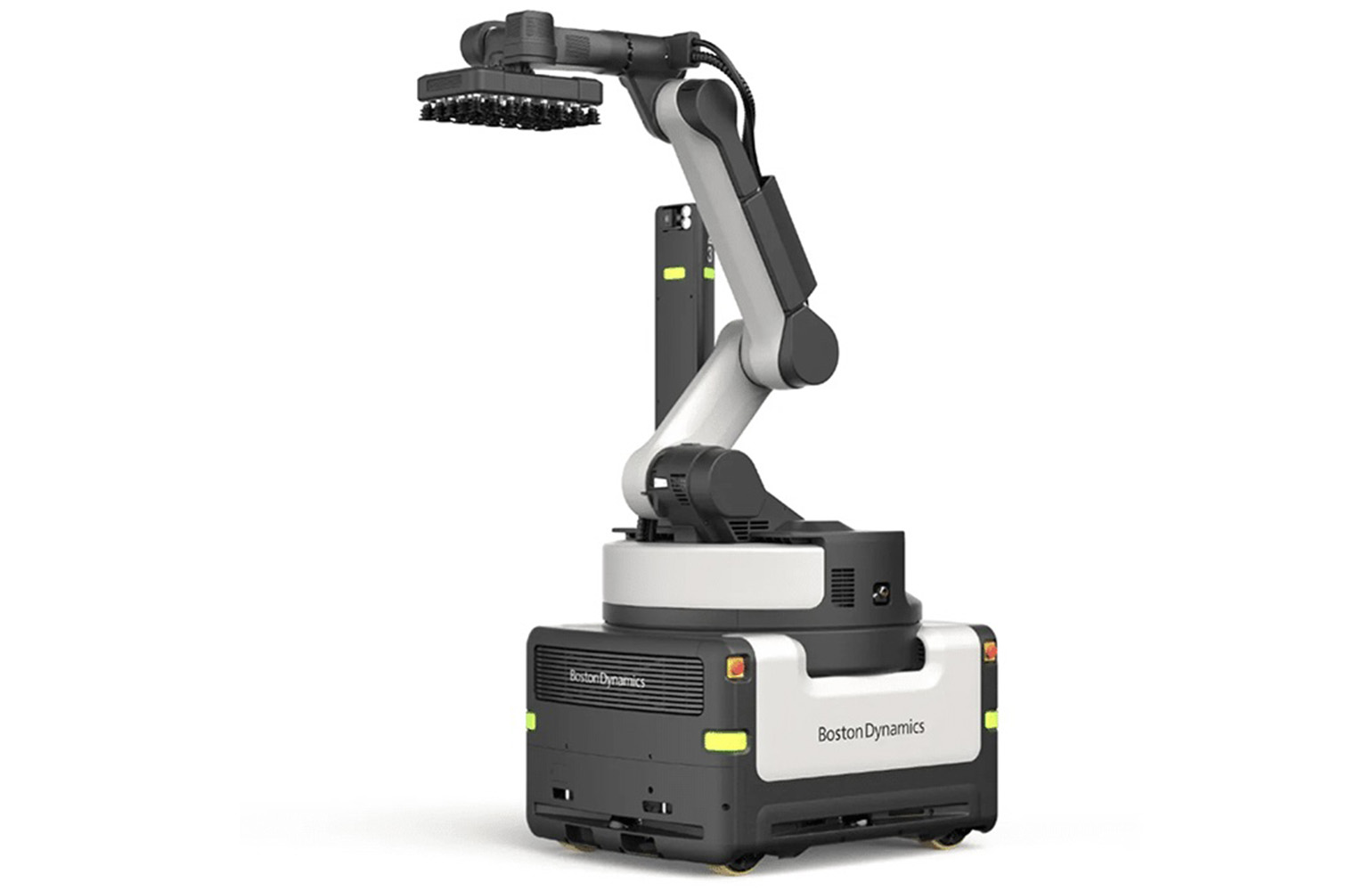
The new Stretch features an updated modular design that enables “plug and play” part swaps. | Source: Boston Dynamics
Boston Dynamics Inc. this week unveiled Stretch Gen 2, the latest generation of its autonomous mobile trailer unloading robot. With over 100,000 operating hours and tens of millions of boxes handled under its belt, the company built the updated robot to maximize uptime and streamline maintenance.
Brian Donnelly, the vice president and general manager of logistics robotics at Boston Dynamics, told The Robot Report that the company has been working on the new version of Stretch for around two and a half years.
“When we made the first generation of Stretch, we were focused on trying to get a product out into the market as fast as possible and really get it in customers’ hands and get it operational,” he said. “It was not the easiest to manufacture; there were a lot of components.”
“[With Stretch 2], we really were focused on simplification, hardening the robot, and really driving improved reliability and performance,” added Donnelly. “That’s really what drove a lot of our decisions was just making the robot better in every way.”
Stretch Gen 2 can unload up to 1,000 cases per hour. This rate is highly dependent on factors such as case weight and how neat or disorderly cases are stacked. It has a multipick feature, a battery that can last two shifts, and a fast charger that can get it to 90% charge in about 75 minutes.
The mobile manipulator also features onboard lighting, making it easier to work in dark trailers, and a pre-trained vision system that can detect most packages without programming needed.
Stretch’s hardware upgrades improve durability
Boston Dynamics geared many of Stretch Gen 2’s upgrades towards reducing downtime and making the robot more durable. For example, the Waltham, Mass.-based company also cut 81% of the internal cabling, around half a mile’s worth.
“[Cabling] is weight, it’s cost, and its points of failure, particularly when you have something that’s in constant motion, you’re creating strain on those cables with every motion,” Donnelly said. “If you don’t have good strain relief, you don’t have good ways of managing the cables in the robot. It can cause stress on the cables and then failure.”
Donnelly said Hyundai helped the company source a cable harness through its automotive supply chain. This isn’t the only thing Boston Dynamics learned from the automotive industry. Stretch Gen 2 uses heavy-duty automotive-grade connectors. These hold up to the vibration of rapid, high-torque box handling and driving over uneven floors.
“In the automotive industry, they have to deal with a lot of real-world challenges in their vehicles. There’s a lot of miles driven dealing with shock and vibration and things like this,” Donnelly said. “As a robot moves around the world, just like a car, if you don’t have latching connectors, then they can sort of wiggle apart. By leveraging those automotive connectors, we’re much more confident that the connectors are going to stay latched together and not pull apart in the field.”
The robot also has continuous rotation joints that move beyond 360° so they no longer hit hard stops. This can help prevent previously caused mechanical stress. Donnelly pointed out this also makes the robot more productive, as it can completely optimize its trajectory planning and move in any direction.
The emergency stop on the robot now sits lower and is recessed. Boston Dynamics made the exterior panels with new materials so a falling box is far less likely to trip an unintentional safety stoppage or break a panel.
How Stretch Gen 2 gets a grip on multiple boxes
The gripper is the part of the robot that often deals with the most stress. It’s making contact with all of the the things the robot needs to handle. Stretch Gen 2 features an upgraded gripper with new valve systems and more precise sensing improves grasping and placement to optimize fast-paced picks.
“[The new gripper] has a value in every suction cup, which enables us to pick multiple boxes with a single motion of the arm, which substantially increases our throughput,” Donnelly explained. “If we can pick multiple boxes, with a single motion of the arm, we get much higher throughput because the pick cycle of picking up a box from the floor of a container and place it to a conveyor is dominated by arm movement. So, if we can keep the arm moving and just do more every cycle, that is really effective and improves the rate at which we can unload a truck for our customers.”
The new gripper is also better at configuring boxes on the conveyor belt in ways that work best for Boston Dynamics’ customers, and use less power in picking up boxes.
“Every cup is individually sensed and actuated, so we know when we have good suction,” said Donnelly. “We only have the value open to pull suction when we have good contact on a box, so that enables us to reduce the amount of power we’re spending running on the vacuum pump, so we’re not pulling suction through cups that don’t have good contact. It also enables us to, when we pick up those multiple boxes, singulate them onto the conveyor.”
Stretch Gen 2 brings service time down to just hours
With Stretch Gen 2, Boston Dynamics didn’t just want to reduce the frequency of service calls; it also wanted to make those service calls faster when they do happen.
“We didn’t have as much experience from a serviceability perspective as a company when we made the first-generation robot,” Donnelly said. “We’ve since deployed these robots, serviced them in the field, and hired a lot of people who have a lot more experience than we originally did in service. Their input and guidance really helped us to make a robot that’s much more manufacturable and more serviceable.”
The robot doesn’t require dynamic cables and complex harnesses. Instead it uses standardized high-strength fasteners to cut down on tool changes and hands-on repair time. For example, the company can perform a full swerve drive swap in just one hour. Before, this process could take an entire day.
Stretch Gen 2 also features new onboard diagnostics and maintenance tools. These put more routine service in the hands of a customer’s own maintenance team, so robots stay on the dock with less reliance on outside support.
Updated robot continuously improves its performance
The new robot runs on a redesigned onboard computing platform that is constantly improving. Boston Dynamics said it will regularly release software updates to bring gains in case detection, motion planning, pick strategies, and world modeling across an entire fleet, with no hardware changes required.
Donnelly said that with the company’s most recent update, it saw a 24% increase in unload rate across its fleet of fielded robots.
“A lot of our activity on this program is really focused on the software. We’re constantly improving our computer vision capabilities to be able to better perceive boxes and conveyors and container walls, and then really pick boxes and place them to convey more and more productivity over time,” Donnelly said.
Right now, Donnelly said Boston Dynamics releases new software, on average, on a monthly basis.
 Submit your innovation now!
How have customers reacted to Gen 2 so far?
Donnelly said Boston Dynamics already has Stretch Gen 2 running at multiple customer sites.
“Customers are really happy with it, and they’re continuing to rely on it to do its work every day,” said Donnelly. “We’re going into these existing sites and deploying these robots within two weeks. The folks who are taking over operating the robots are the folks who are otherwise doing repetitive heavy lifting of these boxes and containers.”
“We put a lot of effort into ensuring that the user experience, from an operator perspective, is really simple. It doesn’t require a ton of training,” he added. “A person can drive the robot into a container, step out of the safety work cell, and they press a big Play button, and then the robot does the rest.”
Many of the people working with Stretch used to spend their days unloading heavy boxes from trailers.
“Fundamentally, unloading trailers is one of the worst jobs in the warehouse,” Donnelly said. “It can be really hot in a container that’s been sitting in a yard in the summer. It can be super cold in the winter. Then the work itself is moving heavy boxes repeatedly from down low or up high. It puts a lot of strain and stress on people’s bodies.”

Tell Us What You Think!