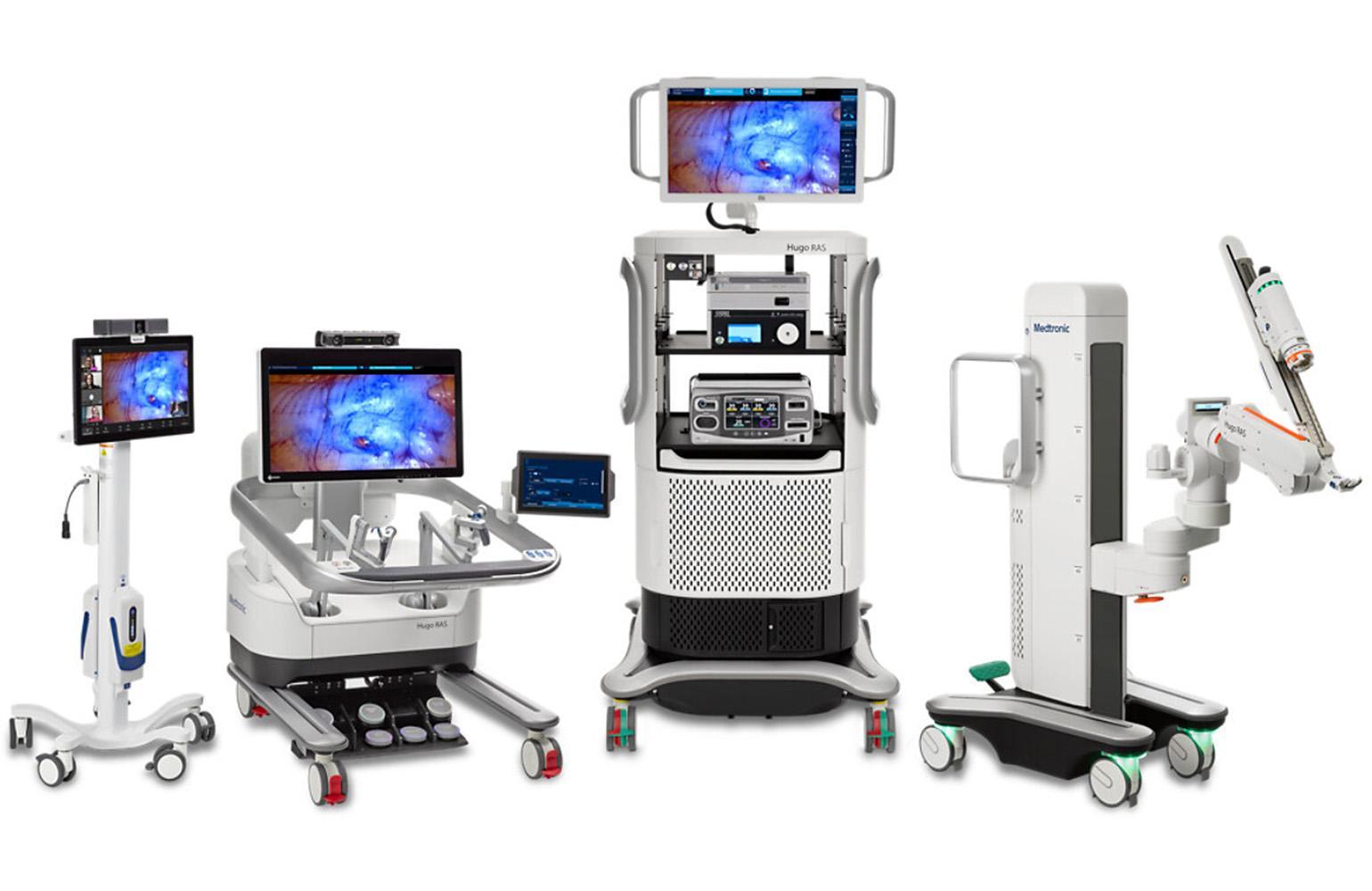
Medtronic’s Hugo surgical robot features a modular design that allows surgeons to use only the robotic arms needed for any given procedure. | Source: Medtronic
Medtronic this week announced the U.S. Food and Drug Administration (FDA) has cleared the Hugo robotic-assisted surgery system for use in general surgery procedures. The approval enables the modular, cart-based system to perform surgeries across the abdomen.
The clearance covers all upper abdominal general surgical procedures, including cholecystectomy, Roux-en-Y gastric bypass, ventral hernia, and small bowel resection. The FDA also cleared lower abdominal procedures of inguinal hernia and appendectomy.
Combined, Medtronic said these procedures account for about 3.5 million surgeries annually in the U.S.
“We started our U.S. journey in February of last year,” Rajit Kamal, the general manager of robotic surgical technologies at Medtronic, told The Robot Report. “We have been pleased with the progress we have made. We are in many leading hospitals in the country with our urology indication. Our general surgery further opens those opportunities for us and for our combined value proposition, not just for Hugo, but in service, training, support, touch surgery, and the broader portfolio.”
Medtronic already has experience in many of these general surgery areas. The company said its technologies in open and laparoscopic approaches have been used for more than fifty years.
Medtronic leverages experience abroad in the approval process
Medtronic received CE marking for general surgery in Europe in 2022. This provided Medtronic with clinical data to support its U.S. submission. Globally, Hugo is on track to surpass 50,000 cumulative procedures by the end of the Medtronic fiscal year.
“General surgery has been available on Hugo outside of the U.S., and it is our fastest-growing procedural mix, because we, as Medtronic, have a strong value proposition in general surgery,” Kamal said. “Many of [the surgeries] are multi-quadrant procedures where Hugo’s modularity provides better coverage, flexibility in port placement, and ability to reach the surgical sites.”
Medtronic gained FDA approval for urology, a more common segment for surgical robots, in December 2025. The company also conducted a U.S. clinical study of Hugo for hernia repair, announcing in September 2025 that the system had met the study’s safety and effectiveness endpoints.
At the same time, the company gained an investigational device exemption (IDE) to operate a clinical trial in the U.S. for general surgery.
“We took two pathways [to gain FDA clearance]. One was we did a clinical trial in the U.S. and worked with the FDA and IDE, but we also leveraged the data from outside the U.S,” Kamal said. “I think it was a creative way of approaching this, and we were able to get a broader set of general surgery indications.”
General surgery also represents the highest growth for Hugo system procedures outside the U.S., surpassing urology and gynecology.
How is Medtronic using the latest advances in AI?
Outside of bringing its existing technology to new markets, Medtronic is also interesting in exploring new technologies. This includes the latest advances in AI, which dominate conversations in the robotics industry today.
Kamal said surgical care has three stages: preoperative, intraoperative, and postoperative. He thinks AI can make a difference in each stage.
“Pre-operative, you could use AI to plan a procedure, using imaging and all that to personalize it. You use AI intraoperatively to be able to identify anatomic structures, to be able to identify critical structures, and to be able to provide intraoperative guidance. You can use AI post-operatively as well to optimize the post-op recovery pathway,” Kamal said.
In June, Medtronic gained FDA approval for its compute platform for the operating room, Touch Surgery Aide. The system brings AI insights to surgeons during surgical procedures. The platform uses computer vision and AI to analyze surgical video and provide real-time information to surgical teams.
“We clearly see AI playing a very important role. Our intent is to bring AI features onto our Hugo platform and continue being that partner with the surgeons to use AI to provide them insights and continue to make improvements in terms of the patient outcome,” Kamal said.
Robotics is changing how surgeons operate
One of the biggest impacts of robotic surgery is on the surgeons themselves. Conventional laparoscopic surgery can be physically demanding, requiring surgeons to stand for long periods while manipulating instruments. Robotic-assisted systems like Hugo allow surgeons to operate from a seated console, potentially reducing some of that physical strain.
“After decades of practicing, it takes a toll on their body. If you think about a robotic procedure, number one, you get a magnified 3D image, so you have clear depth perception. You’re sitting comfortably in a chair,” Kamal said.
Additionally, the controls are more intuitive than the traditional imaging systems a surgeon would use in a manual procedure. “Any laparoscopic surgeon who is doing robotics will tell you that they don’t want to go back,” Kamal continued.
Robotics could also help newer surgeons develop their skills.
“If you’re a new surgeon coming in, just think about the amount of information you get if you are doing it robotically. You can see the surgical field much clearer,” Kamal said. “The instruments are a lot more precise and accurate. Now with AI, you get better features.”
What comes next for Medtronic?
Medtronic is continuing to make progress in the U.S. market. The company is running an IDE study for using Hugo in gynecology. The study evaluates Hugo’s safety and effectiveness when used during radical, modified radical or total hysterectomies, inclusive of those treated for malignancies.
The company is also investing in technologies that it hasn’t developed. In September, it invested $700 million into Cornerstone Robotics. With the deal, Medtronic also gained the rights to distribute Cornerstone Robotics’ Sentire surgical system in select markets outside the U.S. where the system is approved.
When it comes to making robotic surgeries more widely available in the U.S., Kamal said access comes down to three things: cost, training, and support.
“We are focused on all three. We are open to working with the hospitals on how we can create a financial value proposition for them to be able to adopt our system,” Kamal said. “Our goal is to bring the benefits of robotic surgery to many surgeons and patients around the world. Access is our number one priority.”
 Submit your innovation now!



Tell Us What You Think!