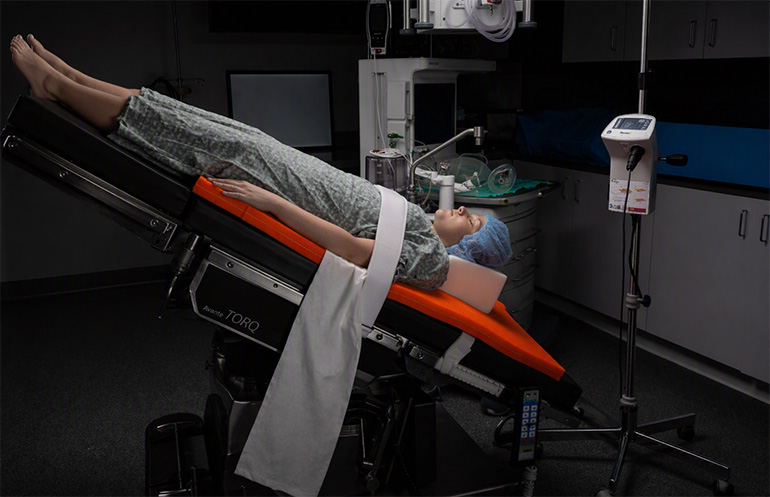
ThermAffyx both securely positions and warms patients during robot-assisted surgeries. Source: Gentherm
Many healthcare advances come from within that industry, but innovations from other industries can also find a role. Gentherm Medical has designed its ThermAffyx Patient Safety System based on thermal management experience from the automotive industry.
The system both securely positions a patient and provides patient warming for robot-assisted surgery. Gentherm Inc. said ThermAffyx does both while minimizing the amount of space required and without the need for forced-air equipment.
The Novi, Mich.-based company launched the system at the Association of periOperative Registered Nurses (AORN) Global Surgical Conference this year. Gentherm noted that numerous medical professionals told it that “almost all of their robotics patients are hypothermic.”
Adam Hauke, global director for product strategy and innovation at Gentherm, replied to the following questions from The Robot Report.
Gentherm addresses Trendelenburg challenge
What is the challenge that ThermAffyx addresses, and how are patient positioning and hypothermia handled conventionally?
Hauke: The ThermAffyx Patient Safety System combines active patient warming and secure positioning into a single solution, helping address two critical perioperative challenges: maintaining normothermia and reducing patient movement during surgery.
The current standard of care consists of forced-air warming solutions and a securement pad. Historically, warming and positioning have been addressed independently because, in many surgical procedures, they do not significantly interfere with one another. However, that’s not the case in most robotic-assisted surgeries.
These procedures frequently require patients to remain in Trendelenburg positioning, where the body is tilted head-down to provide surgical access to the pelvis and lower abdomen. Patients may remain in these positions for extended periods while robotic systems are docked and utilized.
This positioning introduces several challenges, including increased pressure and shear forces that can contribute to pressure injuries, the potential for nerve-related complications if positioning is not optimized, and the risk of patient movement or shifting during lengthy procedures. Underbody securement pads are designed to address these positioning challenges.
At the same time, maintaining normothermia becomes more challenging because robotic equipment occupies the physical space that traditional over-body warming solutions must be deployed in. In these situations, clinicians often rely on under-body warming approaches, but they are difficult or impossible to use in robotics because they would interfere with the underbody securement pads used for safely positioning the patient.
Suddenly, warming and positioning are no longer separate considerations. They are competing for the same real estate.
How much do patients move around during surgical procedures?
Hauke: In the routine course of things in the operating room, “patient movement” is not tracked. “Patient movement,” if it is recorded it is done so as “light anesthesia.” It is usually referring to if the patient’s anesthetic wears off prematurely and they move a hand or leg type thing.
No one is measuring anything on the OR table related to patient movement, as everything is under the sterile drape at that point. The only way the surgical team knows if a patient moves, is if there is tension on the robotic instruments typically.
Any unintended patient movement during robot-assisted surgeries can vary greatly based on a number of factors. There are multiple contributing individual factors such as patient weight, height, and body proportions, as well as procedure-based factors such as the patient position, the steepness the OR table is tilted to and whether or not other positioning solutions are used such as stirrups.
If there is a shift related to Trendelenburg, it’s usually noticed by anesthesia as difficult respirations or a drop in capnography. An actual measurable shift in a patient on the OR table doesn’t occur very often and is not currently a recorded stat.
 Submit your innovation now!
Is there a weight or size range for the system?
Hauke: The ThermAffyx System is intended for adult patients and has been tested on individuals up to 297 lb. [134.7 kg]. The Pad is designed so that a patient can be positioned anywhere within the heating zone to receive active warming.
The Pad’s safety sensors do not require direct patient contact to function. As always, clinicians should follow their facility’s protocols and guidelines for safe patient positioning.
Does Gentherm’s system require more power than existing setups?
Hauke: No, ThermAffyx runs on standard hospital electrical outlets.
Is there any danger of thermal or electromagnetic interference with certain surgical instruments?
Hauke: We have mitigated the risks of compatibility with other devices as far as possible. The system has been designed and verified to comply with all applicable industry standards and FDA guidance — including compatibility with electrocautery, diathermy, defibrillation equipment, RFID devices, wireless power transfer devices, and 5G cellular networks. Therefore, the risk of thermal or EM interference is low.
However, there is always residual risk of issues occurring. We do not control the design and use of external devices that may be used in combination with ThermAffyx, and thus cannot guarantee other devices have been designed to meet the same standards or that devices are being used per the manufacturer’s labeling.
ThermAffyx moves toward the market
How is the system progressing toward commercialization?
Hauke: Commercialization is well under way. Our teams are in active trials across the country with strong adoption in both new accounts and our legacy Gentherm accounts.
How difficult was it to get U.S. Food and Drug Administration clearance?
Hauke: Although Gentherm is an expert in patient warming devices, gaining FDA clearance for ThermAffyx took careful development planning and execution. This is the first and only all-in-one product to have Class II indications for use for maintaining normothermia and securement.
To ensure the proper steps were being taken, we started the process with a Q-Sub to the FDA to receive their feedback on our claims and validation plan. We then implemented the appropriate design and testing per the FDA feedback to validate our claims.
An additional requirement with the FDA is to prove the usability of your device. The operation of the device must fit flawlessly into clinicians’ regular workflows to ensure the system can be used safely without introducing complexity. Nurses and anesthesiologists provided critical inputs to the design through focus groups, then validated the design in extensive hands-on usability studies.
Does this add to the cost of OR equipment or surgical procedures?
Hauke: While ThermAffyx does add incremental cost for the technology — lower than most capital budget thresholds — the more important consideration is its potential impact on reducing costly downstream complications.
By helping to reduce the risk of unintended perioperative hypothermia, patient movement or pressure related injuries, the system may help avoid adverse events that can increase length of stay, require additional treatment, and drive higher overall costs of care.
In robotic surgery, these procedures are already supported by established reimbursement structures and procedure codes, making this technology a natural fit within the existing surgical workflow.
Will you be selling it directly or through third parties?
Hauke: ThermAffyx is available for purchase through Gentherm’s U.S. contract sales team.
Are there other potential use cases for ThermAffyx and its component technologies?
Hauke: ThermAffyx was specifically designed to address the challenge of maintaining normothermia in patients undergoing minimally invasive and robotic-assisted procedures, particularly in gynecological, urological, or general surgery cases that require patient positioning in tilt.
However, its innovative 3-in-1 design offers benefits that extend well beyond these initial applications.
By integrating warming technology into a pressure redistributing underbody foam pad, ThermAffyx can help support patient temperature management in a wide range of surgical settings where maintaining normothermia can be difficult including orthopedics, cardiovascular, colorectal, and plastics cases.


Tell Us What You Think!