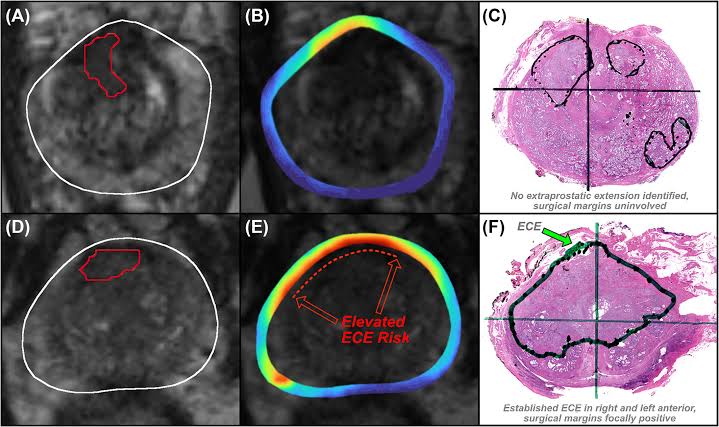
Unfold AI is designed to help physicians identify cancerous tissue. Source: Avenda Health
Prostate treatment has improved with robotics, and it could improve again soon with artificial intelligence. Avenda Health today announced Surgery Mode, a new suit of interoperative features for its Unfold AI offering. The multimodal AI-powered prostate cancer mapping platform is designed to reveal the true size and extent of disease to help physicians make better informed treatment decisions.
“Our goal with Unfold AI has always been to provide more clinical clarity throughout every stage of a patient’s cancer journey,” stated Shyam Natarajan, Ph.D., co-founder and CEO of Avenda Health.
“Whether a physician is counseling a newly diagnosed patient, planning a targeted radiation oncology treatment, or performing a complex radical prostatectomy, having an accurate 3D map of the disease is transformative,” he added. “These new surgical enhancements empower physicians with the visual confidence needed to achieve optimal cancer control while protecting patient quality of life during complex procedures.”
Founded in 2017, Avenda Health said it is creating a more personalized future of prostate cancer care. With deep learning, the Culver City, Calif.-based company‘s software maps a patient’s cancer in 3D, giving physicians precise information and the confidence to make care decisions. Avenda said it aims to improve outcomes, preserve quality of life, and create a new standard of prostate cancer care.
Avenda Health bases Surgery Mode on research
Avenda Health said it designed Surgery Mode to enhance how surgeons use 3D AI mapping during non-robotic and robotic surgeries, alongside new tools to simplify patient case management and physician workflows.
The launch builds on peer-reviewed research predicting that Unfold AI could cut positive surgical margins in half, substantially reducing cancer recurrence. In the study, the system outperformed MRI and other modalities in assessing whether cancer had spread beyond the prostate, assisting surgeons in making nerve-sparing decisions.
In Surgery Mode, physicians can now access enlarged 3D views for clearer visualization, adjust the cancer estimation map to match the camera angle on the surgical console, review underlying MRI slices during the procedure, and access capsule risk scores from within a dedicated surgical view.
Avenda Health claimed that Unfold AI is the only platform implementing multimodal AI to analyze a patient’s MRI, biopsy, pathology, and PSA together. It produces a personalized 3D map of the cancer’s extent to provide surgeons with more precise visualization of tumor boundaries.
While Unfold AI has served as a decision-support tool during preoperative consultations, the latest expansion gives surgeons an enhanced version of these maps during prostate procedures. The suite of improved workflow tools also gives physicians and staff greater visibility into the status of each patient case.
 Register now and help us celebrate 20 years of RoboBusiness!
Key features
- Aligned Capsule Risk Score mapping: The Capsule Risk Score overlay now automatically flips its left/right visual orientation to mirror the surgical camera view, giving surgeons immediate, color-coded risk feedback by quadrant to guide precise nerve-sparing decisions in real time.
- Redesigned patient list and case filters: Improved patient organization and updated case status labels let users search for cases in progress, add new patients, and filter by status to see where each case stands at a glance.
- Improved administrative control: New built-in tools let staff verify insurance approvals and confirm administrative steps are complete before 3D map generation.
- Streamlined case management: Care teams can now add and view patient notes directly from the patient list and update the assigned physician on a patient report.
Unfold AI helps doctors identify tumor extent
Avenda Health said the expanded features extend Unfold AI’s reach across the prostate cancer care pathway, including active surveillance, focal therapy, surgical interventions, and radiotherapy. Its interactive 3D maps serve as a visual guide for patient counseling and decision support, helping patients and physicians confidently select their treatment path.
Now, with Surgery Mode, the same patient-specific mapping technology can be used to provide clear visual boundaries in the operating room, actively guiding surgical procedures such as robotic prostatectomies.
Unfold AI predicts the cancer’s spread into nearby anatomy with 92% accuracy, compared with 52% using MRI alone. That spatial clarity is central to helping surgeons determine whether a nerve-sparing or non-nerve-sparing surgery should be performed.
Avenda noted that additional research demonstrated that Unfold AI improves physician identification of tumor extent, increasing sensitivity from 37% to 97%. By expanding Unfold AI from preoperative decision support into the operating room, the company said it is developing more precise views of prostate cancer that can support physicians across different stages of care.


Tell Us What You Think!