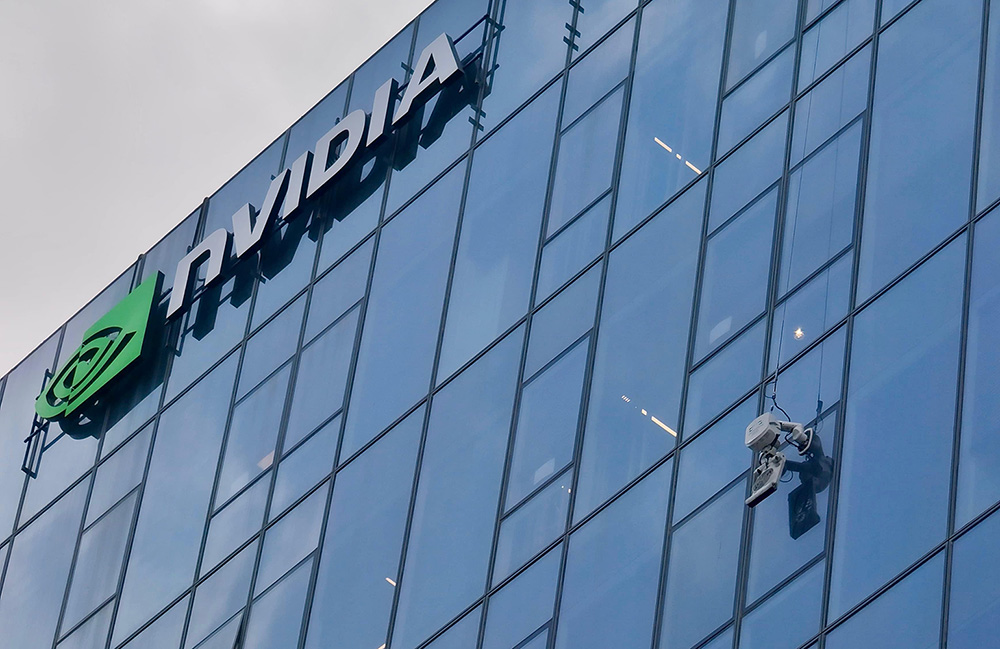
Verobotics engineered a lightweight, surface-agnostic façade robot to bring real mobility, not just suspended access, to exterior cleaning and inspection. | Source: Verobotics
At NVIDIA’s Israel campus, façade cleaning became something far more significant than a maintenance operation.
What began as a practical solution to a universal pain point — dirty windows and difficult-to-maintain high-rise façades — evolved into a real-world demonstration of how AI-powered robotics can fundamentally change the way buildings are monitored, maintained, and protected over time.
Because while every building owner immediately understands the frustration and cost of façade cleaning, the deeper value of Verobotics lies elsewhere: turning routine maintenance into continuous architectural intelligence.
Over a deployment covering roughly 100,000 sq. ft. (9290.304 sq. m) of building envelope and 3,000 windows and façade sections, Verobotics combined robotic façade cleaning, AI vision, and edge computing. The Tel Aviv, Israel-based company reduced work-at-height exposure while simultaneously generating a large-scale visual dataset of the buildings’ exterior conditions.
A deployment built for real conditions
The NVIDIA campus deployment reflected the realities of operating in live commercial environments rather than controlled demo conditions.
One of the buildings sat directly beside an active construction site, creating unusually heavy dirt accumulation, inconsistent surface conditions, and significant contamination after an eight-month cleaning gap. In some areas, debris levels exceeded what robotic cleaning could efficiently handle autonomously.
The final operational split reflected that reality:
- About 60% of façade cleaning completed robotically
- About 40% completed with traditional cleaning support
Rather than forcing full automation, Verobotics deployed a hybrid operating model that combined robotics, human crews, and AI-assisted inspection workflows.
That balance is precisely what makes the deployment important.
In commercial robotics, the breakthrough is not eliminating humans from the process. The breakthrough is creating systems that improve safety, increase visibility, and continuously collect operational intelligence while working alongside existing infrastructure and teams.
Why cleaning matters, and why inspection matters more
Façade cleaning is one of the few building maintenance challenges every property owner immediately recognizes. Dirty windows are visible. Tenants notice them. Visitors notice them. Building managers deal with recurring cleaning costs, operational complexity, safety risks, and scheduling disruptions every year.
That makes cleaning the ideal gateway for robotics adoption. But the real long-term value emerges once robots are already moving across the building envelope.
Every cleaning cycle becomes an opportunity to inspect the façade at scale, repeatedly and consistently, something that is extremely difficult, expensive, and dangerous to achieve manually on high-rise structures.
Instead of viewing façade maintenance as a recurring operational expense, Verobotics views it as a continuous building intelligence process. As the robots navigate the structure, they capture detailed visual data across windows, joints, panels, sealants, and structural surfaces, creating a living historical record of the building envelope over time.
That shift changes the role of façade robotics entirely. The robot is no longer just a cleaning machine; it becomes a mobile AI inspection platform.
Edge AI on the building envelope
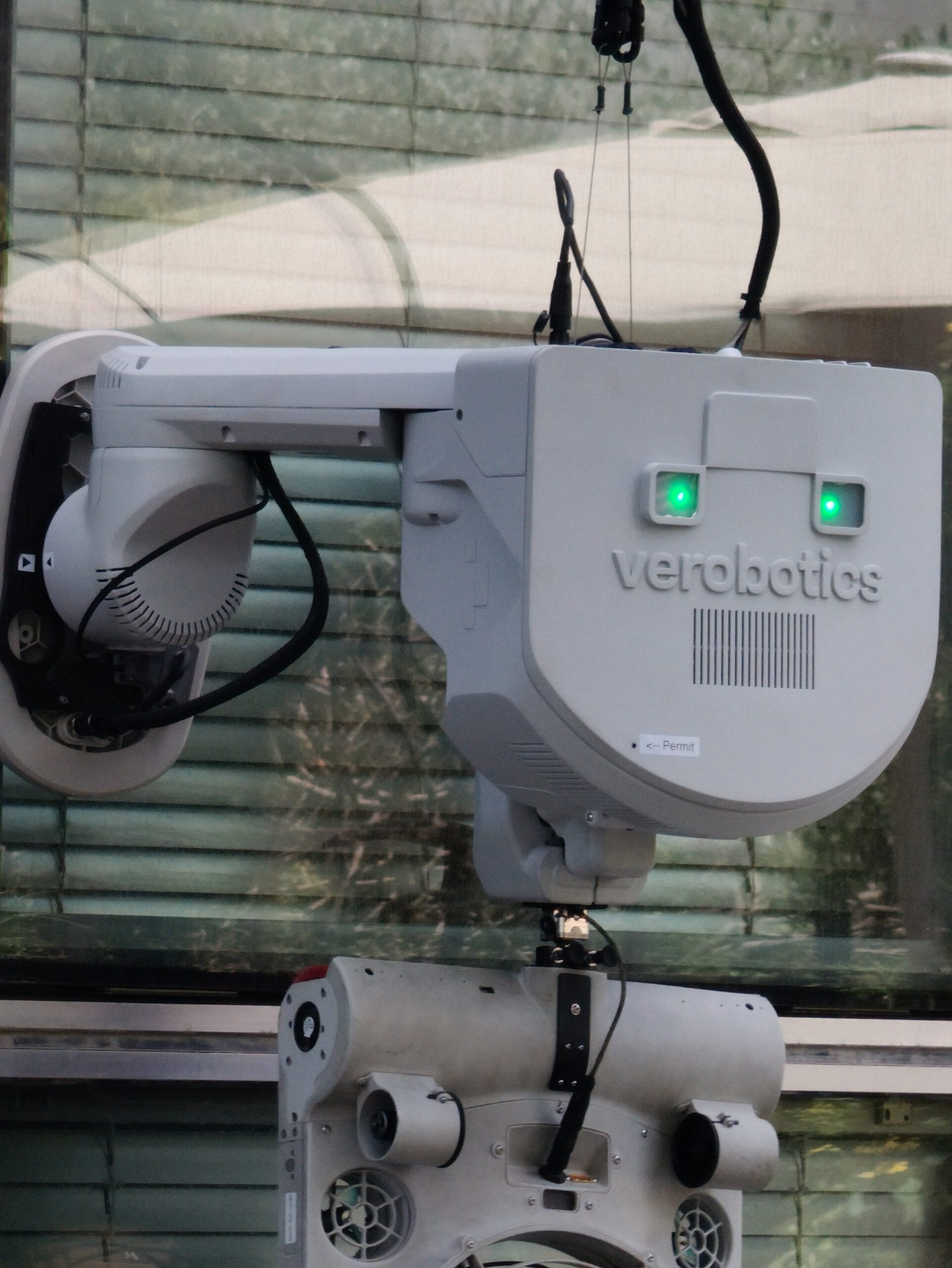
Verobotics’ robot continuously cleans and scans building exteriors, allowing owners to proactively maintain their buildings. | Source: Verobotics
The Verobotics platform was built on NVIDIA Jetson edge AI hardware, enabling onboard processing of visual data directly on the robot itself.
Façade environments are highly unpredictable. Glare, shadows, reflections, wind, dust, changing geometry, and environmental exposure constantly affect robotic perception and navigation.
Processing data locally on the robotic platform reduced dependency on cloud connectivity while enabling faster interpretation of changing conditions during live operation.
During the deployment, the system captured approximately 20,000 façade images across the building envelope, changing the cleaning workflow into a large-scale scanning and inspection operation. This is where the deployment’s significance extends beyond maintenance efficiency.
The images collected are not just operational records, they are the foundation for longitudinal façade analysis, anomaly detection, deterioration tracking, and eventually predictive maintenance models for high-rise buildings.
Over time, repeated robotic inspection cycles can allow building operators to identify subtle changes before they evolve into major structural failures or expensive repairs.
From reactive maintenance to predictive building intelligence
As part of the AI-supported inspection workflow, Verobotics identified 40 façade anomalies requiring escalation and engineering review.
This is where the economic value of robotic inspection becomes substantial. For high-rise buildings, façade failures are not merely cosmetic issues. Undetected deterioration can lead to:
- Expensive emergency repairs
- Water intrusion and long-term structural damage
- Tenant safety risks
- Liability exposure
- Regulatory compliance issues
- Premature degradation of building assets
Traditional inspections are typically periodic, manual, expensive, and heavily dependent on human visibility and access constraints.
Verobotics introduced a different model: Persistent, repeatable, AI-assisted inspection integrated directly into routine building operations.
In other words, the façade is no longer inspected occasionally; it is continuously observed.
That creates the possibility of moving from reactive maintenance toward predictive building intelligence. Identifying risks earlier, tracking deterioration trends over time, and enabling preventative intervention before failures escalate.

A more practical vision for commercial robotics
The NVIDIA campus deployment represents an important milestone not because it proved perfect autonomy, but because it demonstrated what commercially viable robotics actually looks like today: Hybrid. Incremental. Data-driven. Operationally integrated.
Key outcomes included:
- 100,000 sq. ft. of façade coverage
- 3,000 windows and façade sections processed
- 20,000 images captured
- 40 anomalies identified
- Significant reduction in human work-at-height exposure
- Large-scale façade data generation for future inspection analysis
The project also reinforced a critical operational insight: Robotic façade maintenance performs best when buildings maintain consistent cleaning cycles before contamination becomes extreme.
But more importantly, it demonstrated how façade cleaning can evolve into something far more valuable than cleanliness alone. According to Verobotics, cleaning is not the endpoint. It is the operational layer that enables continuous AI-driven understanding of the building itself.
And that may ultimately become the most important role robotics plays in the future of commercial real estate: not simply automating maintenance, but helping buildings communicate their condition before critical problems emerge.


Tell Us What You Think!