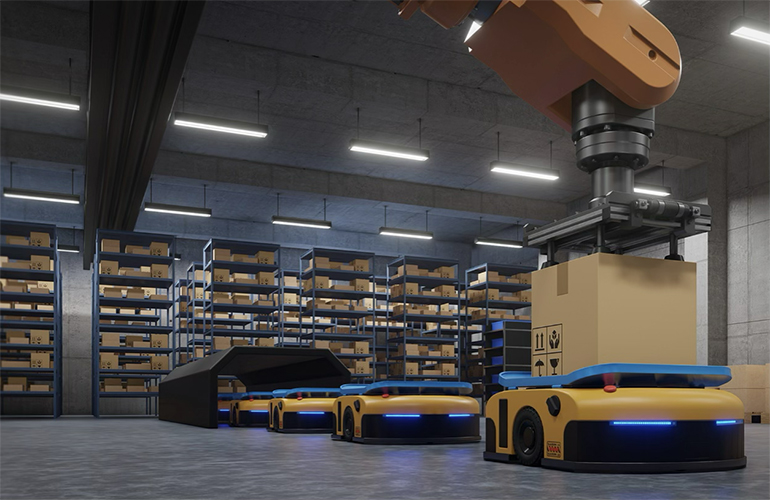
Image courtesy of ADI
Seeing clearly is important. So is everything that comes next.
Just a few years ago, many site owners were satisfied if a robot could move from point A to point B. That’s not quite enough anymore. Today’s robots are being asked to move faster, operate in more dynamic environments, and deal with more obstacles along the way. As those demands increase, vision systems are becoming indispensable for navigation and spatial awareness.
“The biggest challenge is no longer just the image quality itself,” says Stephen Liu, robotics lead at embedded systems developer Advantech. “It’s system-level orchestration. As sensor counts grow, robotic OEMs have to manage bandwidth, latency, synchronization, and compute all at the same time.”
These systems move large amounts of data in real time, and if interfaces cannot sustain throughput, perception becomes unstable. Sensor fusion also depends on precise timing; even a few milliseconds of drift between cameras, lidars, and IMUs can degrade navigation accuracy.
“Robots don’t just see—they have to decide and act instantly,” says Liu. “It requires a lot of coordination between the GPU, MPUs, and real-time operating system to deliver this deterministic performance.”
In harsh environments, the demands become even harder to manage. Robots may have to maintain performance amid vibration, dust, water, and extreme temperatures, while also routing cables through compact designs.
“As cable length increases, connectors are stressed, and ESD interference becomes much more of a concern,” explains Liu. “We require very stable synchronized vision input and long-distance vision transmission, especially for ruggedized situations.”
One technology being applied across the robotics sector to support these vision architectures is GMSL.
“GMSL is a game changer for multi-camera robotics,” says Liu. “You can carry high-resolution video, control signals, and synchronization over a single lightweight cable, reliably and with very low latency. That dramatically reduces cabling complexity, improves EMI resistance, and supports precise hardware-level time synchronization. From an integration perspective, it can also simplify system design.”

Image courtesy of ADI
Similar architectures have been used in automotive systems for years. As the GMSL ecosystem has matured, the design approaches have moved into robotics.
“This transition is very natural,” explains Liu. “Automotive systems like ADAS and autonomous driving already solved many of the same problems robotics faces today, like multiple synchronized cameras, long cable runs, harsh operating conditions. Robots operating in warehouses, farms, or cities are in fact like vehicles themselves. They move fast, operate for long hours, can’t tolerate perception failures. So by bringing automotive-grade GMSL technologies into robotics, teams get proven robustness, deterministic latency, and scalability.”
These systems are no longer limited to proof-of-concept (POC) work—many robots are already relying on GMSL technology in production. About a third of the robotic opportunities Liu manages are using or considering GMSL cameras. After gaining traction in warehouse AMRs, the technology is proliferating into platforms such as humanoid robots and picking stations, with growing adoption in agriculture and certain healthcare applications. In construction areas, robotic technologies are being applied to increase safety and efficiency around heavy-duty machines.
ADI already has a strong GMSL ecosystem that shortens the path from concept to deployment. Instead of spending months on low-level camera integration and driver deployment, teams can start with pre-validated camera modules, adapters, BSPs, and ROS-ready platforms. That means faster prototyping, lower integration risk, and a smoother path from POCs to mass production.
“Robotics teams can focus on what really differentiates them—AI models, autonomy, application logic, deployment and so on—rather than reinventing sensing infrastructure,” says Liu.
For startups, incubators, and innovators, speed and agility are often the most important factors. In a robotics market where time to market can feel like a race, partnerships and turnkey solutions can make a significant difference; without them, many developers would have a much harder time delivering solutions on time.
“We are democratizing GMSL camera technologies to small- or medium-size robotic developers that feature low-volume, high-mix production,” says Liu.
Compute is part of the challenge. Often, lower-level configuration and coding are required, along with different AI SDKs and development tools to optimize performance. This configuration work requires expertise in both the cameras and the computing platforms. Advantech is enabling customers’ GMSL cameras across platforms from Intel and Qualcomm to NVIDIA, where the nuances vary from one system to another.
“We believe that ADI and Advantech can play a more important role in harmonizing and accelerating those computing and camera integrations,” says Liu. “At the end of the day, the customers expect somebody to provide a working system, a ready-to-use solution consisting of both the computer and the camera.”
To learn more about ADI’s GMSL ecosystem, visit https://www.analog.com/en/solutions/gigabit-mulitimedia-serial-link.html
To learn more about Advantech’s solutions, visit https://www.advantech.com/en/resources/news/gmslcamera-afe-asr
Sponsored content by Analog Devices

Tell Us What You Think!