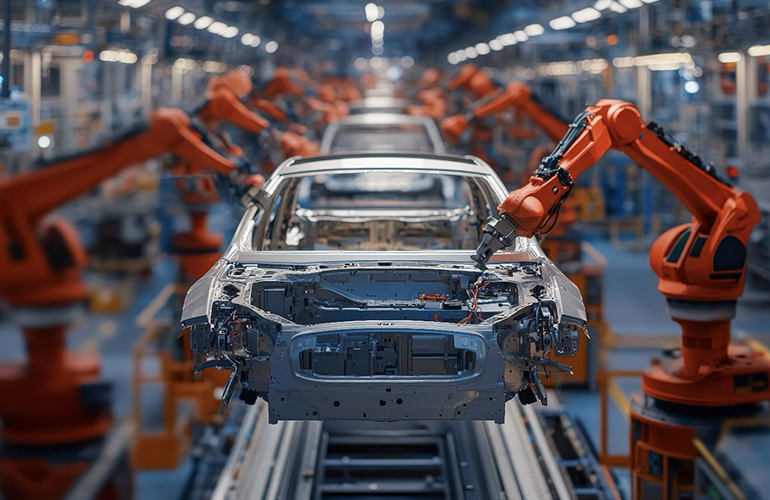
Image courtesy of ADI
Robots are no longer confined to factory cells or fencedoff environments. Autonomous mobile robots now operate continuously in warehouses and hospitals. Drones are flying longer, farther, and with greater autonomy. Humanoid robots are beginning to work in close proximity to people, navigating shared spaces and responding to unstructured behavior in real time.
This new generation of machines shares a common shift: mobility systems are becoming perceptiondriven, computeintensive, and safetycritical. This means the “hard part” is no longer designing a single sensor or a single model in isolation. The real challenge is system-level: ensuring sensing, connectivity, compute, power, and safety operate together reliably under realworld conditions. To address this, the automotive industry shifted toward treating vehicles as distributed nervous systems integrated networks of sensors, edge processors, communications links, and control elements built to behave predictably under realworld conditions. What is now becoming clear is that robots, drones, and humanoids are converging on the same model. These machines must see, hear, and feel their environment; interpret that data in real time; and act safely in dynamic, often unpredictable surroundings.
Perception is no longer a feature. It is infrastructure.
In earlier generations of robots, sensing often played a supporting role. Today, perception is a primary control input. Highresolution vision guides navigation and dexterous manipulation. Multimicrophone audio enables sound localization, voice interaction, and situational awareness. Touch and force sensing refine grasping, balance, and human interaction. In many systems, these modalities must be tightly synchronized to support sensor fusion and closedloop control.
This shift changes the requirements fundamentally:
- Data must arrive quickly, reliably and predictably
- Sensors are physically distributed, often across moving joints or long cable runs
- Failures must be detectable, localizable, and actionable in real time
These are not hypothetical challenges. They are exactly the problems automotive systems had to solve to make advanced driver assistance and autonomy viable at scale.
Delivering quality and reliability at speed
Across mobility markets, speed to market remains critical. But experience with softwaredefined vehicles show that speed which resets with every redesign quickly becomes a liability.
The real advantage comes from architectures where speed compounds over time—where systems can be updated, expanded, diagnosed, and improved in the field without destabilizing what is already deployed.
Robotic platforms face the same risk. Systems that lack observability into sensor integrity, communication links, energy health, or timing behavior become increasingly fragile as complexity grows. Debug cycles stretch. Updates become uncertain. Field failures become expensive and disruptive.
By contrast, platforms designed with diagnostics, deterministic connectivity, and predictive insight can move faster because they reduce uncertainty. Safety and reliability become enablers of iteration rather than constraints.

Image courtesy of ADI
AutomotiveGrade Technologies, Applied Beyond Cars
The reason automotive technologies translate so well into robotics and other mobility systems is simple: they were forged under some of the most demanding constraints in engineering.
They were designed for:
- Harsh electrical and environmental conditions
- Tight power, size, and thermal envelopes
- Long operational lifetimes and massive deployment scale
- Zero tolerance for silent failures
- Continuous evolution after deployment
When these same building blocks are applied to new mobility platforms, they unlock immediate benefits.
Highbandwidth, lowlatency vision links enable multicamera perception across large robotic structures. Deterministic audio networks with support localization and natural human interaction. Embedded diagnostics with allow systems to distinguish between transient disturbances and real faults. Predictive power and battery intelligence with improve uptime and reduce lifecycle cost. Safetyaware architectures enable graceful degradation instead of abrupt failure.
These capabilities are now showing up across mobility:
- In humanoid robots that must navigate human spaces safely and intuitively
- In autonomous mobile robots operating around the clock in dynamic environments
- In drones balancing tight energy budgets with realtime perception and control
- In service and industrial robots where uptime, serviceability, and trust matter as much as performance
The applications differ, but the underlying architectural needs are strikingly similar.
From Technology Leadership to Industry Direction
What distinguishes Analog Devices in this transition is not just the breadth of technologies we possess, but the system-level architecting behind how those technologies are applied.
Automotive autonomy forced a generation of engineers to think in terms of latency budgets, synchronization domains, diagnostic coverage, and lifecycle observability. That experience is now shaping how emerging mobility platforms are built from the ground up.
Rather than reinventing connectivity, safety, and power management in isolation, robotics teams are increasingly leveraging architectures already validated in automotive, along with the ecosystems of tools, standards, and partners that support them. In doing so, they are accelerating development, reducing risk, and establishing a foundation that can scale.
This transfer of architectural maturity—from cars to robots, from roads to warehouses, from drivers to humanoids—is not accidental. It reflects a broader convergence across mobility, where system-level rigor and ecosystem alignment are becoming prerequisites for progress.
The Convergence Is Just Beginning
As robots move closer to people, expectations around trust, predictability, and safety will only increase. At the same time, competitive pressure will demand faster innovation cycles and greater flexibility after deployment.
Meeting both mandates requires a shift in perspective: treating perception, connectivity, diagnostics, safety, and energy management as infrastructure, not afterthoughts. Automotive may have been the first domain forced to confront these realities at scale. But it will not be the last.
The architectural principles developed for autonomous vehicles are now becoming the backbone of modern mobility—powering robots, drones, and humanoids that must operate reliably in the real world.
The next wave of innovation will belong to those who recognize this convergence early—and build accordingly.
Learn MoreSponsored content by Analog Devices


Tell Us What You Think!