
Image courtesy of ADI
Autonomous and robotic systems rely on high-bandwidth, low-latency sensor data to perceive and navigate the world. Real-time decisions are made using inputs from multiple sensing modalities, including cameras, radars, lidars, microphones, and ultrasonic sensors. Most of this data is transported from distributed edge sensors to centralized compute platforms over high-speed serial links, which also carry bidirectional control and error signaling.
As perception systems grow more sophisticated, the bandwidth, number, and complexity of these serial links are increasing rapidly. With that growth comes a wider set of potential failure modes. Preventing a corresponding rise in system faults, downtime, and recalls requires treating diagnostics and preventative link maintenance as firstclass architectural elements rather than posthoc debug tools. This article explores why seriallink diagnostics are essential and how diagnostic capabilities built into GMSL™ technology support robust, scalable vision systems.
Why seriallink diagnostics matter
At a fundamental level, a sensor serial link connects the sensor to a compute node over a cable. Control data and sometimes power, may share the same channel. While this arrangement acts logically like a simple “pipe,” modern multigigabit links operate close to practical performance limits.
System tradeoffs around cable quality, connector choice, PCB layout, power delivery, EMI, vibration tolerance, and cost, often reduce margin. At data rates above 10 Gb/s, even small degradations can push a link toward instability. In real deployments, camera and displayrelated failures have become a notable contributor to mobilitysystem recalls. These failures, whether rooted in hardware defects, marginal signal integrity, misconfiguration, or software interactions, are difficult to diagnose without visibility into link behavior.
Without diagnostics, systems see symptoms but not the causes.
Diagnostics across the system lifecycle
- During system design and integration, engineers need detailed visibility to isolate bring-up issues such as black screens and intermittent communication failures. Insight into link stability, configuration state, and block-level health shortens debug cycles and accelerates integration.
- In endofline production, diagnostics shift toward determinism. Fast, repeatable pass/fail tests are required to validate cabling, connectors, and assembly quality, and to catch marginal units before deployment.
- At runtime, diagnostics serve two primary goals: predicting and minimizing issues, and enabling accurate system responses when issues occur. Distinguishing transient disturbances from persistent faults allows the platform to retry, reconfigure, degrade gracefully, or shut down safely based on precise fault location and severity.
- In service, diagnostic logs and historical link data help technicians pinpoint root causes, reducing guesswork, repair time, and total cost of ownership.
Diagnostic capabilities in GMSL-based systems
GMSL technology provides a layered diagnostic framework spanning chiplevel, linklevel, and transporteddata monitoring.
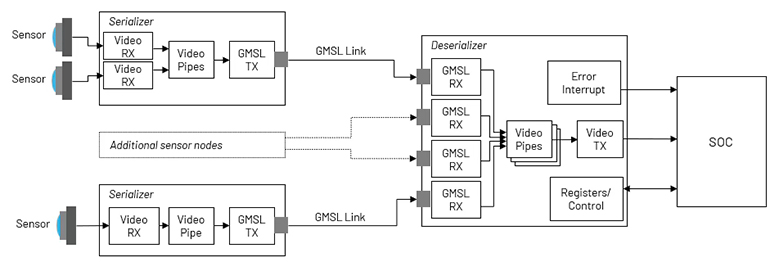
Image courtesy of ADI
At the chip level, GMSL integrates monitors internal temperature, supply voltage, internal error conditions, and register integrity. These indicators provide early warnings of abnormal operating conditions before they affect data transmission.
Linklevel diagnostics assess the health of the physical channel. Error detection and counters enable estimation of biterror rates. Eyeopening monitors provide insight into jitter, noise, and postequalization signal margin. Forwarderrorcorrection monitoring tracks corrected and uncorrected errors, exposing link degradation trends before postFEC failures appear. Nonruntime margin tests intentionally stress transmit amplitude to quantify robustness during manufacturing or service.
At the data layer, video transport diagnostics validate stream integrity and stability. CRC mechanisms detect corrupted content at the frame, line, or region level. Timing and stability monitoring identifies deviations caused by sensor misconfiguration, clocking issues, or upstream faults. Support for ecosystem standards further enables systemlevel validation workflows.
Together, these diagnostics form a multilayer safety net from the physical layer through the application interface.
Diagnostics and functional safety
Functional safety requirements further elevate the importance of diagnostics in autonomous systems. In automotive contexts, ISO 26262 defines Automotive Safety Integrity Levels (ASIL), with many perception systems requiring ASILB through ASILD compliance at the system level.
Modern GMSL devices are ASILB compliant at the component level, requiring identification and reporting of fault conditions across functional blocks. Errors are surfaced via hardware interrupts and detailed status registers, enabling higherlevel software to respond appropriately.
This diagnostic granularity is critical. With precise fault localization, systems can retrain links, invoke redundancy, reset pipelines, degrade functionality, or transition to a safe state. Without it, platforms are forced into overly conservative responses—or worse, silent failure modes.
Software makes diagnostics actionable
Diagnostics are only useful if software can access, interpret, and act on the information.
Lowlevel drivers abstract large register sets into meaningful events, counters, and status flags such as linklock transitions, correctederror thresholds, or video CRC mismatches. GMSL GUI tools allow engineers to explore diagnostic behavior during development and evaluate modules before full system integration. Moving up the stack, the diagnostic data integrates into middleware frameworks and standardized diagnostic services, enabling the autonomy stack in the application-layer to implement informed, systemlevel responses.
A cohesive software strategy ensures diagnostic visibility flows from the physical layer to decisionmaking logic.
Building resilient perception systems
As perceptiondriven systems scale in complexity, seriallink reliability and diagnostic visibility become central to safety and cost efficiency. Visionlink failures already contribute significantly to recalls and operating costs, underscoring the need for comprehensive observability. GMSL diagnostics provide the foundation to detect, localize, and respond to issues throughout the system lifecycle.
Combined with functionalsafetyaware architectures and robust software integration, these diagnostics enable perception platforms that remain reliable not just in the lab, but across deployment, scale, and time
Learn MoreSponsored content by Analog Devices




Tell Us What You Think!