
Image courtesy of ADI
Vision has become a foundational sensing modality in modern robotics. As robotic systems evolve toward higher autonomy, richer perception, and greater scalability, the connectivity technologies used to transport image data have undergone a parallel evolution.
Early robotic vision systems relied heavily on USB and Ethernet-based camera interfaces, borrowing from PC-centric and industrial networking paradigms. These technologies enabled early adoption and rapid prototyping. Today, Gigabit Multimedia Serial Link™ (GMSL™), originally developed for automotive camera systems, is being deployed as an alternative that better aligns with the architectural needs of next-generation robots.
This article traces the evolution of robotic vision connectivity, examining why legacy interfaces are reaching their limits and how GMSL is reshaping system design.
Early Robotic Vision: USB as the Starting Point
USB cameras were among the first widely adopted vision solutions in robotics. Their appeal was straightforward: low cost, broad availability, and native support across PCs and embedded platforms. USB interfaces allowed early robots to stream image data into CPUs or GPUs with minimal hardware integration effort.
However, USB was fundamentally designed as a shortreach, hostcentric interface, not as a deterministic, multi-camera sensor network. Reliability also emerged as a significant barrier to deployment.
The cable length constraints, non-deterministic latency and high CPU overhead made USB suitable for prototyping but poorly matched as robotic systems increased in complexity.
Ethernet and GigE Vision: Scaling Distance, Adding Complexity
To overcome USB’s limitations, many robotic systems transitioned to Ethernet-based vision, most notably GigE Vision. Ethernet offers longer cable lengths, mature infrastructure, and a standardized interface, enabling interoperability between cameras and software between different vendors.
On the other hand, Ethernet-based cameras typically require an oncamera processor to packetize image data and manage network protocols.
For robotics applications that depend on real-time perception, such as obstacle avoidance or closed-loop manipulation, this added latency and non-determinism can be problematic. Aggregating multiple cameras over Ethernet further increases system complexity, often requiring additional hardware and increasing the total solution size and power consumption.
Rising Demands of Modern Robotic Vision
Modern robots are increasingly deploying multiple high-resolution cameras across their structure, serving roles that include autonomy, dexterous manipulation, human–robot interaction, and safety. Key trends driving new connectivity requirements include:
- Higher camera counts, requiring eight (or more) image sensors per robot
- Distributed camera placement, requiring long, robust cable runs through articulated or mobile platforms
- Low-latency sensor fusion, combining RGB vision with LiDAR, radar, and IMU data
- Tight synchronization, especially for stereo and surround-view perception
These trends favor connectivity solutions that are deterministic, scalable, low power, and mechanically robust – attributes not native to traditional industrial interfaces.
GMSL for Vision Connectivity: Built for Cars, Ready for Robots
GMSL enables the transmission of uncompressed image data, bidirectional control, and power over a single cable, using either coaxial or shielded twisted pair.
GMSL was originally designed to meet the demanding requirements of automotive camera systems, where real-time performance, electromagnetic robustness, and long cable reach are mandatory. These same characteristics map naturally to robotics.
Deterministic, Low-Latency Transport
GMSL enables transport of raw image data directly into a centralized compute platform, such as an embedded GPU or FPGA. This dedicated point-to-point link per camera avoids the arbitration and buffering inherent in USB and Ethernet. This results in microsecond-level deterministic latency, which is critical for real-time perception control.
Simplified Camera Modules
GMSL-based cameras typically require only an image sensor and a serializer, eliminating the need for a local processor. This reduces camera size, power consumption, and thermal load, enabling more compact and distributed vision designs.
Long Reach and Robustness
GMSL supports cable lengths far exceeding USB limits, while maintaining high signal integrity with extremely low BER, in electrically noisy environments. This makes it well suited for robots operating in factories, warehouses, hospitals, and outdoor settings. GMSL devices are ASIL-B certified, providing robust link monitoring and diagnostic capabilities, strong EMI/EMC performance, and high reliability.
Scalable Multi-Camera Architectures
With options for single, dual or quad channel serializers and deserializers, GMSL supports easy aggregation of multiple sensor streams on the GMSL devices themselves. This allows designers to scale without adding any more components or cabling or system complexity. This is particularly important for surround-view and multi-modal perception systems, particularly in AMRs and humanoid robots.
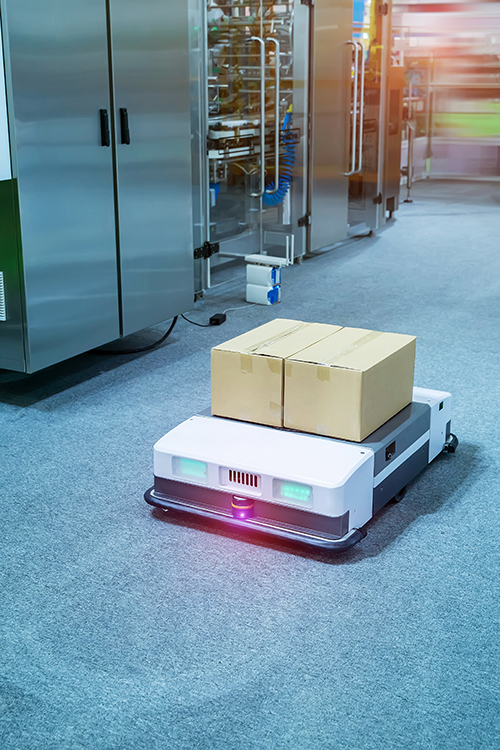
Image courtesy of ADI
Connectivity as a Strategic Design Choice
As robots scale in complexity and autonomy, connectivity choices directly influence performance, reliability, and long-term scalability. The evolution from USB and Ethernet to GMSL reflects a deeper shift in robotics: vision is no longer a peripheral feature, but a core system capability.
Call to Action: For a deeper technical exploration of how GMSL enables these capabilities, including camera deployment models and system-level considerations, read Kainan Wang’s Building High Performance Robotic Vision with GMSL on Analog Devices’ website
Sponsored content by Analog Devices
Tell Us What You Think!