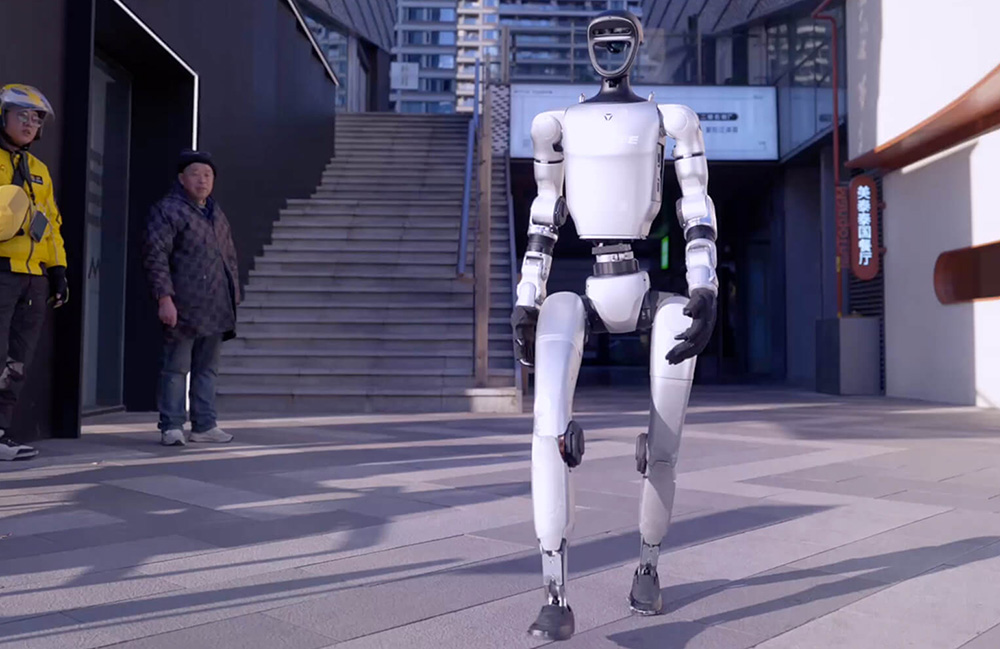
Unitree offers its G1 humanoid robot for $13.5K. | Source: Unitree
Shares of Unitree Robotics have fallen nearly 40% from their first-day closing price on Aug. 19 2026, erasing roughly $20 billion in market value from that point and about $35 billion from their peak.
The Hangzhou, China-based company, trading on the Shanghai Stock Exchange under Ticker 688836, closed Wednesday at 513.93 yuan ($72.10 U.S.). That’s down about 39% from its 845-yuan closing price on debut and about 53% below its first-day high of 1,100 yuan.
Unitree shares are still more than three times higher than its 150.80-yuan IPO price.
The legged robot developer raised about 6.1 billion yuan ($900 million) in its IPO and saw its shares soar 460% on the first day of trading. The stock briefly climbed as high as 1,100 yuan, pushing Unitree’s valuation to nearly 445 billion yuan, or roughly $66 billion.
Before the IPO, Unitree had targeted a valuation of roughly 42 billion yuan ($6.2 billion). It ultimately priced the offering at 150.80 yuan per share, valuing the company at about 61 billion yuan ($9 billion).
The subsequent decline doesn’t necessarily mean investors have lost faith in Unitree. It suggests that the market may be pulling back from the crazy initial valuation.
Unitree has the revenue
Unlike many of its Western humanoid competitors, Unitree isn’t a pre-revenue startup waiting to prove that customers will pay for its robots. The company generated 1.70 billion yuan ($252 million) in revenue in 2025, up from 392.77 million yuan in 2024. It sells humanoids, quadrupeds, and various components.
Humanoid robots are also becoming a major part of that business. Revenue from humanoid robots reached 868 million yuan in 2025, or 51.78% of total revenue. Unitree shipped more than 5,500 humanoids during the year.
Revenue continued to grow rapidly in 2026. Unitree projected first-half revenue of between 1.052 billion and 1.128 billion yuan, representing year-over-year growth of roughly 36% to 45%.
 Register now and help us celebrate 20 years of RoboBusiness!
So the issue isn’t whether Unitree has a real business. It does. At Wednesday’s close, Unitree was worth roughly $30 billion. That’s roughly 125 times its 2025 revenue and more than 350 times its adjusted 2025 earnings. At its peak valuation of roughly $66 billion, Unitree was worth more than 250 times its 2025 revenue. That’s an extraordinary valuation.
China starting to worry about humanoid hype?
Unitree’s stock slide is also happening as Chinese regulators reportedly become more cautious about humanoid companies trying to go public.
According to The Information, the China Securities Regulatory Commission has informally raised the bar for humanoid IPO candidates. Regulators have told some investment banks and companies that prospective listings should demonstrate recurring revenue, progress toward reducing losses or significant technological innovation. Reuters could not independently verify the report, and Chinese financial regulators have not commented.
The Wall Street Journal separately reported that Chinese regulators have informally signaled that humanoid companies seeking to list should demonstrate stronger financials, revenue potential and genuine technological innovation.
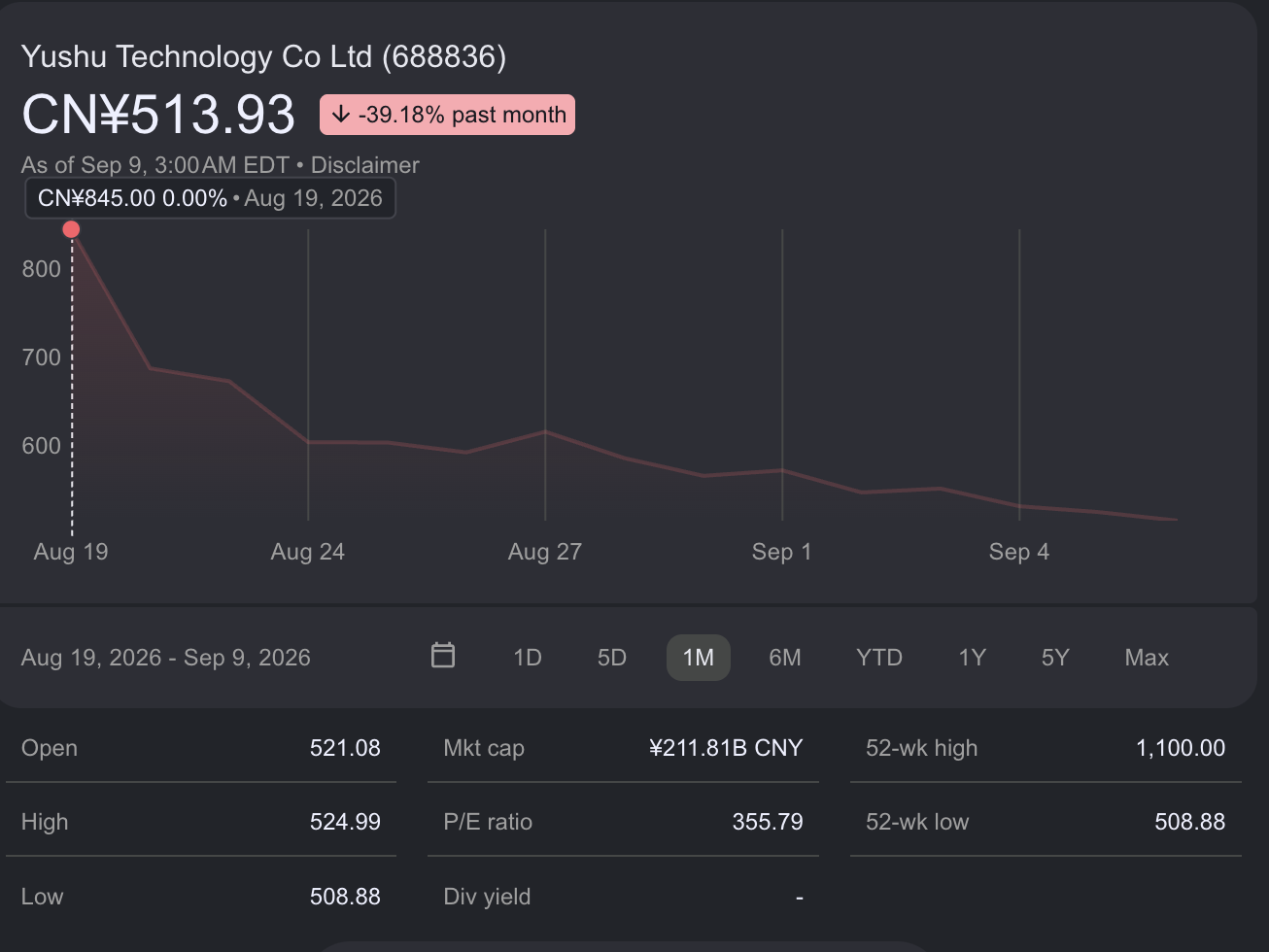
Unitree’s stock performance since debuting on Shanghai’s STAR Market in August 2026.
That scrutiny is notable because Unitree’s revenue is already substantial. The question is what that revenue represents and how much of the humanoid market is coming from repeatable deployments.
The Wall Street Journal said that less than 10% of Unitree’s 2025 revenue came from industrial applications. More than 40% of Unitree’s total 2025 revenue came from overseas, meaning roughly 60% was domestic.
The Financial Times has reported that China has established more than 90 humanoid training centers, many of which are co-funded by local governments and robot manufacturers. These centers buy humanoids and use them to generate training data, often through teleoperation.
Another reality check
Unitree’s financial performance becomes even more interesting when compared with the financials of other humanoid developers, particularly those based in the U.S. that are trying to deploy humanoids in industrial settings. Oregon-based Agility Robotics, for example, recently opened its books for the first time as part of its proposed SPAC with Churchill Capital Corp. XI.
According to its S-4 filing with the U.S. Securities and Exchange Commission, Agility generated $1.78 million in net sales in 2025. At the same time, it recorded a $140.2 million operating loss and a $138.1 million net loss. The company spent about $91.6 million on R&D and ended the year with roughly $103 million in cash.
We don’t have comparable revenue figures for other leading U.S.-based humanoid developers such as 1X Technologies, Apptronik or Figure. Boston Dynamics‘ revenue, meanwhile, comes primarily from its Spot quadruped and Stretch trailer-unloading robots, not its Atlas humanoid. If we did, they’d also be low.
Low revenue numbers aren’t surprising for companies trying to commercialize industrial humanoids. Agility said its Digit robots have been deployed at 9 customer sites and have accumulated more than 65,000 operating hours. The company also said it has more than $300 million in multi-year contracted Digit v5 orders.
The proposed SPAC transaction values Agility at about $2.5 billion, roughly 1,400 times its 2025 net sales. Unitree, meanwhile, is worth roughly $30 billion despite generating hundreds of millions of dollars in annual revenue and turning a profit.
Agility and others are still trying to prove that humanoids can generate meaningful revenue from industry. Unitree has shown the revenue. Now the market wants to know how much more of it is coming, where it’s coming from, and how much today’s valuation is already pricing in.


Tell Us What You Think!