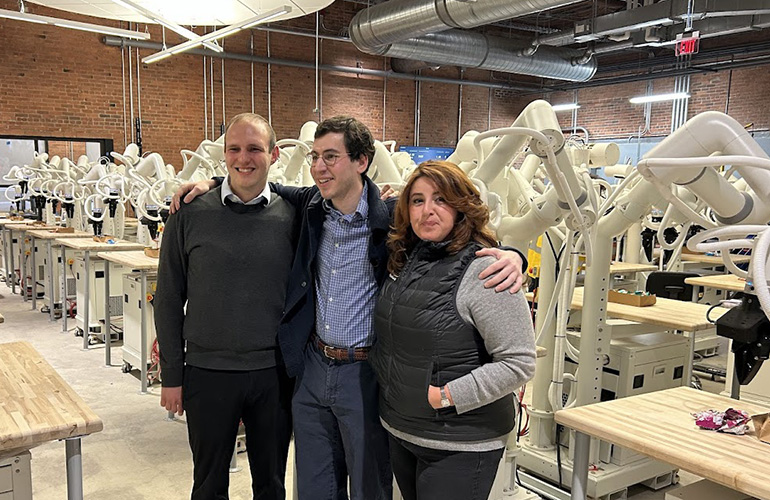
Tutor Intelligence CTO Alon Kosowsky-Sachs and CEO Josh Gruenstein with Alla Simoneau from the AWS Generative AI Innovation Center, at Tutor’s Digital Factory. Credit: Eugene Demaitre
For robots to become more adaptable, they need to learn as humans do but at scale, according to Tutor Intelligence Inc. The company has built DF1, its “kindergarten” or Data Factory of 100 bimanual manipulators. Along with remote teleoperators or “tutors,” they are training its Ti0 vision-language-action, or VLA, model.
“I’ve been building robots since I was 9 years old,” said Josh Gruenstein, co-founder and CEO of Tutor Intelligence. “Unlike LLMs and the Internet, there’s no equivalent of Wikipedia for robots, and we need a mass transfer of intelligence from 8 billion humans. DF1 is not about building models; it’s how to get the right data from people teaching robots.”
In 2021, Gruenstein founded the company with Alon Kosowsky-Sachs, now chief technology officer, out of the Massachusetts Institute of Technology’s Computer Science and Artificial Intelligence Laboratory (MIT-CSAIL). In December 2025, the company raised $34 million in Series A funding, and it held an open house last month.
Tutor Intelligence was part of the first cohort of the Physical AI Fellowship, receiving mentorship and support from Amazon Web Services, NVIDIA, and MassRobotics. It has continued to work with AWS for large-scale cloud compute and with NVIDIA CUDA for modeling.
Editor’s note: At the 2026 Robotics Summit & Expo on May 27 and 28 in Boston, MassRobotics will showcase startups in the second cohort of the Physical AI Fellowship. Registration is now open.
 Submit your session idea for the 2026 RoboBusiness
Data Factory trains physical AI with human help
“We aim to create generally capable robot AI in partnership with the industrial world,” said Gruenstein. Tutor’s goal is to establish a “virtuous cycle” in which robots are commercially deployed to get data at scale and continue training.
Rather than train its robots largely through simulation, Tutor Intelligence has set up DF1 to gain real-world data at its new headquarters in a historical mill in Watertown, Mass. The startup claimed that, to its knowledge, DF1 is the largest “robotic data factory” in the U.S.
The 100 Sonny semi-humanoid robots started with piece-picking tasks common to e-commerce, kitting, and other commercial applications. Like any group of kindergartners, they were clumsy at first with the consumer packaged goods like sponges or bags of snacks.
In just a few weeks, however, the robots have already demonstrated the value of Tutor’s approach to collecting real-world data, with supervision by 45 to 50 tutors in Mexico and the Philippines using proprioceptive teleoperation, as well as staffers on site. They use a similar scoring method to the one that Gruenstein developed as a high school student over a decade ago.
“By evaluating the same policy across all 100 robots, we are able to detect and correct robot behaviors 100x faster,” said Tutor Intelligence. “An edge case that may normally require eight hours of robot operation to notice will be visible in only five minutes of DF1 operation.”
Gruenstein likened DF1 to the Large Hadron Collider in that it is “an instrument of discovery and scientific exploration for scaling humanoids.”
AWS has provided a team of technical strategists and scientists to help startups like Tutor Intelligence, noted Alla Simoneau, physical AI technology lead at the AWS Generative AI Innovation Center.
“We give help from ideation to production,” she told The Robot Report. “The Physical AI Fellowship is unique in that our experts support the startup community to safely and securely go to market.”
To reduce inconsistency in fleet-scale data for “industrial intelligence,” Ti0 is trained with “velocity normalization,” which Tutor described as a “novel preprocessing method that aligns the speed profiles of demonstrations across different teleoperators.”
“Through DF1 and Ti0, our goal is to bootstrap the world’s first commercial humanoid deployment flywheel on the Sonny platform, unlocking compounding policy improvement and real-world value over time,” said the company in a blog post.
Gruenstein said he is optimistic that Tutor can move from training to pilots by the end of this year. To achieve speed to scale, the company has used the same collaborative robot hardware, sensors, and contract manufacturers for Sonny as for its single-armed Cassie system.
Cassie is designed for fast deployment
As Tutor Intelligence demonstrated at MODEX 2026 last month, the latest version of Cassie can be deployed in two days and handles boxes weighing up to 50 lb. (22.6 kg). Thanks to years of data collection and training that continue today, the case-picking and palletizing robot can handle a continuous flow of SKUs with minimal changeover time and move up to 14 cases per minute.
Cassie uses vision and integrates with external sensors using the EVE native I/O module. Its safety features including lidar-informed zones and compliance with ISO/TS 15066 standards. The mobile manipulator can move from station to station.
The system’s tablet interface includes support for multiple languages, and it doesn’t require coding expertise or the setting of waypoints, asserted Tutor. The robot can also be washdown-ready for food handling.
Since Sonny and Cassie share components, will Tutor’s bimanual picking converge with its mobile manipulator?
“Right now, we’re working on training the models for jobs the robots can do,” replied Kosowsky-Sachs. “At MODEX, we were surprised to hear people say, ‘I want this yesterday.’ Cassie can not only be useful for large 3PLs [third-party logistics providers], but it’s also for other customers.”
Usage-based pricing aligns Tutor development, customer needs
Tutor Intelligence charges $14 to $18 per hour for Cassie’s services, which it said is competitive with increasingly scarce manual labor.
“Robotics as a service [RaaS] often has hidden catches, so we talk in terms of usage-based pricing,” said Gruenstein. “For us, innovation is the technology to get to a lower price point. We have a ‘no contract’ or ‘no commitment’ model, which aligns our incentives to build an intelligent robot workforce and partner with businesses, rather than integrators, which make money by supporting complexity.”
BetterBody Foods has added the palletizer to its facilities in Utah and Massachusetts.
“For the deployment process, Tutor lived up to its word,” said Jeff Pulley, facility manager at the company. “The hardest part about the install was setting up the electrical and airdrop. With their team onsite, we got the robot plugged in and up and running in a few hours. Now, it can build on a skewed pallet or straighten boxes.”
Pulley told The Robot Report that he looks forward to using Sonny to run during multiple shifts. “It was cool to see the progress,” he said after touring DF1.
Productiv Inc. conducts highly variable kitting for e-commerce, medical device, and cosmetics customers. It assembles 30 million kits per year with 10 to 15 items each. The Richmond, Va.-based company looked at force- and power-limited robots and humanoids before getting started with automated palletizing using Cassie.
“We didn’t want to spend $150,000, but $14 per hour was competitive,” noted Paul Baker, chief financial officer at Productiv. “The robot was profitable from Day 1 and keeps up the line speed.”
Productiv has four metrics: SKU coverage, placement accuracy, pack time, and how long it takes to program a new SKU. Tutor met all of them, from 99.9% quality and helping to ship 350,000 kits to reducing programming time from five days to one, Baker said.
Tutor Intelligence is also working with leading brands and a major 3PL. The company is hiring for roles including research and software engineers, customer success managers, and salespeople.



Tell Us What You Think!