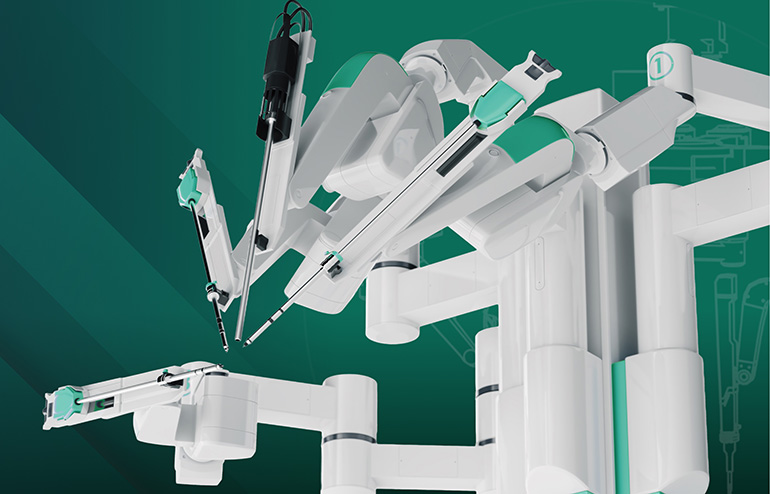
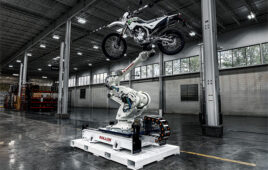
Physical AI is enabling robots to learn and adapt more quickly. Source: Fictiv
Until recently, AI was defined by large language models, or LLMs, and chatbots, but for many of us, using AI to help source and manufacture complex mechanical parts, like those used in robotics, has been in progress for over a decade.
But in the corridors of modern manufacturing and logistics, the conversation has pivoted toward something much more tangible. We are entering the era of real-world physical AI. Humanoids, formerly the stuff of science fiction, are integrated into the daily work of companies like Amazon.
As vice president of business development at Fictiv, I speak daily with innovators who are moving beyond the digital screen and into the physical world.
Physical AI is the synthesis of neural networks with mechanical precision. It is the bridge between the logic of a machine and the physical environment with one major caveat: We must distinguish between the hype of humanoid robots and the reality of scaling hardware in a challenging global supply chain.
Reshaping robotics: The power of physical AI
Physical AI changes the fundamental “brain” of the machine. With computer vision, reinforcement learning, and edge computing, robots are gaining a sense of spatial intelligence. They no longer require a scripted environment; they can perceive, adapt, and learn. This is reshaping development by shortening the feedback loop.
We are seeing “sim-to-real” pipelines where AI agents are trained in hyper-realistic digital twins, performing millions of iterations in hours before ever touching a physical gear.
This shifts the developer’s role from “coder” to “trainer,” allowing for robots to handle high-variability tasks—such as sorting unstructured scrap metal or navigating a crowded hospital hallway—that were previously impossible to automate.
Editor’s note: At the 2026 Robotics Summit & Expo this month in Boston, Fictiv’s Steve Ricketts will speak about “Emergent Robotics: AI at the Edge of Hardware Innovation,” among other sessions on embodied and physical AI. Register now to attend.
 Submit your session idea for the 2026 RoboBusiness
Real-world traction versus the hype cycle
In the current landscape, it is easy to get distracted by the “humanoid hype.” While videos of bipedal robots performing backflips or making coffee capture the public imagination, the real-world traction is happening in much more essential applications.
At Fictiv, we see traction in these areas:
- Mobile manipulation: We are seeing massive adoption of autonomous mobile robots (AMRs) that don’t just move goods from Point A to B, but that can also interact with the shelves at both ends.
- Collaborative precision: In electronics assembly, cobots equipped with physical AI are now sensitive enough to handle delicate components alongside human workers, adjusting their force and speed in real-time to ensure safety and quality.
- Automated inspection: AI-integrated vision systems on robotic arms are revolutionizing quality assurance (QA). These systems can identify a micro-fracture in a turbine blade that would be invisible to the human eye, learning from every defect they find.
Real-world example
Fictiv and MISUMI support large robotics companies. For a large enterprise customer, this meant shifting production back to the U.S. This optimized material flow, logistics, and multi-region production for faster ramp and scale.
Other support included:
- Advanced manufacturing (composites, electromechanical assembly), as well as high-precision robotics components.
- This effort reduced operational risk, improved cost predictability and accelerated time to market.
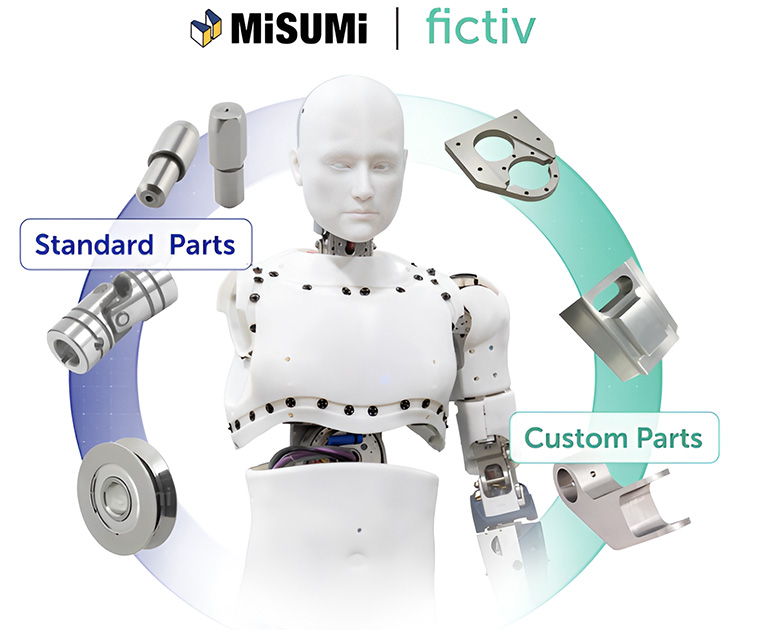
MISUMI acquired Fictiv to better serve manufacturing customers. Source: Fictiv
The scaling wall: Manufacturing and supply chain challenges
The most brilliant physical AI in the world is useless if you can’t build 10,000 units of the hardware that houses it. At Fictiv, we see the “scaling wall” as the primary hurdle for robotics companies in 2026.
The first challenge is hardware agility. Digital AI scales at the click of a button. Physical AI requires CNC-machined joints, injection-molded housings, and specialized sensors. Robotics companies often struggle with the transition from a “gold sample” prototype to mass production.
The supply chain for high-precision components is notoriously volatile. A three-month delay in a specific custom actuator can freeze a company’s entire roadmap.
The second challenge is lifecycle resilience. Unlike a SaaS (software-as-a-service) product, a robot in a warehouse faces dust, heat, vibration, and human error.
Designing for manufacturability and serviceability (DFM/DFS) is often an afterthought for AI-first companies. To scale, these companies must adopt a “digital-first” supply chain—using platforms that provide real-time visibility into lead times and allow for rapid iterations of custom parts.
Finally, there is the integration gap. Most legacy manufacturing facilities were not built for physical AI. Retrofitting a 20-year-old factory to support a fleet of autonomous robots requires a level of systems integration that many startups underestimate. It’s not just about the robot; it’s about the charging infrastructure, the 5G/6G connectivity, and the safety protocols.
Physical AI shows the path forward
Physical AI is the catalyst that will bring the efficiency of the digital world to the physical shop floor. But to get there, we must treat the hardware with the same level of innovation as the software.
The companies that will dominate the next decade are those that realize robotics is a multi-disciplinary sport. It requires world-class AI, yes—but it also requires a robust, agile, and transparent manufacturing strategy.
At Fictiv, we are proud to be the connective tissue for those building the machines of the future, ensuring that the next generation of physical AI doesn’t just live in a demo video, but thrives on the production line.
 About the author
Steve Ricketts is vice president of business development for robotics at Fictiv. A senior-level manufacturing and operations professional, he brings extensive experience in design, development, and global deployment.
Known for reducing operating costs, improving deliverables, and driving profitability, Ricketts is especially skilled in designing new products, developing manufacturing processes, and fostering strong customer and vendor relationships. He is recognized for his unwavering commitment to professional excellence and his ability to combine technical expertise with business and people skills.

Tell Us What You Think!