In Episode 211 of The Robot Report Podcast, hosts Steve Crowe and Mike Oitzman recap the major robotics news of the week. On the show this week, Nohtal Partansky, co-founder and CEO of Sorting Robots.
Disclaimer: This episode talks about cannabis manufacturing and systems from Sorting Robots. Cannabis and related products are legal in various states in the U.S. and regions around the world, and not in others.
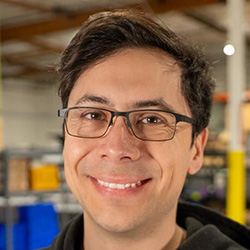
Nohtal Partansky, co-founder and CEO of Sorting Robots.
Partansky, an accomplished entrepreneur and ex-NASA engineer, teamed up with fellow co-founder Cassio Santos to create Sorting Robotics. Over half a decade, Nohtal has steered the company in developing innovative robotic solutions for cannabis producers and vertically integrated businesses, addressing the automation shortcomings he witnessed in the sector that negatively impacted the value chain and profit margins.
As the founder and CEO of Sorting Robotics, Nohtal presently oversees the implementation of AI-powered robotics and automation throughout North America to address these issues.
During his time at NASA, he played a key role as a cognizant engineer in the MOXIE project, which now generates oxygen from Mars’ atmosphere on the planet’s surface. That project was recognized with a 2024 RBR50 Robotics Innovation Award.
Show timeline
- 03:12 – News of the week
- 23:08 – Conversation with Nohtal Partansky, co-founder and CEO of Sorting Robots
News of the week
Video of Figure 02 loading the dishwasher
Figure 02 uses two-hand interaction to make the plates accessible from a stack. Figure continues to produce demos that show the robot in “real-world” home environments, not just lab setups. This helps set the public’s expectations about the capabilities of the solution in a home setting.
New video of Optimus 3 posted on the Singularity subreddit
A new video of Tesla‘s Optimus 3 was posted on the Singularity subreddit. It was not a promising demonstration of the robot. The video showed Optimus attempting to respond to a moderator. Optimus was slow to react and seems to be confused by commands and requests, pausing for several seconds to process each command request. The waist joint design on this third generation is interesting; it appears that Optimus might have more range of motion than the prior generation.
Editor’s note: Unfortunately, since the publication of the podcast, the video that we described on the podcast episode has been removed from the subreddit by the original poster.
Ujjwal Kumar steps down as president of Teradyne Robotics
Ujjwal Kumar announced on LinkedIn that it was his last day as president of Teradyne Robotics Group. He will remain with the company through September 2025 to help his successor, Jean-Pierre Hathout, transition into the role.
“In the last 2+ years at Teradyne Robotics, I’ve been proud of working with an incredible global team in expanding the product & customer portfolios across Universal Robots and Mobile Industrial Robots, extending our global footprint, championing the incredible potential of Physical AI, and above all helping customers to transform the way they work,” Kumar wrote.
Google DeepMind, Intrinsic build AI for multi-robot planning
A recently published study in Science Robotics proposed a new direction in artificial intelligence. The paper, “RoboBallet: Planning for Multi-Robot Reaching with Graph Neural Networks and Reinforcement Learning,” detailed research conducted by Google DeepMind Robotics, Intrinsic, and University College London.
The team developed an AI model that uses reinforcement learning and graph neural networks (GNNs) to generate collision-free motion plans for multiple robots in shared workspaces. You can watch the system in action in the video atop this page.
The problem the researchers tackled is not new: Classic motion-planning algorithms can produce reliable paths for individual robots. However, scaling those methods to several robots operating in tight quarters becomes computationally difficult. Engineers frequently spend significant time parameterizing algorithms or manually adjusting trajectories to avoid conflicts. The new AI approach aims to automate much of that process.
At the core of the method is a GNN trained through reinforcement learning on millions of synthetically generated scenarios. In this framework, robots, tasks, and obstacles are represented as nodes in a graph, while edges define their relationships.
UBTECH secures $1B in financing for Middle East humanoid production
Rumors have circulated that UBTECH Robotics Corp. secured a $35 million order from a Chinese customer, but they have not been verified.
Humanoid robotics developer UBTECH has reportedly secured a credit line of up to $1 billion from Infini Capital to expand production and marketing. The companies plan to establish a joint venture to build a “superfactory,” a research and development center, and a regional headquarters in the Middle East.
UBTECH said its partnership with Infini Capital will help it maintain leadership in robotics development, accelerate commercialization, and increase market share and profitability.
UBtech is one of the “dark horse” humanoid robot leaders. They have a strong manufacturing team and prior development and manufacturing experience. They’ve delivered high-volume consumer robots. They have been in the consumer humanoid robotics and toy market longer than just about any other vendor, with the UBTECH small-form “Alpha” humanoid series.





Tell Us What You Think!