The Robot Report

  • Home
  • News
  • Technologies
    • Batteries / Power Supplies
    • Cameras / Imaging / Vision
    • Controllers
    • End Effectors
    • Microprocessors / SoCs
    • Motion Control
    • Sensors
    • Soft Robotics
    • Software / Simulation
  • Development
    • Artificial Intelligence
    • Human Robot Interaction / Haptics
    • Mobility / Navigation
    • Research
  • Robots
    • AGVs
    • AMRs
    • Consumer
    • Collaborative Robots
    • Drones
    • Humanoids
    • Industrial
    • Self-Driving Vehicles
    • Unmanned Maritime Systems
  • Business
    • Financial
      • Investments
      • Mergers & Acquisitions
      • Earnings
    • Markets
      • Agriculture
      • Healthcare
      • Logistics
      • Manufacturing
      • Mining
      • Security
    • RBR50
      • RBR50 Winners 2025
      • RBR50 Winners 2024
      • RBR50 Winners 2023
      • RBR50 Winners 2022
      • RBR50 Winners 2021
  • Resources
    • Automated Warehouse Research Reports
    • Digital Issues
    • eBooks
    • Publications
      • Automated Warehouse
      • Collaborative Robotics Trends
    • Search Robotics Database
    • Videos
    • Webinars / Digital Events
  • Events
    • RoboBusiness
    • Robotics Summit & Expo
    • DeviceTalks
    • R&D 100
    • Robotics Weeks
  • Podcast
    • Episodes
  • Advertise
  • Subscribe

Google DeepMind, Intrinsic build AI for multi-robot planning

By Steve Crowe | September 3, 2025


Programming industrial robots is a labor-intensive process that often depends on teach pendants, offline tools, and trial-and-error. Coordinating multiple robots in shared spaces adds further complexity, making collisions and inefficiencies likely. With more than 4.3 million industrial robots in use worldwide, the time required for programming remains a major barrier to scaling automation.

A recently published study in Science Robotics proposes a new direction. The paper, “RoboBallet: Planning for Multi-Robot Reaching with Graph Neural Networks and Reinforcement Learning,” details research conducted by Google DeepMind Robotics, Intrinsic, and University College London. The team developed an AI model that uses reinforcement learning and graph neural networks (GNNs) to generate collision-free motion plans for multiple robots in shared workspaces. You can watch the system in action in the video atop this page.

The problem the researchers tackled is not new. Classic motion planning algorithms can produce reliable paths for individual robots. However, scaling those methods to several robots operating in tight quarters becomes computationally difficult. Engineers frequently spend significant time parameterizing algorithms or manually adjusting trajectories to avoid conflicts. The new AI approach aims to automate much of that process.

Intrinsic is a relatively new player in the industrial robotics space. The company spun out of Alphabet’s X “moonshot factory” in 2021 with the goal of making industrial robots easier to use, program, and scale. Since then, it has expanded through both internal R&D and acquisitions. In 2022, Intrinsic acquired the Open Source Robotics Corp. (OSRC). This is the for-profit arm of the Open Source Robotics Foundation, which is the organization behind the Robot Operating System (ROS).
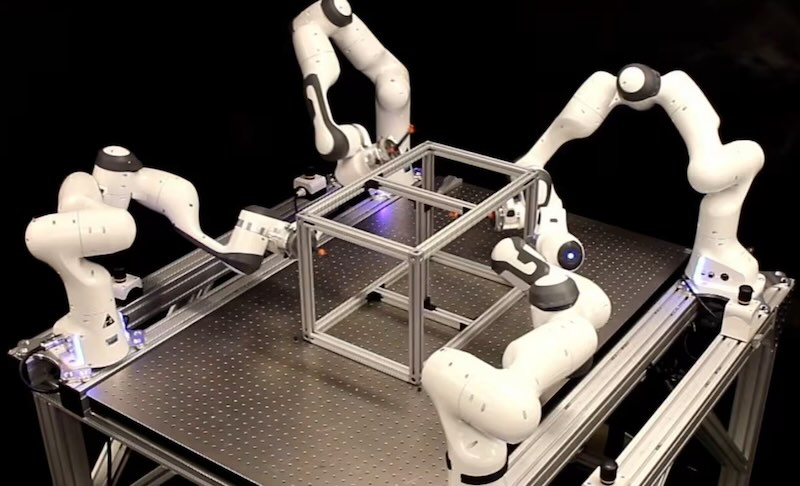
At the core of the method is a GNN trained through reinforcement learning on millions of synthetically generated scenarios. In this framework, robots, tasks, and obstacles are represented as nodes in a graph, while edges define their relationships. The researchers said the model learns to plan trajectories by trial and error, eventually developing generalized strategies that can be applied to new, unseen layouts. Once trained, Intrinsic said the system requires only CAD files and high-level task descriptions to produce motion plans without manual coding, teach pendants, or fine-tuning.

In laboratory evaluations, the model generated motion plans for up to eight robots, often producing near-optimal solutions within seconds. According to Intrinsic, the AI-based approach showed improvements of about 25% in trajectory quality when compared with traditional methods, while also demonstrating strong scalability. For example, when moving from four to eight robots, task execution time decreased by an average of 60%. Intrinsic said this suggests efficiency can increase with system complexity rather than degrade.


SITE AD for the 2026 RoboBusiness call for speakersRegister now and help us celebrate 20 years of RoboBusiness!

The ability to handle “bundles of tasks” without detailed step-by-step instructions makes the system noteworthy. Given a set of objectives, the developers said the model automatically determines the sequence of actions and corresponding collision-free trajectories. Because of the way it encodes relationships between entities in a workcell, it can also adapt to novel scenarios without retraining or human intervention, according to Google DeepMind and Intrinsic.

The RoboBallet team said AI-driven planning could reduce programming time, improve flexibility, and enable faster adaptation to changing product designs or unexpected disruptions. Looking ahead, combining this approach with AI-enabled perception at the edge could allow robots to replan on the fly in response to dynamic changes, further reducing downtime.

About The Author

Steve Crowe

Steve Crowe is Executive Editor, Robotics, WTWH Media, and chair of the Robotics Summit & Expo and RoboBusiness. He is also co-host of The Robot Report Podcast, the top-rated podcast for the robotics industry. He joined WTWH Media in January 2018 after spending four-plus years as Managing Editor of Robotics Trends Media. He can be reached at [email protected]

Tell Us What You Think! Cancel reply

This site uses Akismet to reduce spam. Learn how your comment data is processed.

Related Articles Read More >

Boston Dynamics' Atlas humanoid robot doing a cartwheel.
Will ‘boring’ robots win in the real world? Why robotic form should follow workflow
two race cars come through the famous corkscrew turn at Laguna Seca raceway.
IAC completes autonomous racing event at Laguna Seca
two robot arms at the RAI uncap a soda bottle and pour into a glass.
SoftBank agrees to acquire Robotics and AI Institute
STCs focus on building sustained partnerships across universities, industry, and government and accelerating the use of new ideas and technologies for scientific discovery.
NSF to invest $90M into three new technology centers, including one focused on robotics

RBR50 Innovation Awards

“2026”
“rr
EXPAND YOUR KNOWLEDGE AND STAY CONNECTED
Get the latest info on technologies, tools and strategies for Robotics Professionals.

Latest Episode of The Robot Report Podcast

Automated Warehouse Research Reports

Sponsored Content

  • ADI discusses the race to physical AI in a new report. ADI explains the race to make AI physical
  • The ADI cleanroom in Beaverton, Ore. How ADI is helping robotics startups scale
  • Precision In Motion. Vishay Precision Group, Inc. (VPG) to Showcase Custom Sensing Capabilities for Humanoid Robotics at RoboBusiness 2026
  • Your Robot’s Safety Functions Already Work. What If the Input Lies?
  • Designing long-travel axes: When rack and pinion outperforms ball screws and linear motors
More Sponsored Content >
The Robot Report
  • Automated Warehouse
  • RoboBusiness
  • Robotics Summit & Expo
  • About The Robot Report
  • Subscribe
  • Contact Us

Copyright © 2026 Arrowfly LLC. All Rights Reserved. The material on this site may not be reproduced, distributed, transmitted, cached or otherwise used, except with the prior written permission of Arrowfly
Privacy Policy | Advertising | About Us

Search The Robot Report

  • Home
  • News
  • Technologies
    • Batteries / Power Supplies
    • Cameras / Imaging / Vision
    • Controllers
    • End Effectors
    • Microprocessors / SoCs
    • Motion Control
    • Sensors
    • Soft Robotics
    • Software / Simulation
  • Development
    • Artificial Intelligence
    • Human Robot Interaction / Haptics
    • Mobility / Navigation
    • Research
  • Robots
    • AGVs
    • AMRs
    • Consumer
    • Collaborative Robots
    • Drones
    • Humanoids
    • Industrial
    • Self-Driving Vehicles
    • Unmanned Maritime Systems
  • Business
    • Financial
      • Investments
      • Mergers & Acquisitions
      • Earnings
    • Markets
      • Agriculture
      • Healthcare
      • Logistics
      • Manufacturing
      • Mining
      • Security
    • RBR50
      • RBR50 Winners 2025
      • RBR50 Winners 2024
      • RBR50 Winners 2023
      • RBR50 Winners 2022
      • RBR50 Winners 2021
  • Resources
    • Automated Warehouse Research Reports
    • Digital Issues
    • eBooks
    • Publications
      • Automated Warehouse
      • Collaborative Robotics Trends
    • Search Robotics Database
    • Videos
    • Webinars / Digital Events
  • Events
    • RoboBusiness
    • Robotics Summit & Expo
    • DeviceTalks
    • R&D 100
    • Robotics Weeks
  • Podcast
    • Episodes
  • Advertise
  • Subscribe