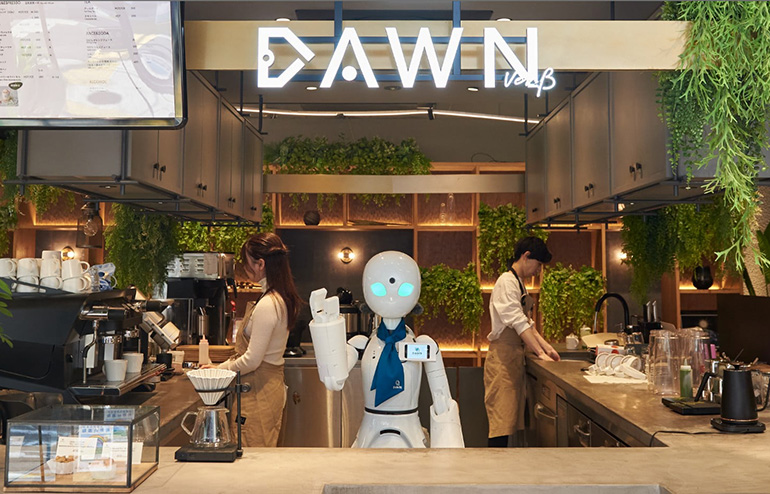
The Dawn cafe, in which people with disabilities teleoperate robots, shows the possibility of human-robot collaboration across industries. Source: OryLab
In Japan, robot cafes remotely run by people with disabilities reveal a side to the automation story that is not often talked about: Robots can bring people into the workplace rather than replace them. We are now seeing this concept in manufacturing.
This is an important counterpoint to the common misconception that robots will replace human workers. In 2024, 542,000 robots were installed, more than double the number 10 years prior, according to the International Federation of Robotics (IFR).
Robots’ role is being increasingly viewed as a value generator beyond time efficiency. A little over half of global manufacturers are adopting robots for quality improvement. Manufacturers should not focus on whether AI will replace humans. The most important questions they should be asking are:
- Into which processes should AI be integrated?
- How can new technologies bring in more people to the production workforce?
- How should they prepare for AI-powered systems and automation accordingly?
Why all-out replacement isn’t actually feasible
Most manufacturers still do not have the IT or technological infrastructure to make generative AI viable, let alone physical AI. It’s no secret that this is an industry that is notoriously manual-dependent for a lot of processes, including data and information collection.
In fact, manufacturing has one of the widest data gaps of any industry: 70% of manufacturers still capture data manually.
Digging deeper, there are two distinct technical challenges that illustrate just how complex this gap is to close. The first is how the link between purpose and action is captured correctly. That means not only understanding what a worker does, but also why they do it in that particular way.
This is a vital consideration to translate to robots before simply plugging them into the process, which is the second challenge to navigate. The action needs to be translated into a way that the robot can replicate it. In recent years, progress has accelerated in this regard, in the form of motion sensors connected to sophisticated generative AI systems.
But the first challenge is far more complex to solve, because the people with the most intimate knowledge of processes are the operators on the factory floor. Their expertise has been honed in their physical actions over years, often decades, becoming, to a large extent, instinctual. That instinct is difficult to capture and replicate in a robot, which is where a knowledge gap lies.
Bridging that knowledge gap is arguably the biggest, most underrecognized hurdle standing between manufacturers and truly autonomous robots. The foundations in terms of data and IT are simply not available for more autonomous robotics, which don’t simply execute basic tasks at scale.
To make workflows and the wider digital ecosystem of each organization AI and robot-ready, there will need to be a reconfiguration of how these workflows are designed and managed—from the ground up.
 Submit your session idea for the 2026 RoboBusiness
The manufacturing labor pool evolves
Modernization and digital transformation cannot happen without people involved. The skills that will matter most are strategic thinking, problem-solving, creativity, and critical thinking. These are what redesigning processes around advanced robotics and remotely operated systems demand.
Manufacturers also need people who can think like data scientists and engineers and are excellent communicators, problem solvers, designers, and strategists. The manual capacity freed up with robots taking on lower-stakes tasks can be redirected toward strategic leadership, vendor relationships, compliance, and AI architecture. Humans connect with humans—this is an aspect of manufacturing that cannot be replaced.
People’s physical presence will still be required in certain processes, too. In mobile phone manufacturing, for example, assembling particular components still requires specialized human dexterity.
Over the next few years, humans will need to remain closely involved in training robots to take on more complex assembly tasks. That in itself calls for skilled, informed guidance, whether physically on the workshop floor or operating these systems remotely.
A future-forward workforce includes robot collaboration
A future-forward workforce is more exclusive than ever before, where people and robots collaborate, not compete with each other.
Manufacturers are well advised to focus on reskilling and training to prepare the workforce for the next phase of AI. There needs to be an emphasis on upskilling, training, and operational redesign when the goal is augmentation rather than substitution. Employees must be well-versed in working alongside and overseeing AI tools.
Central to that is enshrining a hierarchy of priorities and guardrails that govern how AI and robotics are deployed on the factory floor, as well as how workers are trained to oversee them. Without question, safety must come first, followed by quality and productivity.
It is highly tempting to lead with productivity and quality, but manufacturers who pursue this approach do so to the detriment of human welfare. The trade-off is far too steep: breaking labor laws, damaging reputation and relationships, and incurring legal action that could cripple a firm or bring it under entirely.
Reskilling and training programs must be founded on this hierarchy, ensuring that staffers stepping into these oversight roles know that safety is always a top, non-negotiable priority.
The second most in-demand skill is the ability to understand and contextualize details without losing a holistic view and awareness of wider ramifications. Employees must be able to connect in both a top-down and bottom-up approach within remote and automated operations.
Finally, staffers need the flexibility to adjust their course of action based on the evolving tools and workflows. AI technology is still rapidly developing, and the costs for switching are relatively lower than for other technologies. If the purpose or environment needs have changed, manufacturers and their workforce must be able to readjust to better maximize return on investment (ROI).
Examples of worker enhancement with robots
Panasonic‘s pilot uses OryLab‘s OriHime avatar robots for people with physical disabilities to partake in operations. The results are very compelling: About 94% of respondents reported a more positive view of the abilities and motivation of workers with physical impairments. They said they would want to work with these colleagues in the future.
OryLab’s OriHime robotics technologies are designed to bridge the physical gaps that keep people with disabilities out of the workforce. Its OriHime-D avatar helps employees carry out telework that involves physical tasks, and Panasonic said the pilot shows the promise of robots augmenting human labor.
These are also the same OryLab robotics technologies that one to ONE Holdings is looking to implement as part of its broader vision around robotics augmenting human labor.
Train both people, manufacturing systems to be flexible
A key operational consideration with teleoperated systems such as delivery or service robots is workforce training and adaptation. Successfully integrating avatar robotics typically requires both in-person staff and remote operators to learn new communication and collaboration workflows.
For office teams, that can include understanding how to interact effectively with remote operators, navigating technical limitations such as response lag or limited camera visibility, and adapting workplace accessibility and communication practices.
For remote operators, onboarding would likely involve training around navigation controls, communication tools, task coordination, and managing the unique cognitive demands that come with operating through an avatar interface.
For too long, the conversation around robots on the shop floor has been framed as one where people lose, and machines win. This is not the case at all, and the reality is far more nuanced.
Manufacturers must lead with prioritizing human-in-the-loop approaches to automation and robots, not just aggressively embedding these solutions where a quick win is uncovered. The future of efficient production lies with a workforce that is more inclusive, collaborative, and AI-literate, bolstered, but not replaced, by robots.

About the author
Shinichiro Nakamura is president of one to ONE Holdings, a manufacturing and technology group with operations across Japan, Vietnam, and the U.S. Through its affiliated companies, the group has invested in advanced manufacturing technologies, smart factory solutions, and industrial innovation.
Nakamura has led the company’s global expansion and modernization efforts, with a focus on how technology can support the future of manufacturing and workforce development. Prior to joining the family business, Shin worked as a consultant at Bain & Co. and later earned his MBA from MIT Sloan.



Tell Us What You Think!