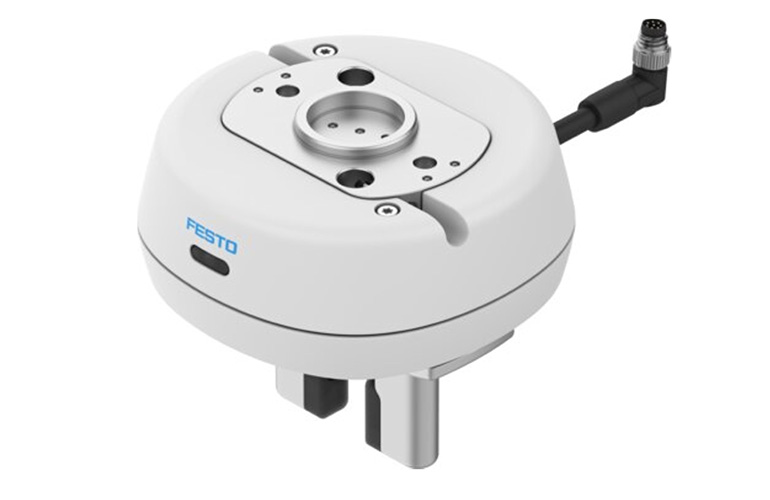
The new HPPH gripper is designed to reduce wiring and weight while supporting
safe operation. | Credit: Festo
Festo Corp. has launched the HPPH two-finger pneumatic parallel gripper, a lightweight system designed to overcome collaborative robot payload and wiring constraints by integrating the controls, sensing, and certified safety functions directly into the gripper body. The company also shared its progress with the GripperAI software.
Force- and power-limited robot arms typically operate within strict payload and mounting constraints, noted Festo. Pneumatic grippers that rely on external components add weight, increase footprint, and complicate routing along compact cobots, noted the company.
By reducing the number of these components, the HPPH preserves payload capacity and simplifies mounting and wiring on collaborative robot platforms, said Festo. The new gripper integrates the pneumatic control valve, position sensors, and electrical interface directly into the gripper body.
This functional integration also simplifies ordering, minimizes wiring complexity, and shortens installation and commissioning time, Festo asserted. An IO-link version is available for enhanced diagnostics and remote configuration.
The HPPH weighs 1.5 lb. (0.68 kg) and helps preserve robot payload capacity while reducing mechanical load on smaller cobots. The maximum gripper opening is 0.63 in (16 mm), and the HPPH is suitable for handling objects weighing up to 2.2 lb. (1 kg).
Festo added that it developed the HPPH in accordance with ISO/TS 15066 for collaborative robot safety and that it meets TÜV Süd-certification when used with HAFH-B30-16-45-N gripper fingers. The system features a force-limited gripping mode of 31.5 lbf (140 newtons), roughly the equivalent of a firm handshake, to reduce the risk of injury during close-proximity operation.
If higher gripping force is required, the force limit can be disabled to support non-collaborative applications with gripping forces up to approximately 40.5 lbf (180 newtons). The company said it also minimized sharp edges and pinch points with a smooth housing.
The HPPH is not suitable for machining or environments with aggressive media, grinding dust, or welding splatter, noted Festo. The gripper joins more than 30,000 interoperable pneumatic, electric, and software products in Festo’s automation portfolio.
The HPPH is available through Esslingen am Neckar, Germany-based Festo’s website and the Universal Robotics Marketplace.
GripperAI is compatible with a range of robots, grippers
Festo has also introduced GripperAI, which is designed to handle unfamiliar objects in disordered environments without requiring programming or teach-in training. Compatible with a wide range of grippers, the software uses artificial intelligence to determine optimal grasping points, aiming to make material handling more flexible and accessible for various industrial applications.
GripperAI is robot-agnostic, said Festo, whose North American headquarters are in Islandia, N.Y. It works with manufacturers and kinematic systems including cobots, classic robots, and Cartesian handling systems.
The software enables robots to grip previously unseen or chaotically positioned objects, including bulk materials, without the need for programming or teach-in training, saving significant setup time, according to the company.
In addition, GripperAI can automatically perform a tool change to acquire the appropriate end effector for a picking task. This adaptability makes it suitable for handling diverse items in logistics, manufacturing, and packaging environments.
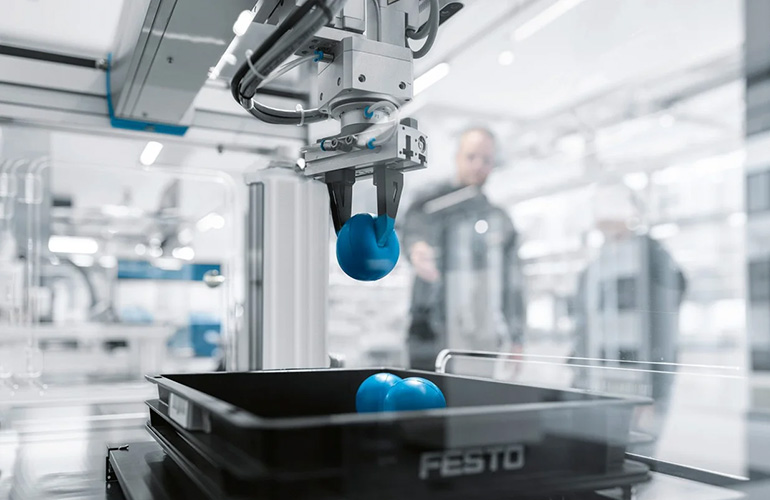
GripperAI is built to reduce the setup time for a robot in a picking application. | Credit: Festo
Festo designs software to work on the edge
GripperAI is designed to use edge computing and can operate with minimal hardware: A low-cost 3D RGB-D camera and a basic CPU (Core i3, >4 GB RAM) are sufficient for simple tasks. For more complex applications such as gripping bags, irregular geometries, or chaotically stored parts, higher-end GPUs and cameras can improve speed and success rates, said Festo.
The software is modular and can be installed on-site or operated in the cloud, supporting REST interfaces for integration. GripperAI can be deployed on robot CPUs, industrial PCs, or even within the camera itself.
Würth Group, which has about 1 million parts in its portfolio, has already tested the software in its logistics operations. It used GripperAI-equipped robots to empty crates filled with mixed, randomly oriented items.
“We built a copy of Würth’s sorter conveyors in our laboratory, which allowed us to develop the robot’s various capabilities: object-dependent gripper selection, gripping any objects from the trays, packing shipping cartons and handling the cartons and trays,” explained Jan Seyler, head of advanced development analytics and control at Festo.
The system identifies each object, selects the appropriate gripping tool, and efficiently transfers items for packaging or sorting, all without manual intervention or pre-programmed object data. The robot cell can operate in all of Würth’s planned lines, and the companies have defined further development work and optimization steps.
Tell Us What You Think!