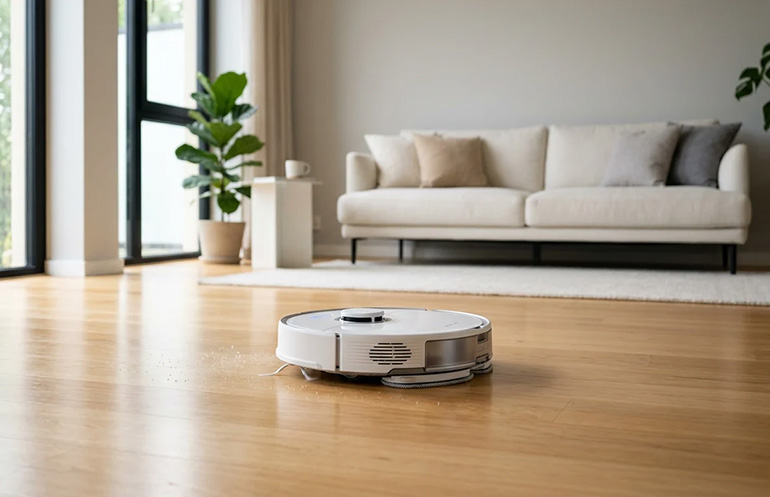
Narwal has designed robots that can both vacuum and mop. Source: Narwal
Robots have entered homes, but the path to consumer adoption has been long and winding. iRobot Corp. was the pioneer but entered bankruptcy proceedings late in 2025. Narwal Robotics Corp. has spent a decade on research and development, testing 30 technical routes to self-cleaning robotic mops, and building a supply chain to retain cost control.
While iRobot has emerged from bankruptcy with a new owner, Narwal is working toward an initial public offering (IPO). The company, which has offices in Shenzhen, China, and Covina, Calif., is looking to embodied intelligence to take home robots from the “iPod stage” to the “iPhone moment,” according to founder and CEO Junbin Zhang.
Zhang and Icey Bin, head of global brand at Narwal, replied to the following questions from The Robot Report:
Narwal took time to understand the household space
Why has the household robotics market been so difficult to break into?
The household robotics market has exceptionally high barriers to entry in R&D, supply chain, and algorithm development. In the early days, there were no mature industry solutions to reference. For instance, Narwal spent three years with zero revenue solely focused on R&D, iterating the self-cleaning mop structure over 10 times from scratch.
Additionally, contract manufacturers were initially reluctant to cooperate due to the complex product structures and low initial volumes. On the software side, features like automatic mop washing require extremely precise positioning algorithms for the robot to frequently return to its base station, which the industry lacked at the time.
Most importantly, to achieve a high market penetration, a company must refine the product’s experience, quality, and cost to the reliable standards of mature home appliances, which is an incredibly difficult ceiling to break through.
iRobot struggled for a number of reasons. Haven’t other vacuum providers such as Dyson picked up market share?
Over the past decade, the core dimension of industry competition has fundamentally shifted from stacking hardware parameters to delivering a low-intervention, automated cleaning experience. While traditional handheld vacuums still have a place, overseas households face complex pain points that require automated solutions—such as deep cleaning for carpets and managing pet hair.
To address this, Narwal innovated a dedicated carpet deep-cleaning module that automatically lifts the mop and increases suction, boosting carpet cleaning performance by 40% to 50% compared to traditional models.
Furthermore, we pioneered the DualFlow tangle-free system to fundamentally solve the pet hair tangling issue. This paradigm shift toward comprehensive automation and solving highly specific pain points is why Chinese challengers have reshaped the global market landscape.
 Submit your innovation now!
Technology and supply chain were built from scratch
How is Narwal’s technology and business model different from those of existing cleaning robot players?
Narwal stands out from incumbent players by rejecting the industry playbook of parameter stacking and scale-first growth, instead building original, user value-centered innovations across four core dimensions:
- Technology route: category-defining innovation from scratch: Instead of incremental upgrades to basic sweeping functions, Narwal created the entire self-cleaning robot mop category from its first product. Its proprietary technology portfolio — including self-developed SLAM algorithms, NarMind autonomous system, FlowWash hot water cleaning, and DualFlow tangle-free system — all target universal industry pain points rather than meaningless parameter competition.
- A model with full end-to-end control of the supply chain: Unlike the prevalent asset-light, OEM-heavy model, Narwal leverages the mature Greater Bay Area, a leading comprehensive manufacturing hub in southern China. Its full “Shenzhen R&D + Dongguan manufacturing” setup covers the full product lifecycle from development and design to manufacturing and delivery, enabling faster product iteration and consistent quality control.
- Operating logic: refined long-term management: Narwal rejects short-term tactics such as exchanging losses for market share and eroding brand value through price wars. It operates under a business-unit structure where R&D and frontline teams function as mutual profit centers, balancing innovation investment and market demand to avoid blind feature stacking or ineffective marketing spending.
- Strategic path: experience-first penetration: Contrary to the “chasing scale first, fixing experience later” industry norm, Narwal follows a long-term experience-first strategy: it polishes floor cleaning performance to mature home appliance standards first, then gradually reduces costs and drives market penetration through supply chain optimization, with the goal of turning robot vacuums from tech novelties into household essentials.
In what geographic regions have you found the most traction and why?
To date, Narwal’s products have entered more than 30 countries and regions globally, reaching over 6 million users. We have seen significant traction across North America, Europe, Asia-Pacific, and the Middle East.
Between January and April 2026, our overseas revenue grew by nearly 50% year-on-year. This success is primarily because we practice a “one country, one policy” approach, heavily customizing product features based on local lifestyle needs.
In North America, the U.S. is one of our most important markets. Our Flow 2 claimed the No. 1 spot in the robot vacuum new release category on Amazon U.S. within 24 hours of launch, with sales up 305% year over year versus the previous generation.
Key local optimizations include battery capacity and path planning upgrades for large single-family homes, plus a dedicated carpet deep-clean mode and DualFlow tangle-free system roller brush tailored to the high pet ownership rate. We have also established offline retail partnerships with major national chains including Best Buy and Costco.
In Europe, we have expanded steadily since 2024. During the 2025 Black Friday period, revenue in the French market surged 449% year on year, and first-launch sales across Europe grew 241% year on year.
Key local optimizations are enhanced carpet-cleaning performance and DualFlow tangle-free system for pet households, as well as water system adjustments for hard-water regions. We have a direct presence via our official website and Amazon in France, Italy, and Germany, with extended reach in Spain, Sweden, and the Netherlands, plus an extensive offline retail network.
Narwal address AI and privacy concerns
How do you see recent AI advances enabling more applications for consumer robots?
Recent AI advances are transforming consumer robots from executing “command-based cleaning” to performing “perception-based intelligent cleaning.” For example, Narwal pioneered the AI DirtSense technology and FlowWash hot water cleaning to sense floor dirt levels and automatically adjust cleaning power.
Furthermore, we were the first to mass-produce robot vacuums with dual-camera vision, allowing robots to achieve precise environment perception, obstacle avoidance, and scene recognition. Additionally, large language models enable natural language dialogue, allowing users to issue complex commands like “clean up the melon seeds near the sofa” instead of rigid keywords
When you mention “3D embodied intelligence,” how do you avoid the privacy concerns that affected iRobot?
Data privacy and security are core commitments across every market we operate in, and we have built multi-layer safeguards to address privacy risks. Beyond data governance, most of our products have obtained TÜV certification for product safety and quality as part of our broader commitment to being a trusted brand in people’s homes.
Minimized data collection by design: Our privacy policy explicitly states that Narwal does not automatically collect user photos or videos without user consent and affirmative user action. Sensitive network information, such as Wi-Fi passwords, is stored locally on the user’s robot and app only, and is never uploaded to our cloud servers.
Personal information collected is only used for necessary purposes, including providing product services, verifying accounts, optimizing product experience, ensuring security, and complying with legal obligations. We never repurpose it for unrelated uses.
Full regulatory compliance: Our products and services comply with applicable data protection laws and regulations in all operating markets, including GDPR in the EU/EEA and CPRA in California.
Cleaning robots are tailored for the U.S. market
How are you navigating tariffs and the recent FCC restrictions? How do you ensure a reliable supply chain?
Regarding the FCC’s action, we want to assure our customers that Narwal’s current lineup is not impacted—every model sold in the U.S. today remains fully certified, fully supported, and available at retail. For future products, we are closely reviewing the FCC’s announcement, including the conditional approval process.
As for tariffs, we are currently evaluating what these new requirements would mean for our operations. To ensure a highly reliable supply chain, Narwal relies on an “end-to-end” closed-loop talent and manufacturing system based in the China Greater Bay Area. While overseas competitors might take months to prototype a product, our highly clustered supply chain lets us prototype and iterate within a week, giving us the efficiency to weather external shocks.
Are you customizing any features for the U.S. market?
Yes, we have customized products and operations for the U.S. market across product performance, scenario adaptation and compliance dimensions:
Cleaning scenario adaptation: For the high pet ownership rate in the U.S. market, we optimized the DualFlow tangle-free system roller brush to effectively solve the pet hair tangling pain point.
For the high carpet coverage rate, we launched a Carpet Deep Clean module. When the robot detects carpet, it automatically lifts the mop pad and increases negative pressure suction to enhance deep carpet cleaning performance, improving dust removal by 40–50% compared to standard models.
Home size and runtime adaptation: For the common scenario of large single-family homes in the U.S., we upgraded battery capacity and optimized path planning for large-area cleaning. Our “charge while washing” design allows the robot to charge while returning to the base station to wash the mop, extending effective runtime without increasing battery size and weight.
We also enhanced AI navigation powered by dual-camera vision to handle complex floor plans in open-concept homes and large villas.
Stain scenario adaptation: Our FlowWash hot water cleaning technology continuously cleans the mop with fresh hot water during cleaning, preventing secondary contamination from dirty mops. This is optimized for common U.S. household stain scenarios such as kitchen food spills, muddy paw prints, and water tracked in from pools.
Robot vacuums approach their ‘iPhone moment’
When you say “iPhone moment,” are you thinking of apps and a platform approach, increasing levels of autonomy, or something else?
The “iPhone moment” describes a maturity leap for the entire robot vacuum category, rather than an app ecosystem or platform business model.
Right now, robot vacuums are still in the “iPod stage”: they only address flat floor cleaning, and remain tech novelties for early adopters. Penetration in China stands below 10%, while roughly 15% in mature overseas markets — far below the 90%+ rate for mature home appliances like refrigerators and washing machines.
The category will hit the “iPhone moment” inflection point when product experience, reliability and cost all reach mature home appliance standards. At that point, robot vacuums will become a daily household necessity, and penetration will see explosive growth.
Alongside mass adoption, products will also evolve in parallel from flat floor-cleaning tools to full-space “housekeepers” with 3D cleaning and organizing capabilities — the embodied intelligence form we are working toward.


Tell Us What You Think!