Colin Angle has already defined consumer robotics once with the Roomba. iRobot didn’t just build a successful product; it reshaped how people think about robots in the home. Now, Angle is attempting the seemingly impossible again.
His new startup, Familiar Machines & Magic, came out of stealth today with a companion robot. It’s a space filled with false starts and abandoned devices that sparked curiosity but often failed to build lasting emotional attachments.
Familiar Machines & Magic is building robots to perform what Angle calls “emotional work” to support routines, reduce loneliness, and integrate into daily life in ways screens and apps can’t. The Woburn, Mass.-based company’s first product is called a “familiar,” which in folklore refers to a companion spirit or creature that assists its owner.
“This is a really cool time to be in the robot world, because we have a better toolkit,” he said. “I’m glad I’m active at this moment in time, when suddenly all the things I’ve dreamed about over the last 35 years are within reach.”
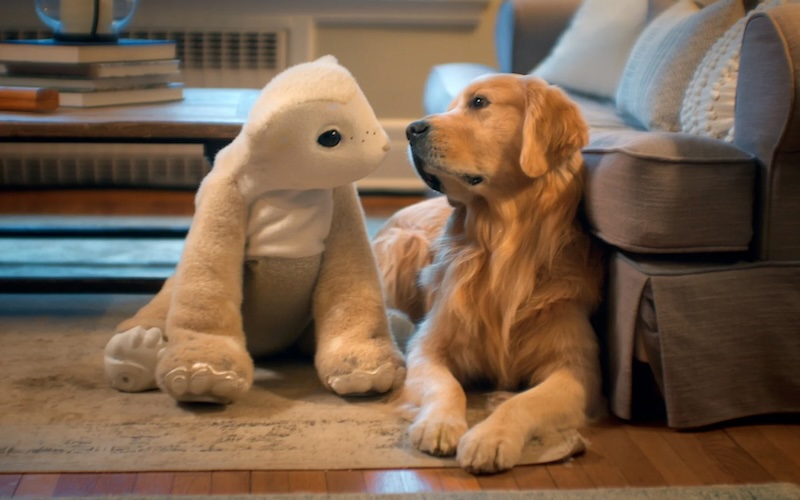
Angle told The Robot Report that his familiar in Dungeons & Dragons was a horse. Familiar Machines’ first familiar is not a horse, but a small, bear-like animal that Angle said is meant to feel expressive without triggering unrealistic expectations.
The robot is a quadruped about the size of a small dog, covered in a touch-sensitive, fuzzy exterior. Angle said the material draws on innovations from the sneaker industry and advanced 3D knitting techniques that help the internal electronics stay cool. The familiar has 23 degrees of freedom and can walk around the house and autonomously interact with users.
Technical specs, such as battery life, were not available at press time. The robot is expressive through its face, eyes, posture, and movement. It features edge AI processing and can follow a user from room to room, said Angle.
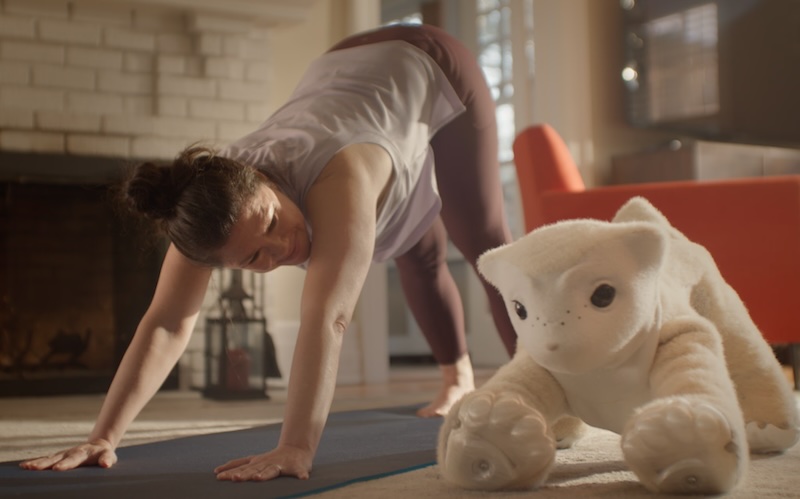
Familiar Machines & Magic came out of stealth mode with this companion robot.
Familiar Machines & Magic designs for daily interaction
Most previous companion robots have struggled to move beyond novelty, with limited interactivity. One of the few exceptions is Sony‘s Aibo robot dog, which was introduced in 1999. The company reportedly sold more than 150,000 units of Aibo before it was discontinued in 2006. After it was discontinued, some owners in Japan held funerals for the robot dogs once they were beyond repair.
Sony launched a new version of Aibo in 2018 with updated functionality, including more advanced emotional behaviors, and sold more than 20,000 units in Japan shortly after release.
“If I try to make a robot dog, I disappoint,” said Angle. “I’m not trying to make a pet. I’m trying to make a familiar—something pet-like, but not bound by those expectations.”
Familiar Machines’ robot is also designed to be physically embedded in daily life. It doesn’t just sit on a counter—it lives in your space, said Angle. The legged robot can follow a user into the kitchen or wait by the door. It can nudge the user to go play or go outside, he said. And that physical presence, Angle argued, is what makes connection possible.
He cited research suggesting that screens don’t solve loneliness. The familiar has no screen by design. At this stage, the robot doesn’t debate politics or answer trivia questions. It doesn’t even speak. “Screens are actually not very good at human connection. When you’re physically interacting with something, you get a physiological response that you don’t get with a screen.”
Instead, the familiar communicates through motion, behavior, and context. Angle said it might greet you excitedly after work, back off when you’re busy, or try to pull you out of a late-night doom-scrolling spiral with a nudge to take a walk.
“We’re trying to build a hyper-loyal, above-animal-level intelligence little creature in my life that is looking out for me the way that it can,” he said. “It’s a familiar in every sense of the word.”
This robot is wild. Familiar Machines & Magic just unveiled it at the Wall Street Journal Future of Everything conference. It’s got AI, autonomy and is adorable. More to come on this. #WSJFutureofEverything pic.twitter.com/bEo9hAcY5D
— Lance Ulanoff (@LanceUlanoff) May 4, 2026
Companion robot prioritizes EQ over IQ
Each familiar’s personality will evolve over time through interactions with its owner, he explained. And that’s the real challenge facing Familiar Machines & Magic: Can today’s AI build a meaningful emotional connection strong enough to keep the robot from collecting dust in a closet?
The startup is prioritizing emotional intelligence (EQ) over raw cognitive intelligence (IQ). Instead of trying to build a social robot that can talk about anything, Familiar Machines is focusing on one that can behave appropriately in context. Its system combines vision and audio inputs with a compact multimodal model that interprets facial expressions, gestures, and tone.
From there, a behavior engine trained on thousands of short narrative vignettes determines how the robot should respond based on personality, memory, and situational cues.
Angle said all of this runs locally on-device. This allows for faster reactions and avoids constant cloud streaming, which helps address privacy concerns that are especially sensitive for always-on home robots.
The bet is that emotional believability doesn’t require perfect intelligence. If the robot can read the room, adapt to routines, and develop a personality that feels coherent, it may succeed where others have failed.

Angle acknowledged this is a tough challenge. Even iRobot‘s Roomba vacuum required careful design decisions, like scheduling, to sustain user engagement. With companion robots, the bar is much higher. They’re not competing with gadgets; they’re competing with real pets—animals that demand attention, initiate interaction, and have had millions of years to evolve emotional bonds with humans.
“More failures than successes, right? Let’s be honest: this is a challenge,” he said. “But we’ve never had the tools before and never had the bringing together of the experience before. We have a toolbox to do something that literally was impossible six months ago.”
There’s still a lot of work to be done. Angle said the first familiar will be available in 2027. He didn’t disclose a price but said it will be comparable to the cost of owning a dog. If this works, Angle said familiars could become a platform that expands into new roles and form factors.
“When we get to act two and humanoids are coming in the home, you want them to be familiar, right? You don’t want them to be uncanny,” Angle said. “I do talk about what we’re doing as a platform. This first familiar itself can blow away Roomba as far as economic value and scale. Selling a million familiars has more economic value than all of the Roombas ever sold by a large margin. But even with that scale, it’s the beginning, not the end. I think that as we get responsible communication, we can start creating familiars where there’s an expectation.”



How are they with stairs?
And how are they if they miss a step and fall down the stairs?
And if the answer is “not so good,” then how good are they at avoiding stairs? Roombas, for instance, knew better than to try to deal with stairs.