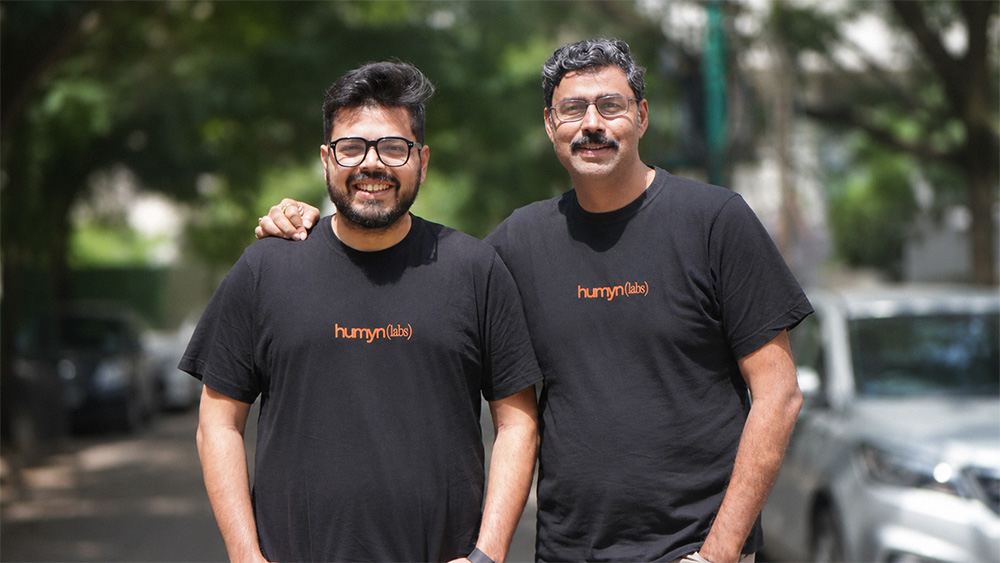
Humyn Labs’ co-founders, from left to right, Ishank Gupta and Manish Agarwal. | Source: Humyn Labs
Humyn Labs, a physical AI research and deployment company, today announced it raised $47 million in Series A funding. The company said it has also surpassed $50 million in annualized revenue within six months of operations.
Humyn Labs works with frontier AI labs, robotics companies and world-model developers. It uses its own data capture and enrichment operations across over 20 countries to help robots better prepare for deployments in the real world.
“A lot of robotics development is bottlenecked in terms of what’s happening in the real world. A bunch of the robotics development that we were seeing and a bunch of the partners that we were talking to were working on essentially simulated environments,” Ishank Gupta, the co-founder of Humyn Labs, told The Robot Report. “The biggest gap was how do you take what’s happening in the lab into the real world?”
The funding round includes $26 million in equity led by Accel. It included participation from Prosus Ventures, BeeGlobal, Finserv Intelligence through Bajaj Finance, Bajaj Alts AI Opportunities Fund, Dallas Venture Capital, Lighthouse Canton, Jump Trading LLC and marquee angel investor Anita Pramoda, former CFO of Epic. The $21 million venture debt round was led by Lighthouse Canton with participation from Trifecta Capital.
Humyn Labs gathers data across four modalities
Right now, Humyn Labs gathers data across vision, sound, touch, and motion. “The idea is to not just be a data partner, but also a deployment partner to our customers,” Gupta said. The company gathers data using its proprietary capture devices.
These devices record how people perform specific jobs to a specific labs’ requirements. Meanwhile, Humyn Labs’ end-to-end data engine converts these into labelled, training-ready datasets with verified provenance across these four modalities.
“We want to be an extension of the lab’s research team. We work backwards from what the researchers need, and then build out bespoke large-scale collection programs and enrichment programs,” Gupta said. “We currently operate and partner with on-ground collection partners across 20 countries. Our biggest area of operations are LATAM, southeast Asia, south Asia, and east Asia.”
For audio data, Gupta said the company focuses on gathering data across different languages rather than across different industries. Vision, touch, and motion data, however, typically go hand in hand and are more industry specific.
Humyn Labs’ data can be applied to a range of industries. The company divides the industries it works in into three overarching categories: residential, commercial, and industrial.
“The distinction between commercial and industrial is anything manufacturing or anything factory sits in industrial. Anything outside that sits in commercial. Warehousing, retail, hospitality, all of that will sit in commercial,” Gupta said.
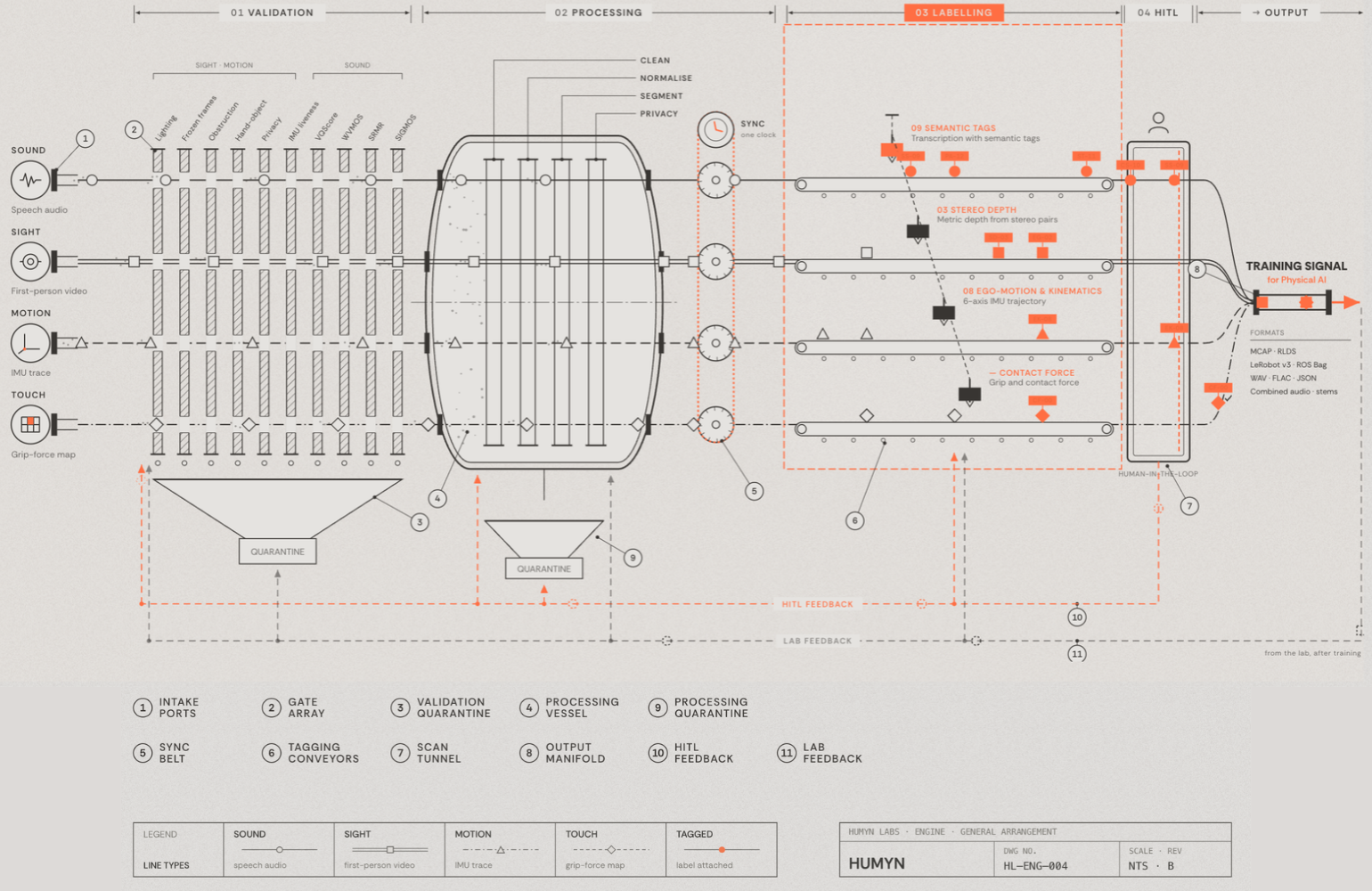
A chart showing how Humyn Labs’ data engine works. | Source: Humyn Labs
Working across different robot embodiments
Humyn Labs’ isn’t interested in deciding how end-users should automate tasks, so its data can be useful across a range of robot embodiments.
“We work across embodiments, because the focus is on understanding how certain tasks can be done. Robot arms are amazing for any task that requires manipulation but doesn’t require navigation. Those are amazing in industrial environments or in an assembly line setup or any other setup where a person has a stationary task where they don’t need to move,” Gupta said.
This is especially important in industrial environments. Meanwhile, in commercial environments, you see more tasks that require manipulation and navigation.
“If you are working in a hotel, for example, or in a warehouse, you have to do manipulation but also move around,” Gupta said. Home environments, he continued, include a mix of these kinds of tasks.
“Different labs have different thought processes on embodiments. There are some labs that are working on building a brain, which could be embodiment agnostic. Most of your frontier labs sit in that bucket, and then there are embodiment-specific robotics companies. So, we work across a spectrum,” Gupta said.
 Submit your innovation now!
What are Humyn Labs’ plans for the funding?
The funding will support three areas: deployment readiness infrastructure in Brazil, Korea and India; the company’s capture hardware and enrichment engine; and on-the-ground presence in San Francisco, London and Seoul. The team hopes to make it so robotics labs can spend more time focusing on important work.
“When the stakes are so high, and the models are evolving so fast, why would a lab waste time ensuring that certain hardware reaches a site in Venezuela, and then that operators are collecting that data,” Manish Agarwal, the co-founder of Humyn Labs, said. “I would rather have high impact work happening with the best of the research scientists so that I can compete.”
Additionally, the company hopes to accelerate deployment readiness. Agarwal said right now, the robotics industry is in a place where its still figuring out how long the average deployment cycle might be.
“We see that as an opportunity rather than a challenge. For deployment readiness, the biggest gap is this whole real-sim-real flywheel, and with every percentage improvement, we will really need that flywheel to work faster and deeper,” Agarwal said. To make this happen, the industry needs the right data, and the right data partner, he said.




Tell Us What You Think!