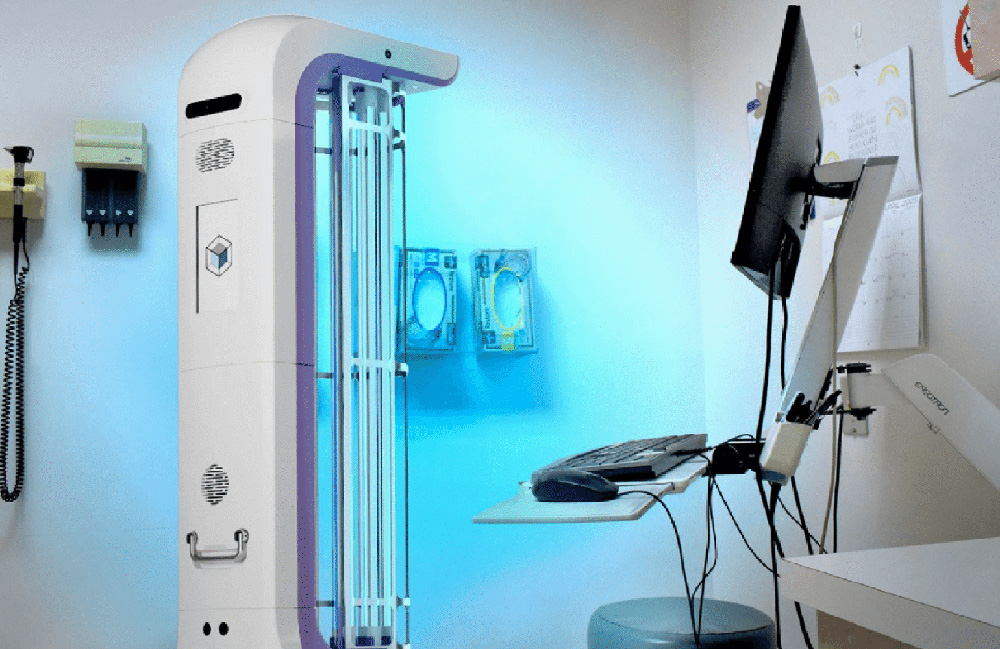
GlobalLogic developed the UV disinfection robot with Haystack Robotics. | Source: GlobalLogic
In hospitals, hygiene is critical. But the cleaning process, which is time-intensive and difficult to scale, remains manual work. This often means the process is also inconsistent. Healthcare facilities are under pressure to care for more patients with fewer resources. These challenges are why the Silicon & Embedded division at GlobalLogic helped Haystack Robotics engineer a mobile robot to handle disinfection.
The project started during the COVID-19 pandemic, when disinfection became a critical use case for robots.
“Obviously, this was a big use case at that point of time, in terms of being able to sanitize hospitals and care facilities,” Kunaal Mahanti, physical AI lead at GlobalLogic, told The Robot Report. “So [Haystack] came up with this concept of being able to do disinfection better.”
“While there were disinfections which are happening manually, it wasn’t really good coverage,” he added. “We were really the engineering and collaboration partner there to see how we can take this concept and make it.”
The result is an autonomous mobile robot (AMR) that combines real-time perception, edge-based intelligence, and navigation to deliver hospital-grade UV disinfection with minimal human intervention. The Santa Clara, Calif.-based company said it can operate safety alongside people, interpret its surroundings, and adapt to changes in its environment.
GlobalLogic aims to create a scalable platform
When designing its robot, Mahanti said GlobalLogic didn’t want to just quickly design a system for one use case or environment.
“We wanted to make it an expandable platform,” he explained. “The idea was that you can look at, for example, the track part of it, which is the thing that is carrying the robot, independent of what it is carrying, which is the UV. Architecturally, you keep them separated so that we can mount other things at a later date.”
“It went from a concept to what would be an architectural foundation, so that it’s not just that one product,” said Mahanti. “It actually becomes a class of solutions that we can build for the same industry segment.”
While GlobalLogic hasn’t done many other deployments in hospitals, Mahanti did say the company used some of the base components of the UV robot for other projects.
“When you look at the platform that moves, there are things that have come out from there in terms of the control of the motors,” he said. “Then we use ROS to do the programming and the sensor fusion part, that is reusable, and we’ve used that. So, if not necessarily the same device, but that architecture broadly.”
Navigating the challenges that come with hospitals
Healthcare facilities are crowded, chaotic, and involve many closed-off spaces, making them difficult for robots to work in.
“The known part was that, obviously, you have to interact with humans. The unknown part is that there are doors, there are things that need to be opened, and you can’t always just barge in,” Mahanti said.
This is different from more common use cases for mobile robots in warehousing or manufacturing, which typically involve open-spaces that are easy to navigate
“There are two modes that we ended up building for [the robots],” noted Mahanti. “Essentially, one was this autonomous mode, where it would navigate and find the right room. The other was a ‘follow me’ mode, in which case it would follow a caregiver or a nurse.”
This means the caregiver can open doors and ensure spaces are ready for the robot to enter. It also means a patient wouldn’t be blindsided by a robot entering their room, for example.
However, designing an AMR that can work in these complex spaces has created benefits in other parts of GlobalLogic’s business. With a much higher bar for safety, the company could apply the platform to other industries.
“The other learning is just being able to be in an environment where you cannot be loud, for example, when we are designing the motors or looking at what we need to put in [the robot],” said Mahanti. “Those things are specific to this industry, but then dealing with that has helped us build machines with higher fidelity elsewhere, where it is not necessarily a given, but it’s a good thing to have. Why wouldn’t you want to have a nice quiet thing that doesn’t interfere with the rest of the environment?”
What’s holding back robotic adoption in hospitals?
While more robots are making their way into hospitals, most people cannot yet walk into their local hospitals and find robots roaming the halls. This is still an emerging area for robotics, so what challenges still exist? Mahanti said three things come to mind.
The first is cost. “There needs to be an ROI,” he replied. “For example, if you look at this use case during COVID, at that point of time, you needed less people in the hospitals. You needed to be safe. It was a big issue. So that ROI was justifiable.”
Second is compliance with medical standards, which becomes much trickier when deploying robots that will interact with the public and patients.
Third is the perception of robots. Mahanti acknowledged that hospital staffers don’t want a big, bulky robot taking up space in busy corridors and elevators.
Prem Balasubramanian, chief technology officer of GlobalLogic, said that safely integrating into hospital workflows is also challenging.
“There are clearly safety concerns, from multiple angles. Navigating in a very human-crowded situation is not easy,” he said. “For a disinfectant use case, if a robot waits for people to keep moving and then slowly moves, you’re okay. But if you’re using it for anything else, like if a doctor calls and you have to get something fast to help a patient or bring some stuff, a robot could get stuck because it sees people moving and it can’t move.”
The hospital is difficult on its own, and it’s made even more difficult when you consider how made-for-humans they are, said Balasubramanian. For example, a robot might be able to navigate an emergency room in a perfect condition with no obstacles, but the addition of patients who constantly moving or being moved and staffers running around to solve critical issues make navigation much more challenging.
“The entire workflow within a hospital is built for humans. You can’t just fit a robot in thinking it’s a human. So, there is work to be done in converting some of the workflow, the spaces, everything,” Balasubramanian said.
 Submit your innovation now!

Tell Us What You Think!