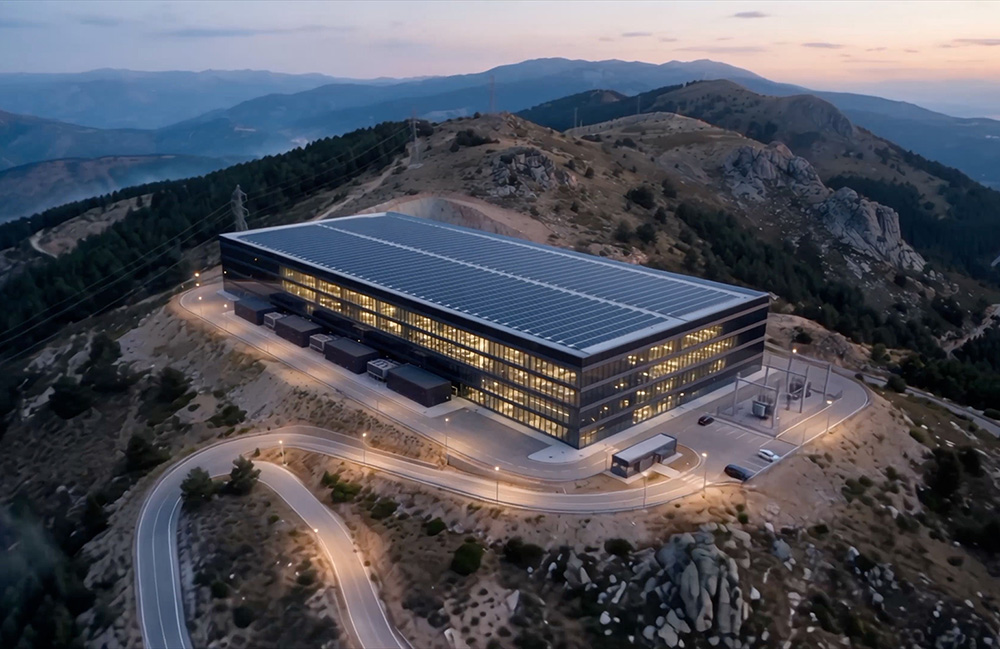
The first Data Factory hub is set to become one of Europe’s largest physical AI training facilities for humanoid robots. | Source: Generative Bionics
Generative Bionics this week announced plans to build a proprietary, multi-site “Physical AI Data Factory” in Italy. The company said the new 5,000-sq.-m (53,819.5-sq.-ft.) hub will help move humanoid robotics from laboratory demonstrations to reliable industrial deployment.
In addition, Generative Bionics said it hopes to advance European humanoid sovereignty, ensuring that the data, models, and know-how behind Europe’s industrial humanoids are generated, trained and validated on the continent.
“The value that Europe has right now is within its industry, and we have to extract physical AI data in order to train our own models,” Daniele Pucci, the CEO of Generative Bionics, told The Robot Report. “This is a competitive advantage that Europe right now has, because of the automation that we have been putting in place over the last 40 years.”
Generative Bionics said the new facility will be operational by the fourth quarter of 2027. The Genoa, Italy-based company plans to eventually open a second facility elsewhere in Europe and a third serving global markets. Together, the three facilities will reproduce real industrial environments, generate high-fidelity physical data, and connect that data with large-scale simulation.
Building on their strategic technology collaboration, Advanced Micro Devices Inc. will be Generative Bionics’ AI infrastructure partner, and the Physical AI Data Factory network will be powered by AMD Helios. Its rack-scale architecture will provide the compute foundation to process physical and synthetic data, train physical AI models, and run thousands of digital-twin scenario variations in parallel.
Data Factory to test GENE.01 in a range of industries
The Physical AI Data Factory will connect real-world robot operations, simulation and AI development in a continuous real-to-sim-to-real cycle, said Generative Bionics. The company said this will allow it to configure and validate its GENE.01 humanoid robot for specific industrial environments before customer deployment, then feed data from deployed fleets into future training cycles.
Industrial humanoids must learn from the conditions they will encounter at work, noted the Generative Bionics. This requires data that captures contact, force, motion, proximity, temperature, task constraints, and human interaction in realistic operating settings. For GENE.01, the dataset will include vision and motion data as well as signals captured through its full-body multimodal skin.
“A robot is not only vision and is not only language,” said Pucci. “It is position, velocity, acceleration, temperature, and contact forces, so there is a large variety of data that you have to take into account.”
The Data Factory will reproduce environments selected with industrial partners and allow fleets of GENE.01 robots to perform tasks continuously in real-world conditions. These operations will generate high-fidelity physical data for training world action models (WAM) and validating the complete robot system, including perception, control, safety behavior, and task execution, before deployment at customer sites.
Each physical environment and robot configuration will also be recreated as a digital twin. The same tasks can then be repeated across thousands of variations in layout, objects, materials, operating conditions, and failure modes that would be impractical to reproduce physically. Models trained and tested in simulation will be deployed back to the robots for validation, while data from physical operations will feed the next training cycle.
Generative Bionics wants to help find robot ‘ChatGPT moment’
Large language models (LLMs) learn from vast amounts of information available online, noted Generative Bionics. Humanoid robots have no comparable source of data on how to act in the physical world.
The Physical AI Data Factory will create such a source by collecting data as GENE.01 performs industrial tasks and expanding those experiences through digital-twins running on AMD compute.
“We have the ambition of being the European champion in physical AI, and even robotics, designed to scale globally,” said Pucci. “That’s our clear positioning, and for this, we are taking a close look at the supply chain that can supply our future manufacturing.”
“Manufacturing here is divided into three levels: the manufacturing of data, the manufacturing of robots, and the manufacturing of models,” she continued. Pucci said if Europe wants to achieve sovereignty in this area, it needs to invest in all three.
Right now, humanoid robots from China have been garnering a lot of attention with flashy demos and large funding rounds. But, Pucci, notes that this doesn’t mean the country is necessarily ahead of Europe.
“I want to be crystal clear about this. Many of the Chinese robots that are out there are simply not certified to enter industrial settings,” Pucci said. “The narrative that the Chinese solved as the issues is very far from reality.”
“Right now, we believe that many of the existing solutions are basically for entertainment, and this is a market segment that we respect,” she added. “But, Generative Bionics is taking the issue of safety and certification very seriously because we want to go B2B first.”
GENE.01 can be customized for specific applications
Generative Bionics claimed that a few things separate its platform from the average humanoid robot. To start, GENE.01 features full-body tactile sensing.
“It comes naturally to give the humanoid robots the sense of touch, because humanoid robots have to perceive people not only while talking, but also while interacting with them physically,” Pucci said. “That’s why GENE was given this unique multimodal scheme, which can perceive not only the sense of touch but also the sense of proximity.”
Generative Bionics also plans to offer GENE.01 as a base platform that can be customized for different industries.
“We have a clear view that humanoid robots cannot be used for anything that comes to your mind, because a humanoid robot welding in a shipyard cannot be the same as a humanoid robot in healthcare,” noted Pucci. “There is a fundamental difference in the development cycle.”
The company has three levels of customization. “The first one is the AI, because a robot moving boxes does not need the same AI of a robot in healthcare,” said Pucci. “The second is the exterior design. In the shipyard, you have to be resistant against high temperatures, sparks, and powders. The third is the hands and the feet.”
“This is really scalable at the manufacturing level, because you have a common platform, and then you can customize at the end the so-called end of lines at these three levels,” she continued. “This is basically the same approach that you have in automotive.”
Generative Bionics is building on more than 20 years of research, development, and prototyping of humanoids at the Italian Institute of Technology (IIT). The company spun out of IIT in 2024, and IIT has granted it exclusive licenses to key technologies.
 Register now and help us celebrate 20 years of RoboBusiness!


Tell Us What You Think!