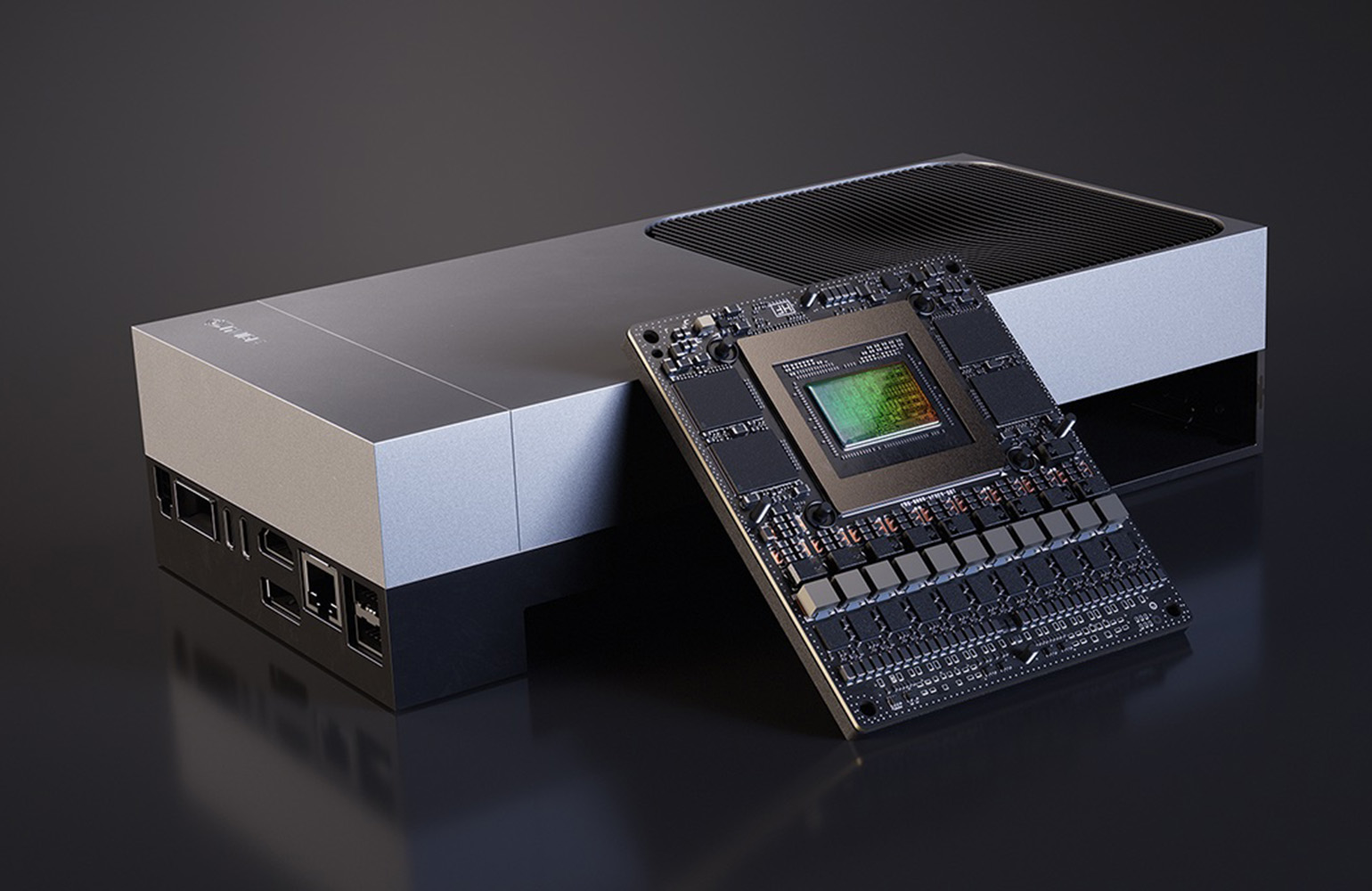
Jetson Thor delivers up to 2,070 FP4 teraflops of AI compute within a 130-watt power envelope. | Source: NVIDIA
Last month, NVIDIA launched its powerful new AI and robotics developer kit, NVIDIA Jetson AGX Thor. The chipmaker says it delivers supercomputer-level artificial intelligence performance in a compact, power-efficient module.
The module enables robots and machines to run advanced “physical AI” tasks—like perception, decision-making, and control—in real time. It does this directly on the device without relying on the cloud.
The full-stack NVIDIA Jetson software platform powers the module, which supports any popular AI framework and generative AI model. It is also fully compatible with NVIDIA’s software stack from cloud to edge, including NVIDIA Isaac for robotics simulation and development, NVIDIA Metropolis for vision AI, and Holoscan for real-time sensor processing.
NVIDIA says it’s a big deal because it solves one of the most significant challenges in robotics: running multi-AI workflows to enable robots to have real-time, intelligent interactions with people and the physical world. Jetson Thor unlocks real-time inference, critical for highly performant physical AI applications spanning humanoid robotics, agriculture, and surgical assistance.
Jetson AGX Thor delivers up to 2,070 FP4 TFLOPS of AI compute, includes 128 GB memory, and runs within a 40-130 W power envelope. Built on the Blackwell GPU architecture, the Jetson Thor incorporates 2,560 CUDA cores and 96 fifth-gen Tensor Cores, enabled with technologies like multi-instance GPU. The system includes a 14-core Arm Neoverse-V3AE CPU — 1 MB L2 cache per core, 16 MB shared L3 cache — paired with 128 GB LPDDR5X memory offering about 273 GB/s bandwidth.
There’s a lot of hype around this particular piece of kit, but Jetson Thor isn’t the only game in town. Other players, like Intel’s Habana Gaudi, Qualcomm RB5 platform, or AMD/Xilinx adaptive SoCs, also target edge AI, robotics, and autonomous systems.
Here’s a comparison of what’s available currently and where it shines:
NVIDIA Jetson AGX Thor specs, strengths
- Built on NVIDIA Blackwell graphics processing unit (GPU)
- Delivers up to 2,070 FP4 TFLOPS (trillion floating-point operations per second) and includes 128 GB LPDDR5X memory—all within a 130 W envelope. That’s a 7.5 times AI compute leap and three times better efficiency compared with the previous Jetson Orin line.
- Equipped with 2,560 CUDA cores, 96 Tensor cores, and a 14-core Arm Neoverse CPU.
- Features 1 TB onboard NVMe (Non-Volatile Memory Express), robust I/O including 100 Gigabit Ethernet (GbE), and optimized for real-time robotics workloads with support for large language models (LLMs) and generative physical AI.
Use cases and reception: Early pilots and evaluations are taking place at several companies, including Amazon Robotics, Boston Dynamics, Meta, Caterpillar, with pilots from John Deere and OpenAI.
Qualcomm Robotics RB5 Platform specs, strengths
- Powered by the QRB5165 SoC (system on chip)
- Combines Octa-core Kryo 585 CPU, Adreno 650 GPU, Hexagon Tensor Accelerator delivering 15 TOPS, along with multiple DSPs (digital signal processor) and an advanced Spectra 480 ISP capable of handling up to seven concurrent cameras and 8K video
- Connectivity is a standout—integrated 5G, Wi-Fi 6, and Bluetooth 5.1 for remote, low-latency operations.
- Built for security with Secure Processing Unit, cryptographic support, secure boot, and FIPS certification.
Use cases and development support: Ideal for robotics use cases like SLAM, autonomy, and AI inferencing in robotics and drones. Supports Linux, Ubuntu, and ROS 2.0 with rich software development kits (SDKs) for vision, AI, and robotics development.
AMD adaptive SoCs and FPGA accelerators
Key capabilities: AMD’s AI Engine ML (AIE-ML) architecture provides significantly higher TOPS per watt by optimizing for INT8 and bfloat16 workloads.
Innovation highlight: Academic projects like EdgeLLM showcase CPU–FPGA architectures (using AMD/Xilinx VCU128) outperforming GPUs in LLM tasks. For example, they achieved 1.7 times higher throughput and 7.4 times better energy efficiency than NVIDIA’s A100.
Drawbacks:
- It is powerful but requires specialized development and lacks an integrated robotics platform and ecosystem.
- The Intel Habana Gaudi is more common in data centers for training and is less prevalent in embedded robotics due to form factor limitations.
Connect with NVIDIA at RoboBusiness
NVIDIA will have a major presence at RoboBusiness, which takes place on Oct. 15 and 16 in Santa Clara, Calif., and is produced by The Robot Report.
Deepu Talla, vice president of robotics and edge AI at NVIDIA, will deliver the opening keynote on “Physical AI for the New Era of Robotics.” The big bang of generative AI for the physical world is here, according to Talla. Physical AI, where models can perceive, reason, and act in real-world environments, is redefining what’s possible in robotics.
Jim Fan, director of AI and a distinguished research scientist at NVIDIA, will be on a keynote panel about lessons learned from early humanoid deployments. He’ll be joined by Katlyn Lewicke, head of global automation strategy and intel at GXO Logistics, and Pras Velagapudi, chief technology officer of Agility Robotics.
Amit Goel, director of product management for autonomous machines at NVIDIA, will be on a keynote panel about the state of robotics. Goel and other industry leaders from Cobot, DHL, and F-Prime Capital will discuss the breakthroughs driving progress, the barriers still holding robotics back, and the trends shaping robotics in the years to come.
Founded in 2004, RoboBusiness is the premier event for developers and suppliers of commercial robots. There will be more than 60 speakers in the conference, a startup workshop, a robotics startup competition, networking receptions, and more. Over 100 exhibitors on the show floor will showcase their latest enabling technologies, products, and services to help solve your robotics development challenges.
Editor’s note: This article was syndicated from The Robot Report sibling site, Engineering.com.
 Submit your session idea for the 2026 RoboBusiness

Tell Us What You Think!