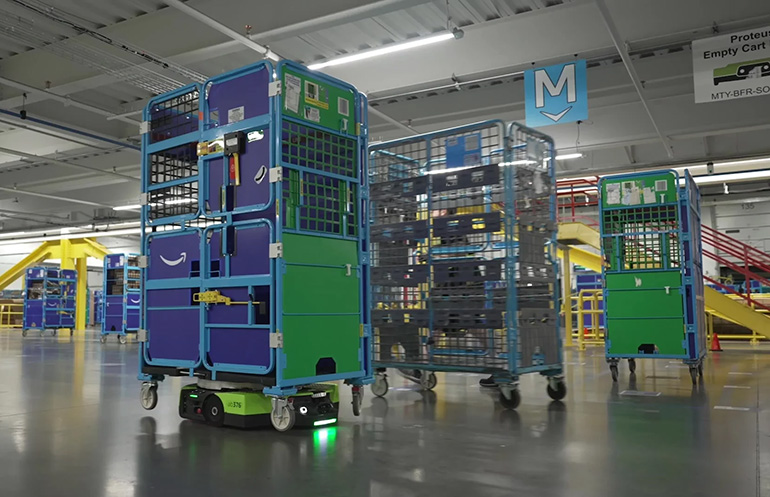
Fennec Engineering has worked with clients including Amazon Robotics. Source: Fennec Engineering
Functional safety is critical for robots and related technologies to earn trust and adoption, and it must be considered as early as possible in development, according to Fennec Engineering. The company today said it has received independent certification from TÜV Rheinland for its Advanced Safety Acceleration Platform, or ASAP.
The year-long Tool 2 (T2) qualification process demonstrated that ASAP meets the rigorous requirements of IEC 61508 and ISO 13849 for software tools used in safety-critical development. Steven Marks, director of product at Fennec, led the process of assessing the platform’s methodology and end-to-end traceability for both standards.
In addition, the company codified the full process for IEC 61508 certification to create a roadmap for its customers to use going forward.
“Establishing this process is obviously beneficial for the manufacturer, but what I learned during this qualification process was how beneficial it was to the assessor,” said Marks. “Having a cohesive, traceable safety narrative makes it easier to demonstrate that safety has been systematically engineered into the product. This is just as important for building public trust as it is for achieving certification.”
“I think of our SaaS offering as the TurboTax of safety — it’s the first tool of its kind,” he told The Robot Report. “We’ve built proprietary test cells showing how safety is a competitive advantage instead of a block to innovation.”
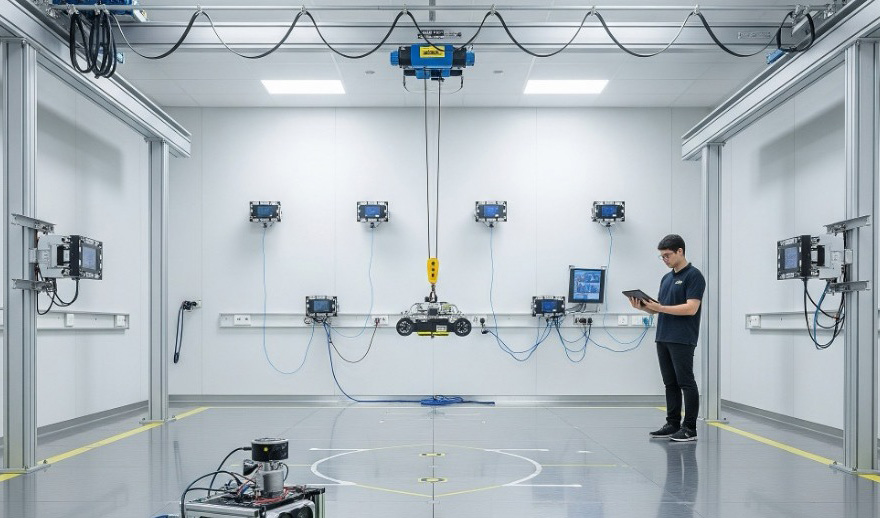
A test cell for safety-critical development. Source: Fennec Engineering
Functional safety requires culture as well as tools
“It’s a matter of culture versus tools,” said Justin Croyle, chief product officer at Fennec. “You have to build in performant safety systems from the beginning. Instead of thinking of functional design — ‘What are the actions I need the device to do?’ — we need to change the culture to focus on functions and hazards.”
“Physical guarding of machinery evolved into E-stop, and then from the 1980s, it became more complex with silicon,” he noted. “With software, robotics, and AI, we now have even more complex systems. We want to see a change from safety as a rudimentary system bolted on to a control that can unlock performance.”
“For example, there was a mobile robot program that I got hired into, and it was building code for actuation,” recalled Croyle. “The team didn’t have a coding standard and relied on static analysis. It had to do a massive rewrite and hire dozens of engineers. They thought they had a fault-tolerant architecture, but it turned out they didn’t. Instead of being run once every eight hours, the diagnostics had to run within 100 milliseconds. How can you do that without overwhelming your compute? That was an ‘aha’ moment for me.”
Waiting to add safety features could lead to over-engineered or under-engineered products, where expensive sensors can’t handle environmental interference or the shape of a robot, he added.
“In an increasingly AI-enabled world, functional safety demands complete traceability: every requirement linked to a test case, every failure mode accounted for,” said Fennec Engineering. “Managing this traceability manually, version by version, is where projects break down.”
 Submit your session idea for the 2026 RoboBusiness
Fennec automates engineering traceability with ASAP
Founded in 2021, Fennec Engineering builds safety infrastructure for autonomous systems, robotics, and AI. The company claimed that its platform supports safety from concept through certification.
ASAP is designed to automate traceability across the “V-model” lifecycle, replacing error-prone, spreadsheet-based processes with a single, auditable environment, Fennec asserted. The company said it unifies safety across the supply chain; eliminates regulatory guesswork; and helps electrical, mechanical, and software teams collaborate to bring innovations to market faster.
“If you’re not just bolting systems together for a palletizing robot or a mobile manipulator, you can handle complexities in motion control systems, like translational motion, velocity, momentum, and shifting centers of gravity,” added Croyle. “The only way to define secondary hazards like knocking over shelving or dangerous workpieces is with a clear risk assessment.”
“We’re also looking at IEC 22440 to guide development of safety systems and digital twins that use AI themselves,” he told The Robot Report. Fennec has also engaged with humanoid robot developers.
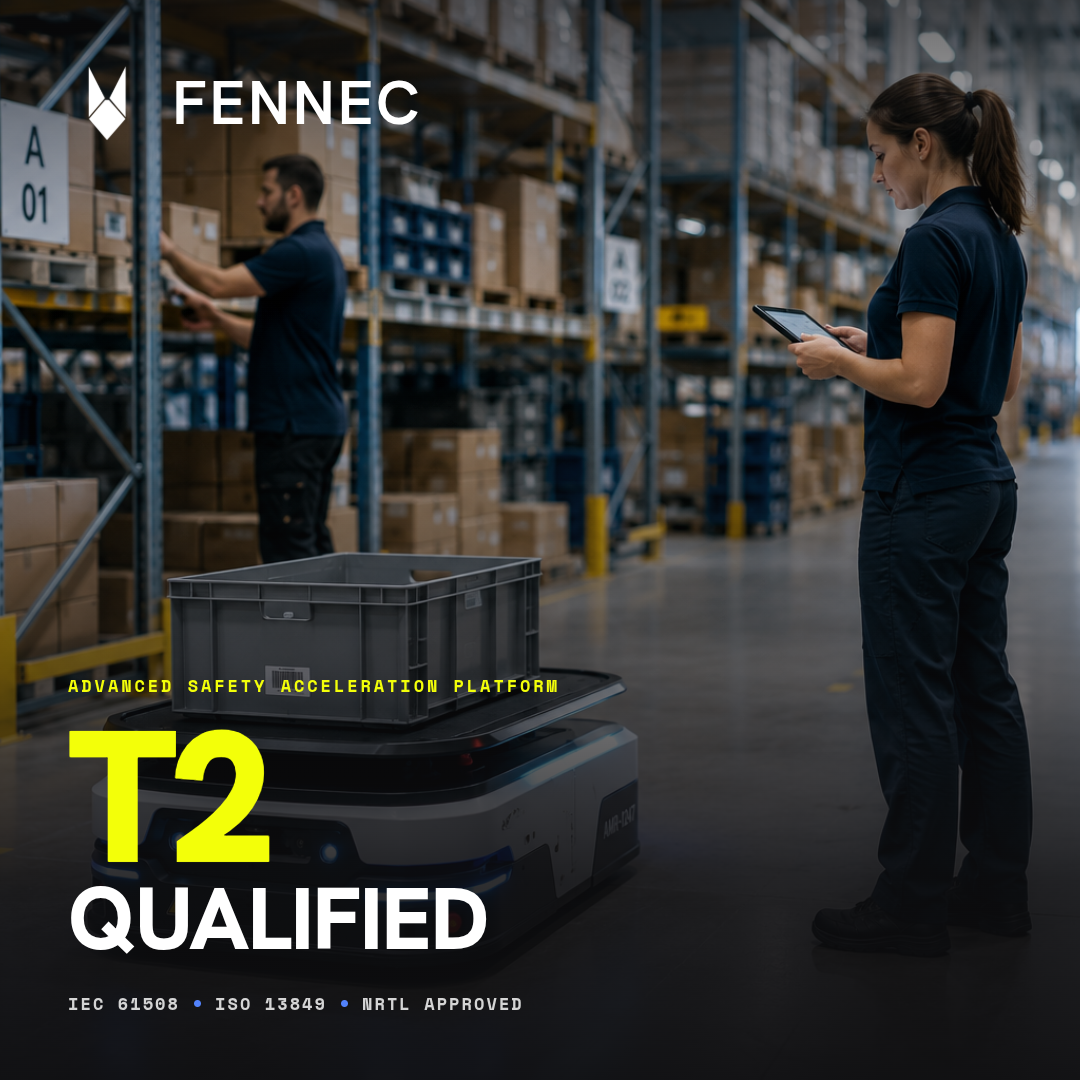
TÜV Rheinland has certified ASAP for compliance with safety standards. Source: Fennec Engineering
T2 qualification provides confidence
TÜV Rheinland has validated that ASAP can support stringent requirements for safety-critical engineering of autonomous systems and physical AI, said Fennec Engineering.
“T2 qualification means our customers can build that case on ASAP with confidence that the platform itself has been held to the same standard,” said Yurkovich.
“Autonomous systems don’t earn trust through marketing; they earn it through evidence,” stated BJ Yurkovich, founder and chairman of Fennec. “Every safety requirement, hazard analysis, and verification record is part of that case.”
Fennec has deployed ASAP at Amazon Robotics since 2021 and is launching the product for the wider market. The T2-qualified version of ASAP is now available.
Fennec to exhibit at Automate 2026
Fennec Engineering plans to exhibiting at Booth 4454 at Automate next week in Chicago. Attendees can see ASAP in action, discuss their functional safety needs with the Fennec team, and learn how T2 qualification changes what’s possible for their certification processes.


Tell Us What You Think!