The Robot Report

  • Home
  • News
  • Technologies
    • Batteries / Power Supplies
    • Cameras / Imaging / Vision
    • Controllers
    • End Effectors
    • Microprocessors / SoCs
    • Motion Control
    • Sensors
    • Soft Robotics
    • Software / Simulation
  • Development
    • Artificial Intelligence
    • Human Robot Interaction / Haptics
    • Mobility / Navigation
    • Research
  • Robots
    • AGVs
    • AMRs
    • Consumer
    • Collaborative Robots
    • Drones
    • Humanoids
    • Industrial
    • Self-Driving Vehicles
    • Unmanned Maritime Systems
  • Business
    • Financial
      • Investments
      • Mergers & Acquisitions
      • Earnings
    • Markets
      • Agriculture
      • Healthcare
      • Logistics
      • Manufacturing
      • Mining
      • Security
    • RBR50
      • RBR50 Winners 2025
      • RBR50 Winners 2024
      • RBR50 Winners 2023
      • RBR50 Winners 2022
      • RBR50 Winners 2021
  • Resources
    • Automated Warehouse Research Reports
    • Digital Issues
    • eBooks
    • Publications
      • Automated Warehouse
      • Collaborative Robotics Trends
    • Search Robotics Database
    • Videos
    • Webinars / Digital Events
  • Events
    • RoboBusiness
    • Robotics Summit & Expo
    • DeviceTalks
    • R&D 100
    • Robotics Weeks
  • Podcast
    • Episodes
  • Advertise
  • Subscribe

Built Robotics, Penn xLAB to develop physical AI for construction

By Mike Oitzman | June 16, 2026

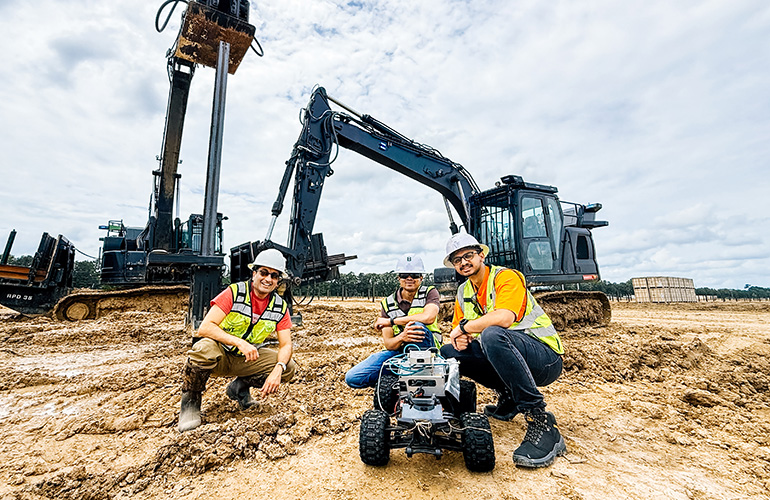
two workers stand behind a mobile robot equipped with sensors at a job site.

Built will leverage small mobile robots equipped with a sensor suite to scan jobsites and build a dataset to be analyzed by xLAB researchers at the University of Pennsylvania. | Credit: Built Robotics

The University of Pennsylvania’s Safe Autonomous Systems Lab (xLAB) is teaming up with Built Robotics to turn construction sites into a proving ground for “physical AI.”  Built plans to use its large construction robotics dataset and a new purpose-built, data-collection robot to develop a world foundation model for how machines and people can safely coexist on the job site.

Built Robotics has been in the field since 2016, developing autonomous controls for large construction equipment. The company entered the utility-scale solar market in 2023 with the announcement of a new product called the RPD 35, or Robotic Pile Driver. Since its inception, Built has amassed more than 50,000 hours of operations, installed more than 3 gigawatts of solar, and is deployed at 40+ sites.

Rahul Mangharam is a professor in electrical and systems engineering and the principal investigator of xLAB at Penn Engineering. Noah Ready-Campbell, founder and CEO of Built Robotics, is a Penn alumn, so this relationship is an obvious one for both parties. Mangharam has an interest in the safety-critical issues with automating outdoor construction equipment, and the partnership will bring real-world data back to the lab.

Built expects to collect diverse personnel and environment data beyond what the work-focused piling and trenching robots naturally see. This includes more edge cases such as odd body poses, occlusions, weird lighting, unexpected human behavior.

“xLAB is committed to building safety-critical autonomous systems for real-world deployment, and construction represents one of the most demanding frontiers for that work,” said Mangharam. “The fundamental challenge is bridging the gap between validation in controlled environments and robust performance under operational conditions. Our collaboration with Built will give us access to active jobsites with high-fidelity mapping data and real-world operational parameters, enabling us to build practical autonomous systems solving a real-world need.”

“What xLAB has built in safety architecture is precisely the kind of rigorous foundation that physical AI demands,” said Ready-Campbell. “Our proprietary edge AI model for personnel detection has been refined across some of the most demanding operational environments in the industry — active construction sites with hundreds of employees stretching over thousands of acres.”


ITE AD for the 2026 RoboBusiness call for speakersSubmit your session idea for the 2026 RoboBusiness

By systematically collecting and labeling edge cases, the collaboration will design AI models capable of detecting humans in atypical conditions and unique construction environments. This advanced training pushes the edge AI model toward “superhuman” perception, enabling it to identify unusual, transient dangers that humans might miss.

Ready-Campbell told The Robot Report, “We’re members of AEM (Association of Equipment Manufacturers), and they have what’s called the Futures Council, which is basically a kind of forward-looking committee that is looking at, among other things, physical AI and construction and autonomous machines. We think safety is a rising tide that lifts all boats. If there’s a safety issue, even if it wasn’t one of Built’s robots, it will cast a pall across the overall industry, and so the right thing to do is to try to help everybody work safely across the industry.”

Ready-Campbell also noted that Erol Ahmed, VP of communications at Built, is currently the chair of the AEM Futures Council.

Liam Osler, engineering director for AI at Built Robotics, commented, “We are driven by the same core conviction as xLAB: that physical AI must first be safe, and that it is poised to set a new standard for safety in construction.”

The initial phase of the research pilot will focus on deploying Built Robotics’ edge AI model across a fleet of construction survey robots tasked with collecting high-fidelity sensor data on active solar projects. This data will then be used to improve Built’s own AI models and to expand the models to other vehicle platforms and construction activities.

“With one of the most respected robotics programs in the world, Penn Engineering — my alma mater — was a natural starting point for this collaboration,” said Ready-Campbell. “Dean Vijay Kumar’s pioneering work on quadcopters and multi-robot coordination at the GRASP Lab was formative for me when I started Built. And as our fleet of robots has scaled in the field, the mission alignment with xLAB has become crystal clear. I couldn’t be more excited to partner with Professor Mangharam to set a new bar for how physical AI is designed, validated, and deployed in the field.”

About The Author

Mike Oitzman

Mike Oitzman is Senior Editor of WTWH's Robotics Group and founder of the Mobile Robot Guide. Oitzman is a robotics industry veteran with 25-plus years of experience at various high-tech companies in the roles of marketing, sales and product management. Mike has a BS in Systems Engineering from UCSD and an MBA from Golden Gate University. He can be reached at [email protected].

Tell Us What You Think! Cancel reply

This site uses Akismet to reduce spam. Learn how your comment data is processed.

Related Articles Read More >

ABB GoFa helps test PSYONIC’s Ability Hand for robotics, combining touch sensing, compliant design and human-derived training data copy
PSYONIC partners with ABB Robotics to apply human touch to robot dexterity
Einride's autonomous freight vehicle.
Autonomous freight developer Einride goes public via SPAC
The Grande 44 is Burro’s most powerful autonomous platform to date and its first purpose-built for the demands of heavy industry. The robot brings Burro’s field-proven physical AI to industrial applications that conventional warehouse robots cannot reach.
Burro introduces Grande 44 with proven outdoor autonomy built for heavy industry
Industrial robot adoption has continued to increase, according to the IFR.
Modernizing the global economy with industrial robotics is needed but not inevitable

RBR50 Innovation Awards

“2026”
“rr
EXPAND YOUR KNOWLEDGE AND STAY CONNECTED
Get the latest info on technologies, tools and strategies for Robotics Professionals.

Latest Episode of The Robot Report Podcast

Automated Warehouse Research Reports

Sponsored Content

  • Daimon Robotics and Galbot jointly launches RobOmni for benchmarking tactile perception and dexterous manipulation
  • genisom tradeshow booth with quadrupeds. GENISOM AI debuts deployable robotics platforms at ICRA 2026
  • How humanoids learn to read the room
  • GMSL and the growing ecosystem around robotic vision systems
  • The Convergence in Perception Systems from Cars to Robots
More Sponsored Content >
The Robot Report
  • Automated Warehouse
  • RoboBusiness Event
  • Robotics Summit & Expo
  • About The Robot Report
  • Subscribe
  • Contact Us

Copyright © 2026 WTWH Media LLC. All Rights Reserved. The material on this site may not be reproduced, distributed, transmitted, cached or otherwise used, except with the prior written permission of WTWH Media
Privacy Policy | Advertising | About Us

Search The Robot Report

  • Home
  • News
  • Technologies
    • Batteries / Power Supplies
    • Cameras / Imaging / Vision
    • Controllers
    • End Effectors
    • Microprocessors / SoCs
    • Motion Control
    • Sensors
    • Soft Robotics
    • Software / Simulation
  • Development
    • Artificial Intelligence
    • Human Robot Interaction / Haptics
    • Mobility / Navigation
    • Research
  • Robots
    • AGVs
    • AMRs
    • Consumer
    • Collaborative Robots
    • Drones
    • Humanoids
    • Industrial
    • Self-Driving Vehicles
    • Unmanned Maritime Systems
  • Business
    • Financial
      • Investments
      • Mergers & Acquisitions
      • Earnings
    • Markets
      • Agriculture
      • Healthcare
      • Logistics
      • Manufacturing
      • Mining
      • Security
    • RBR50
      • RBR50 Winners 2025
      • RBR50 Winners 2024
      • RBR50 Winners 2023
      • RBR50 Winners 2022
      • RBR50 Winners 2021
  • Resources
    • Automated Warehouse Research Reports
    • Digital Issues
    • eBooks
    • Publications
      • Automated Warehouse
      • Collaborative Robotics Trends
    • Search Robotics Database
    • Videos
    • Webinars / Digital Events
  • Events
    • RoboBusiness
    • Robotics Summit & Expo
    • DeviceTalks
    • R&D 100
    • Robotics Weeks
  • Podcast
    • Episodes
  • Advertise
  • Subscribe