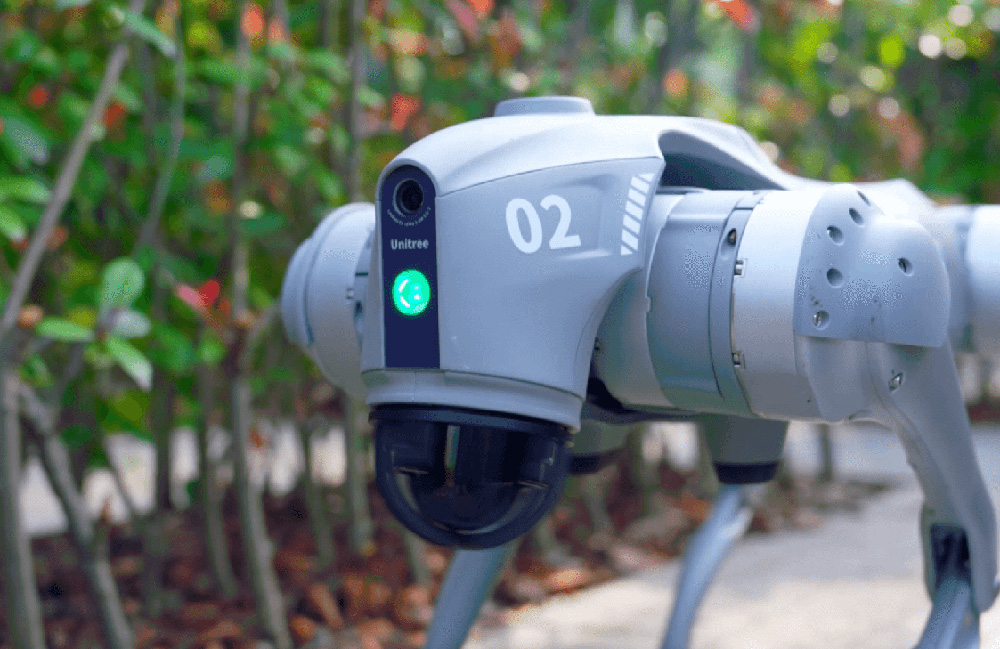
The Go2 quadruped robot from Unitree, a prominent Chinese robot developer. | Source: Unitree
The FCC is right to treat connected robots as a security issue. Its recent action restricting foreign-produced advanced robotic devices reflects a real risk. These machines carry cameras and sensors, transmit data, take remote software updates, and make their own decisions inside factories, warehouses, stores, and airports.
But where a robot was assembled tells you little about who controls it once it’s deployed. A robot built entirely in the United States, with unsigned updates and open remote access, is a bigger risk than one built overseas with secure software. The real security boundary is the code, the data, and whoever can change them, not the chassis.
The FCC has already recognized this. Its definition of a covered device relies on software: firmware and AI or machine-learning model weights that control navigation, perception, data collection, and remote command and control. The agency has identified the layer that matters. The next step is to turn that critical layer into the standard.
Brain Corp builds autonomy software, so of course I think software deserves scrutiny. But that’s also why I know where the risk lives. Our technology runs more than 50,000 robots on six continents and has logged more than 25 million hours of autonomous operation. At that scale, the failures that matter are rarely in the hardware. They’re in how software gets updated, who can reach the machine, and what happens when it meets a situation nobody anticipated.
Regulate control, not just origin
Software provenance alone can’t mean where the code was written. Robots run on open-source libraries, globally trained models, and international engineering teams. What should matter is provenance of control, demonstrated rather than declared. Any robot deployed in a sensitive or public setting, wherever its parts came from, should be able to show:
- Who can push code to it, and that every update is signed and verified before it runs.
- That unauthorized code can’t execute.
- Where its data goes, where it’s processed, and who can access it.
- How remote access is granted, logged, and revoked.
- How quickly a newly discovered vulnerability can be patched across the entire fleet.
- An independent safety layer that the AI cannot override.
- Independent audits and certifications that back up all of the above.
 Submit your innovation now!
AI can be probabilistic. Physical safety can’t be.
The safety layer deserves emphasis, because AI is changing what robots can do faster than policy is changing how we judge them. When a chatbot gets something wrong, the result is a bad answer. When a robot gets something wrong, it could generate unsafe behavior in a crowded aisle or beside a worker.
AI models will make robots far more capable, but they shouldn’t be the final authority over physical behavior. Robots need deterministic constraints beneath the intelligence layer. If a model proposes an unsafe action, an independent mechanism must stop it, and sensor data should check the model’s reading of the world rather than defer to it.
The more sophisticated the models become, the more this separation matters, and the more it belongs in any serious security standard.
The next step
The industry doesn’t need to wait for regulators to adopt these standards. Developers can publish how their systems meet them today, and enterprise buyers can require them in procurement. But voluntary practice is no substitute for a clear rule.
The FCC has already recognized that a robot is defined by its software. The next step is to regulate it that way: not just where the parts were made, but who controls the code.
About the Author
 David Pinn assumed the role of CEO at Brain Corp in 2022, where he has held various executive positions since joining in 2017, including chief strategy officer and chief financial officer. During his tenure, Pinn was instrumental in leading Brain Corp’s transformation from a robotics hardware company to a software as a service (SaaS) provider. He played a pivotal role in securing over $100 million in funding from prominent investors such as the SoftBank Vision Fund, Qualcomm Ventures, Hercules Capital, ClearBridge Investments, and Satwik Ventures.
Prior to joining Brain Corp, Pinn served as head of finance for Antenna79, a technology startup backed by L Catterton, the world’s largest consumer-focused private equity group, where he facilitated the raising of $94.9 million in private equity funding. Before his tenure at Antenna79, Pinn co-founded Snaptracs, Qualcomm’s consumer electronics subsidiary. Under his leadership, Snaptracs was successfully sold, leading to a merger with Whistle and a $117 million acquisition by Mars.
Pinn holds a Bachelor of Science degree in Electrical Engineering from the University of Texas at Austin and a Master’s in Business Administration from the University of California, Berkeley, Haas School of Business.




Tell Us What You Think!