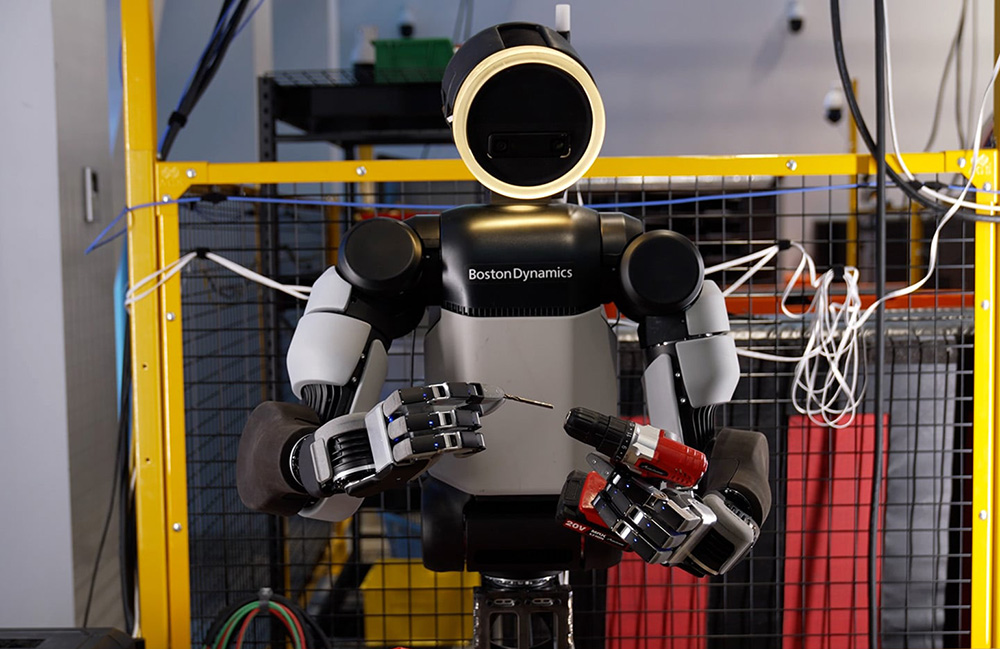
Boston Dynamics said it didn’t set out to build a complicated hand, but instead a reliable one capable of using tools. | Source: Boston Dynamics
Boston Dynamics today unveiled the newest hand for its Atlas humanoid. The hand has four fingers, 13 degrees of freedom (DOF), is directly actuated, and is designed for mass manufacturing.
Previous versions of Atlas’ hand featured seven degrees of freedom and were designed to grasp a large variety of objects, Boston Dynamics said. With the latest hand, the company is shifting its focus to manipulating those objects.
“We considered many, many designs, and there were many questions like: Do we want the hand to have one thumb or two thumbs? Do we really want the hand to have a pinky or not? And most of these don’t have straight answers,” said Alberto Rodriguez, director of robot behavior for Atlas. “There’s always some amount of intuition and experimentation. It boils down to a trade of different competing objectives.”
Boston Dynamics said the four-fingered hand, which doesn’t have a pinky finger, is built for high fidelity simulation to enable sim-to-real reinforcement learning (RL). The company said it maintained transparent direct actuation at the joints, all with a single actuator type. As in Atlas’ body, these actuators are completely encapsulated, with no fragile cables crossing joints.
The new hand is capable of:
- Sliding the fingertip of the thumb along the length and across the width of all other fingers
- Dexterous pinch grasps between the thumb and any of the other fingers
- Dexterous tripodal grasps
- Triggered tool grasps, like drills, power torque drivers, grinders, nail guns, and welding torches
The news comes just a week after Boston Dynamics opened its Robotics Metaplant Application Center (RMAC) at Hyundai Motor Group Metaplant America. The company said the Georgia facility is a training center for integrating Atlas humanoids into parent Hyundai’s automotive manufacturing operations.
Why is Boston Dynamics betting on four fingers?
When it comes to robotic hands, many companies are trying to recreate human-like hands as closely as possible. So, why didn’t Boston Dynamics take that route?
“There’s no pinky because the team determined that the additional dexterity and tasks you’d be able to accomplish is not worth the extra complexity of three additional degrees of freedom, the size, the power consumption, all of the things that come with adding additional actuators,” said Dylan Thrush, a mechanical engineer on the Atlas team.
Before the design was finished, Zachary Jackowski, Boston Dynamics’ chief product and technology officer, asked the team to tape their pinky and ring finger together for a day and report back on what they weren’t able to do. At the end of the experiment, the team had agreed the robot hand didn’t need a pinky.
With four fingers and 13 DOFs, the hand is capable of in-hand reorientation, recovery from a slipping grasp, and handling tools while pressing their triggers.
Size was also a big concern. A robot hand needs to grasp objects of a variety of sizes and potentially reach into small spaces. So it can’t be too big. Additionally, hands that are more similar to human hands have a smaller cross-embodiment gap from human manipulation data.
So, Atlas’ new hand is similar in size to a large human hand, which heavily drives the size of the actuators. Thanks to several unique actuation technologies, the company said it maintained similar strength to the previous hand.
Backdrivability and transparency of the actuators are core to the design philosophy of the entire robot, Boston Dynamics said. It allows the company to rely on proprioception for agile dexterous behaviors. Complementary to proprioception, Boston Dynamics has equipped the hand with dense pressure tactile sensors that cover the fingertips and palm that make it possible to pick on small contact signals.
Building a hand for simulation learning
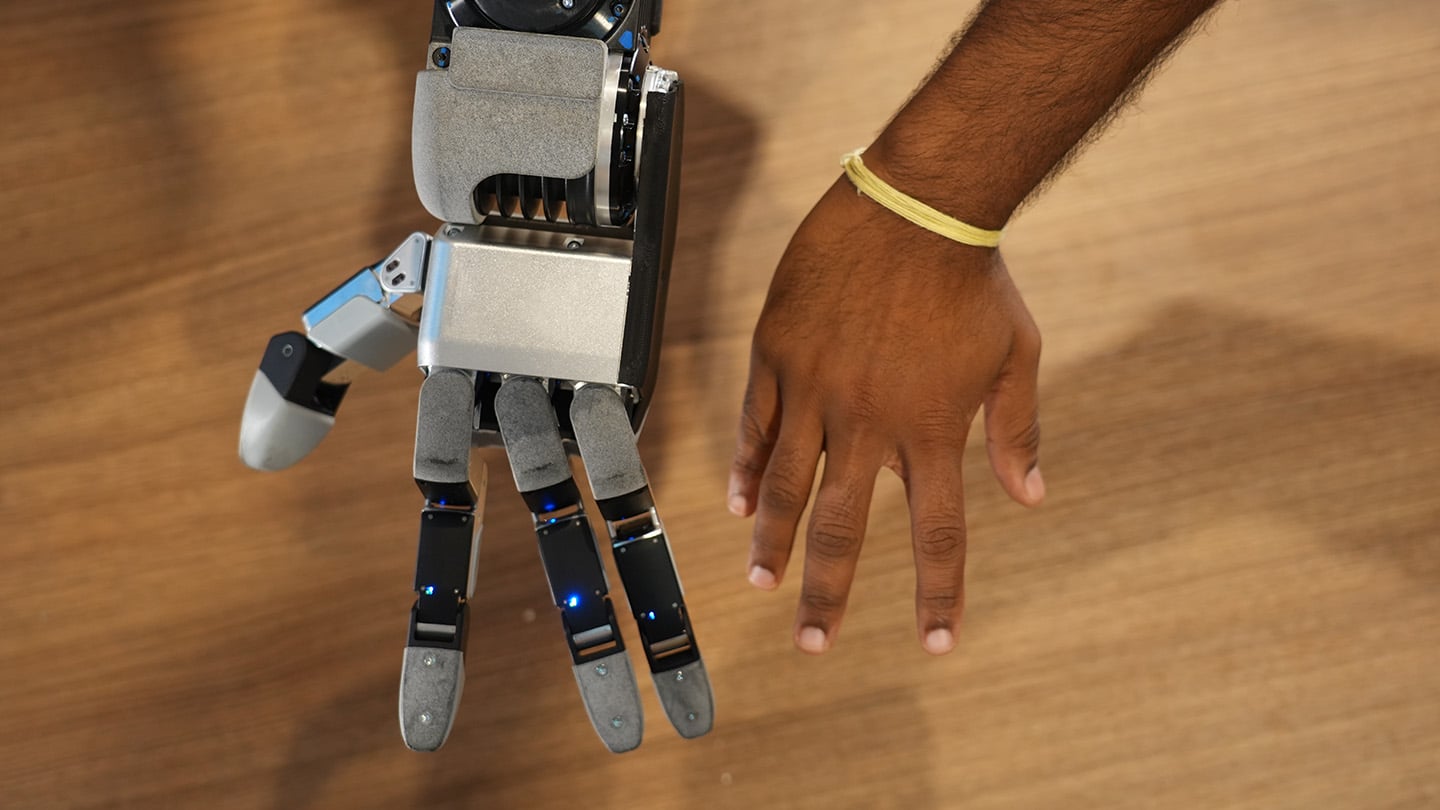
Atlas’ thumb features four DOFs, while the other three features each have three DOFs. | Source: Boston Dynamics
Some of today’s best options for scaling data collection for manipulation involve Universal Manipulation Interfaces (UMIs). With these wearables, demonstrators perform tasks naturally, while sensors capture the most relevant signals during manipulation, like contact events and pressure distribution.
Direct imitation has its limits, however, something Boston Dynamics said it learned when it comes to whole body humanoid control. Whole body behavior for a humanoid is always deployed on top of a whole body controller that takes care of the high rate dynamics of behaviors such as balancing, recovery steps when tripping, and compensation for forces like gravity, self-collisions or external shoves. Importantly, today these whole body controllers are always trained with RL in simulation.
Boston Dynamics said human demonstrations are best suited to capturing the visual complexities of a situation. But, at its core, fast and agile dexterous manipulation is also a byproduct of high-rate closed-loop control and force regulation. This is something wearable devices don’t capture. So, the company believes that RL in simulation is an essential component to solve dexterous manipulation.
This has had a large impact on the design of the hand. Boston Dynamics said, in many ways, it built the hand for sim2real transfer and RL. The rigid-drive actuation and backdrivable transmission, along with controls innovation to compensate for cogging and friction, makes it possible to simulate the hand with high dynamic fidelity.
This fidelity in turn makes RL more effective at training robust control policies with exposure to randomizations of motor torque profiles, surface friction coefficients, object geometries, and task disturbances.
The company has initial results showing promising sim2real transfer in dynamic tasks. These behaviors are trained directly in simulation with domain randomization and rolled out in hardware relying only on high rate actuator proprioception for feedback.
Editor’s note: Brendan Schulman, vice president of policy and government relations at Boston Dynamics, will participate in a panel on “Reshoring With Robots: A Policy Discussion” at RoboBusiness 2026, which will be on Oct. 20 and 21 in Santa Clara, Calif. Register now to attend.
 Register now and help us celebrate 20 years of RoboBusiness!
Tell Us What You Think!