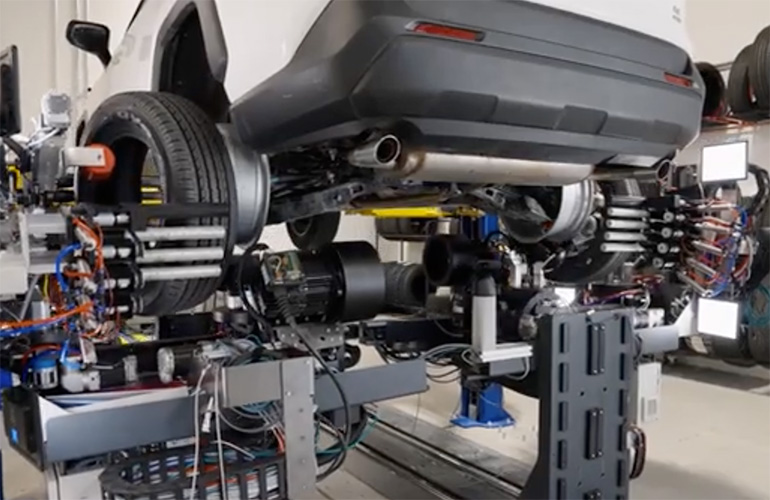
The Automated Tire SmartBay changes two tires at a time without removing the wheel from the vehicle. | Credit: Automated Tire Inc.
Aiming to modernize the traditional service bay, Automated Tire Inc. emerged from stealth today to unveil SmartBay, an AI-powered robotic platform that automates tire changes and vehicle inspections.
By replacing manual, injury-prone labor with advanced computer vision and robotics, the system can cut service times in half to as little as 30 minutes, said the startup. This enables a single technician to manage three bays simultaneously while addressing a critical national shortage of automotive professionals.
“While the auto industry has made great strides with advanced technologies over recent decades, automotive service bays have seen little innovation to match,” said Andy Chalofsky, CEO of Automated Tire. “Most notably, electric vehicles wear through tires up to 30% faster. The proliferation of EVs creates significantly more tire service opportunities, but tire technician jobs are dirty, injury-prone, and difficult to fill.”
“Our SmartBay platform gives modern shops a meaningful solution to turn a dangerous, manual chore into a high-tech, automated process that matches the sophistication of the vehicles being serviced,” he added.
Automated Tire takes an industry-centered approach
Chalofsky, a four-generation “tire man,” said he is approaching the problem from the needs of the industry, rather than “developing a solution in search of a problem.” To that end, Automated Tire’s system is semi-automated in this first generation, with a custom design and optimization.
The most notable feature of the SmartBay is that the tires are changed by leaving the wheels attached to the vehicle. This single feature reduces the biggest chunk of the labor cost of the process — removing and installing wheel lug nuts.
The machine changes two tires at the same time (front or rear), approaching the vehicle from underneath. The footprint of the machine is also designed to fit into existing service-bay space.
A human operator is required to remove the used tire and position the new tire in the machine, said the Woburn, Mass.-based company.
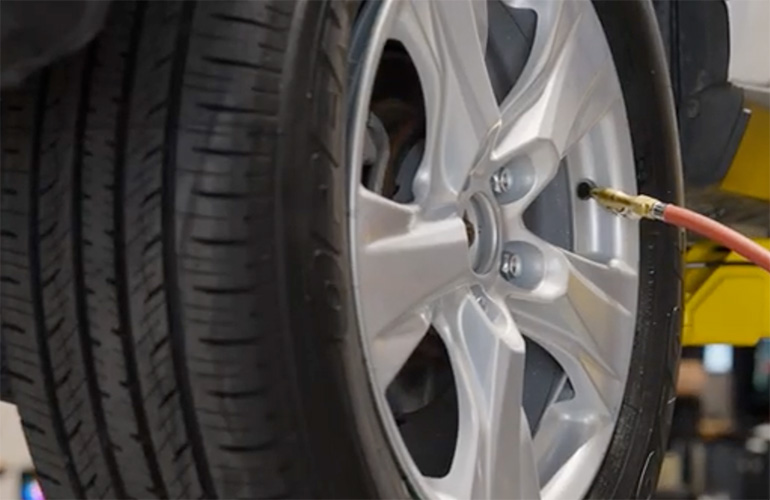
In this first generation of SmartBay, an operator is still required to connect the air line to inflate the tire. | Credit: Automated Tire Inc.
After mounting the new tire, the operator returns to connect the air line to pressurize the tire.
The tire is subsequently balanced on the vehicle, and then the operator mounts the balancing weights at the proper position.
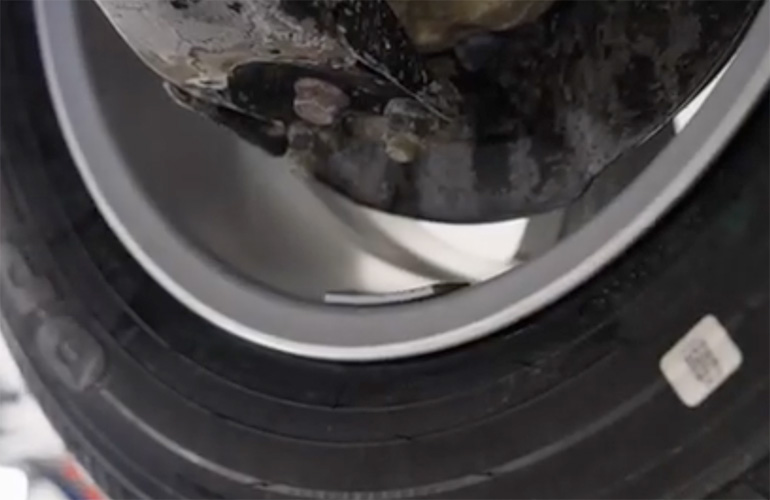
Operators need to manually connect the air line to inflate the tire. | Credit: Automated Tire Inc.
Chalofsky told The Robot Report that “a future version of the SmartBay might completely automate the entire mounting, airing, and balancing process, but this first generation is ready to deploy into the field.”
SmartBay offers immediate ROI
Today, manual tire replacement typically requires an hour for one operator to replace and balance four tires. The SmartBay reduces the total time to 30 minutes with one operator, and one operator can manage three bays at a time.
As a result, the use case at a major tire center is that a single operator managing three bays can replace 24 tires or 6 vehicles in the same amount of time as a single manual tire technician in one bay.
Throughout the process, SmartBay continuously collects and analyzes data, generating real-time insights and customer-facing reports while optimizing each step for efficiency. The integrated service is called BrakeWise brake insights.
By combining automated inspection, tire handling, balancing, and data intelligence into a single workflow, SmartBay reduces manual intervention, increases throughput, and delivers faster, more consistent service outcomes, claimed Automated Tire.
According to the company, SmartBay addresses three primary concerns in the automotive service industry: an ongoing and increasing labor shortage; automation of tire changes, the most injury-prone aspect of routine automotive service; and increasing service bay throughput by significantly reducing the time required for tire changes.
Auto service faces widening worker shortage
According to a report from the National Automotive Dealers Association (NADA), the industry faces a shortage of at least 37,000 new technicians annually, as seasoned technicians retire and fewer young professionals enter the trade.
This shortage leaves shop owners trapped in a cycle of understaffing and expensive retraining, noted Automated Tire. That perpetual cycle worsens as high technician churn leads to inconsistent service quality and even more grueling wait times that frustrate customers and compress profit margins.
It has been more than two years since a similar company, RoboTire, went bankrupt. It had raised $7.5 million in Series A funding back in 2022 and was a RBR50 Innovation Award winner in 2023.
Chalofsky was aware of RoboTire’s failure but said he is confident that SmartBay is designed to solve the very real labor issues facing the automotive repair industry, a business his family has been in for four generations. Chalofsky said SmartBay provides a measurable return on investment (ROI) and delivers a platform that can grow in functionality in the future.



Tell Us What You Think!