Sponsored by GAM.
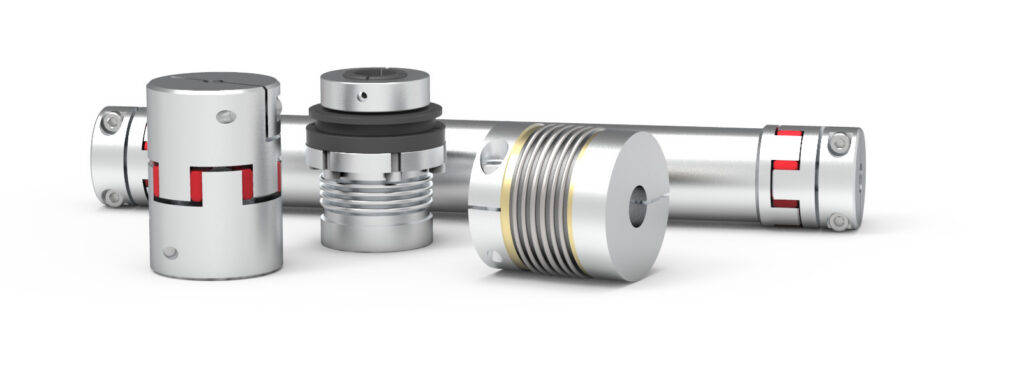
Servo couplings, from bellows and elastomer types to distance and safety types, connect rotating components while compensating for misalignment. (GAM.)
When engineers evaluate servo performance, the motor, drive and gearbox usually get most of the attention. However, the connection between these parts also has a direct effect on how accurately motion is transmitted and the long-term health of the system.
A coupling links the shaft of a servo motor to a gearbox, a servo motor to the drive mechanism, or the gearbox to the drive mechanism. It transmits load from one component to the next while compensating for misalignment, allowing connected parts to function properly without breaking.
“The components don’t normally connect together naturally,” says Matt Ruggles, senior design engineer at GAM, a U.S.-based manufacturer of servo gear reducers, servo couplings and other motion control components. “If you can’t make it perfect, make it adjustable.”
Shaft misalignment can introduce several problems into a servo system. Noise and vibration are often the first signs of components fighting each other, leading to inefficiency in the system. Misalignment also creates unexpected loads on the bearings, causing premature wear that can shorten the service life of the motor, gearbox and surrounding components.
Misalignment generally falls into three categories. Axial misalignment is movement in and out along the axis of rotation, commonly caused by temperature changes. Angular misalignment occurs when the shafts sit at an angle to each other. Lateral misalignment happens when the shafts are parallel but offset.
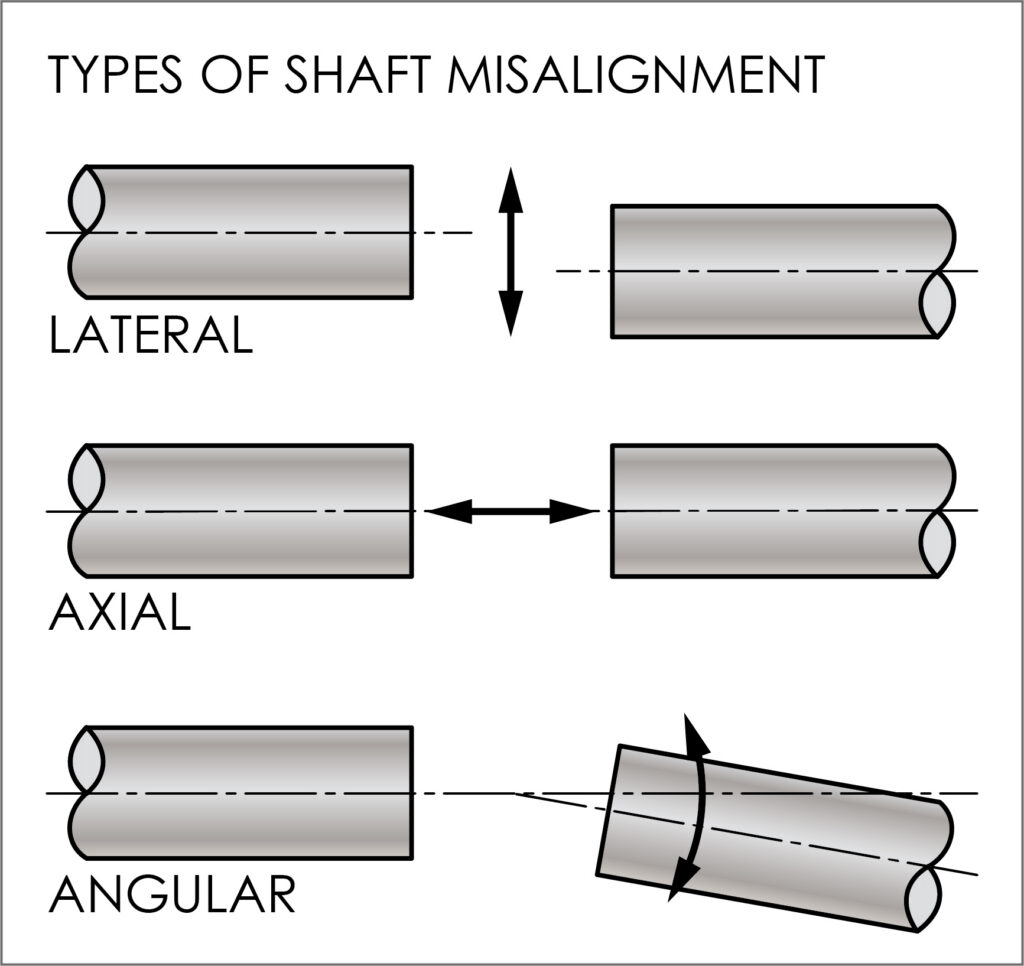
Axial, angular and lateral are the most common types of shaft misalignment. (GAM.)
“The amount of misalignment that you can put through a coupling and have it last a good amount of time is dependent on what type of coupling it is,” says Ruggles. “There are as many types of couplings as you can name stars in the sky, and some of them are purpose-built for specific types of misalignment.”
For example, the universal joint in cars is designed specifically to handle angular misalignment as the axle moves up and down over bumps in the road, even over thousands of miles. It’s all about the coupling’s long-term alternating-stress limits; if the acceptable limits are exceeded, the resulting fatigue can cause the coupling to fail over time.
While misalignment compensation helps protect component life, stiffness affects how precisely motion is transmitted between components. A coupling with higher torsional stiffness helps reduce backlash and lost motion, eliminating sponginess in the system.
“The stiffer the coupling is, the less compliance there’s going to be in your system, which means that your motion system is going to be much more responsive and accurate,” says Ruggles.
The trade-offs between misalignment tolerance and stiffness show up when comparing GAM’s two main servo coupling styles: bellows and elastomer. Both are zero-backlash, low-inertia couplings designed to compensate for shaft misalignment, but they do so through different compensating elements.
A bellows coupling uses stainless steel bellows connected to the clamping hubs via a press fit brass wire or a welded connection. This design gives it very high torsional stiffness while still allowing flexibility for misalignment, especially angular misalignment. As a result, it is better at maintaining precision and responsiveness, but is less forgiving when alignment is off.
Bellows couplings also offer some tunability where changing the number of corrugations influences both stiffness and how much misalignment the coupling can accommodate. They are a strong fit for faster, higher-torque or cyclic-duty applications, as well as higher-temperature environments where a maintenance-free design is preferred. (Depending on the model, bellows couplings can handle temperatures up to 300°C and torque up to 4,000 Nm.)
An elastomer coupling uses an elastomer spider between two clamping hubs. Because the two halves are separable and the elastomer sits between them, it is more tolerant of misalignment, adds vibration dampening and can provide electrical insulation. The separable construction also lends itself to plug-in assembly and repair.
Its stiffness depends on the spider’s Shore hardness but is generally lower than that of a bellows coupling, so it can wind up slightly like a spring and introduce a small amount of delay into positioning. Elastomer couplings are typically a lower-cost option for less precise continuous-duty applications, with temperature capability up to 120°C and torque capacity up to 2,000 Nm.
GAM offers a wide range of servo couplings, including elastomer and bellows designs in a variety of sizes. Distance couplings use elastomer or bellows couplings at either end of a long drive shaft to span up to 20 feet without external bearings, while safety couplings provide adjustable torque settings and single-point 360° re-engagement.
“We have couplings that can attach to hollow shafts,” says Ruggles. “We have ones that have shrink discs. On our bellows coupling, we can do full stainless steel if you need it for food or other special environments. We have high-speed couplings, which are specifically balanced so that they can run at much higher speeds than our normal catalog couplings. And we have a large size variation, from little couplings the size of my thumb to big couplings that are the size of a pumpkin. It’s a large variety of options to tune to whatever the customer needs for their application.”
Visit GAM to learn more about servo couplings for motion control applications.


Tell Us What You Think!