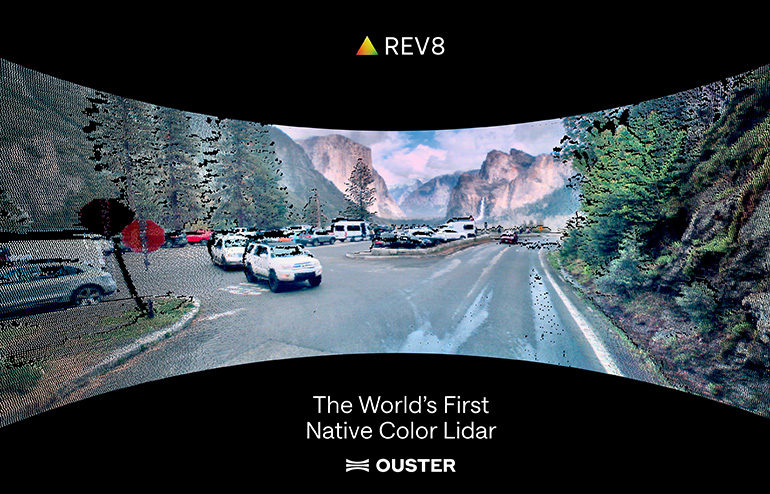
Ouster says its Rev8 OS is its first patented sensor with point-for-point 3D color vision. Source: Ouster
Ouster Inc. today announced Rev8, its new family of OS digital lidar sensors using its next-generation L4 Ouster Silicon. The company said Rev8 features its patented native-color lidar sensors and provides up to double the range and resolution of the previous generation.
“Rev8 is the most advanced family of lidar sensors ever released and sets a new standard in sensing,” stated Ouster CEO Angus Pacala. “With the L4 Ouster Silicon, we are delivering on the promise of our digital architecture to deliver exponential improvements in performance, doubling our core specs, and simultaneously introducing the world’s first native-color lidar to give machines 3D human-like sight for the next era of physical AI.”
“Rev8 is the foundational technology that will allow customers to move from prototype to commercial production at scale, providing the reliability and affordability required to enable real-world autonomy across industries,” he added.
Ouster acquired vision-based perception provider StereoLabs for $38 million in February.
“For 10 years, Ouster was a pure-play lidar vendor. The acquisition is to build a systems or platform business,” Pacala told The Robot Report. “We’re selling to the entire world of companies building the next generation of robotic systems.”
L4 Ouster Silicon designed for safety, reliability, and scale
San Francisco-based Ouster said its L4 architecture is designed for functional safety, reliability, affordability, and scale. Based on patented Ouster Silicon with embedded Fujifilm color science, the L4 chip can process color data and offers hardware-enabled HDR.
The company said its technology has 42.9 GMACs of processing power, detection of up to 20 trillion photons per second, and a 40 kHz measurement rate with picosecond timing precision. It is capable of processing up to 10.4 million points per second and 22.4 gigabits per second of data bandwidth off-chip, claimed Ouster. The L4 architecture features both the 128 channel L4 and 256 channel L4 Max.
“We’ve invested in software running on edge compute and are at the cutting edge of physical AI,” said Pacala. “Some people have seen cameras and lidars as being at odds, but not for our customers. It’s a matter of using the right sensor for the job.”
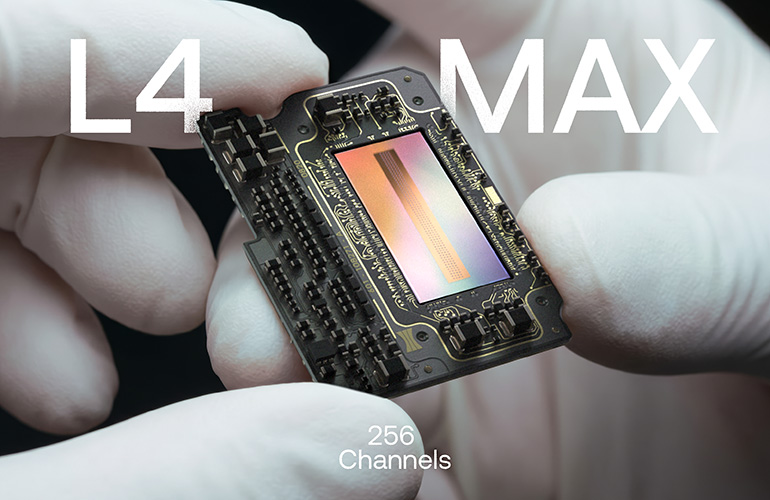
The new Rev8 OS family of sensors uses the L4 and L4 Max Ouster Silicon. Source: Ouster
Rev8 unifies structure and native color
“Rev8 represents a paradigm shift in AI perception with the world’s first native color lidar sensors,” said Ouster. “To perceive the world in full context requires a combination of structure and color, and Rev8 is the first sensor to unify both. For the first time, a single sensor can understand road signs, interpret break lights, or simply capture the richness of planet earth in survey-grade, colorized maps.”
The company asserted that Rev8 lidar sensors fuse data through physics rather than software for megapixel resolution and stunning image quality. “Every point is ‘born’ with color, ensuring ultra-low latency and perfect spatial-temporal alignment,” it said.
This single-sensor solution eliminates the need for complex calibration, providing understanding of 3D environments with rich visual and depth information, said Ouster. Because of its 48-bit color depth and 116 dB of dynamic range, the company noted that its native color data maintains performance in lighting extremes ranging from 1 lux to 2 million lux.

Ouster touts Rev8 specs
The Rev8 OS family features completely redesigned OS0, OS1, and OSDome sensors and adds the flagship 256 channel OS1 Max.
- The flagship OS1 Max: Doubles the range and resolution through a 256-channel architecture powered by the L4 Max. The OS1 Max sees up to 200 m (656 ft.) at 10% reflectivity, with a maximum detection range of 500 m (1,640.4 ft.), all with a 45 degree field-of-view. Built for high-speed autonomy, smart infrastructure, and heavy industrial use, the OS1 Max offers native color and reliability to power long-range, high-performance applications.
- Engineered for functional safety and reliability: Every sensor is automotive-grade, cybersecure to ISO 21434, and designed to meet ASIL-B to ISO 26262, SIL-2, and PLd functional safety certifications. This ensures continuous uptime and reliability in the most demanding applications, said Ouster.
- Built for affordability and scale: The systems are designed for low-cost, high-volume production deployments to support mass-market adoption. With a planned 10-year production life, Rev8 sensors offer the long-term program stability and scalability required for global commercial rollouts, the company said.
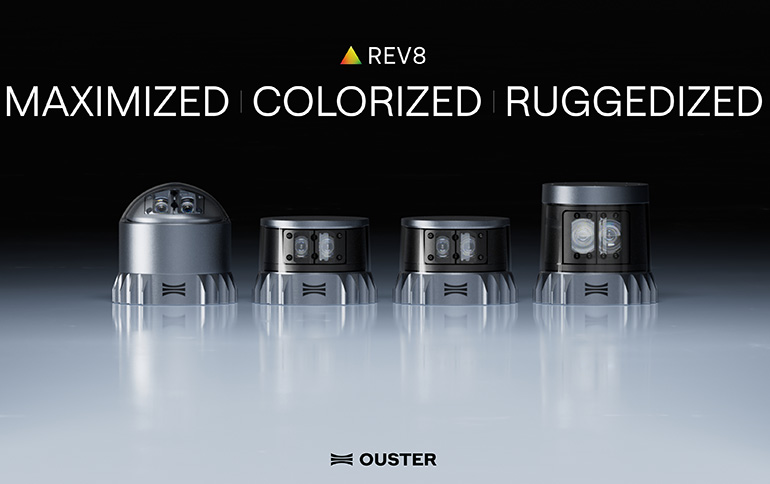
The Rev8 sensor family is automotive-grade, cybersecure, and designed for functional safety. Source: Ouster
Lidar built for the physical AI era, global adoption
“The benefits of native color for object classification and sensor fusion, and the unparalleled performance of the OS1 Max, alongside the functionally-safe, ruggedized, scalable design of the entire OS family, are a game-changer for customer development and capability,” said Ouster.
It said the Rev8 sensors can collect the high-quality 3D color data necessary to train the next-generation of physical AI world models. The company added that its focus on affordability and scalability allows customers to use the same sensor suite for both data collection and production deployments.
“To me, physical AI is something with the AI component in the software layer, fed by a suite of advanced sensors and being run on a computer like an NVIDIA edge GPU,” Pacala told The Robot Report. “We’re selling picks and shovels, offering a family of products across a variety of platforms. The application could be on a traffic light, a humanoid robot, a car, or a delivery robot.”
Dozens of industrial, robotics, automotive, and smart infrastructure companies have said they intend to adopt the Rev8 OS sensors. Ouster named Google, Volvo Autonomous Solutions, Liebherr, Epiroc, Field AI, Flyability, Skydio, PlusAI, Constellis, Bedrock, Kässbohrer, Third Wave Automation, Burro, Seegrid, Gecko Robotics, Pratt Miller, AIM Intelligent Machines, Cyngn, Freefly Systems, ATI Robotics, and SwarmFarm.
Ouster’s Rev8 OS sensors are available to order today and shipping this quarter.
Tell Us What You Think!