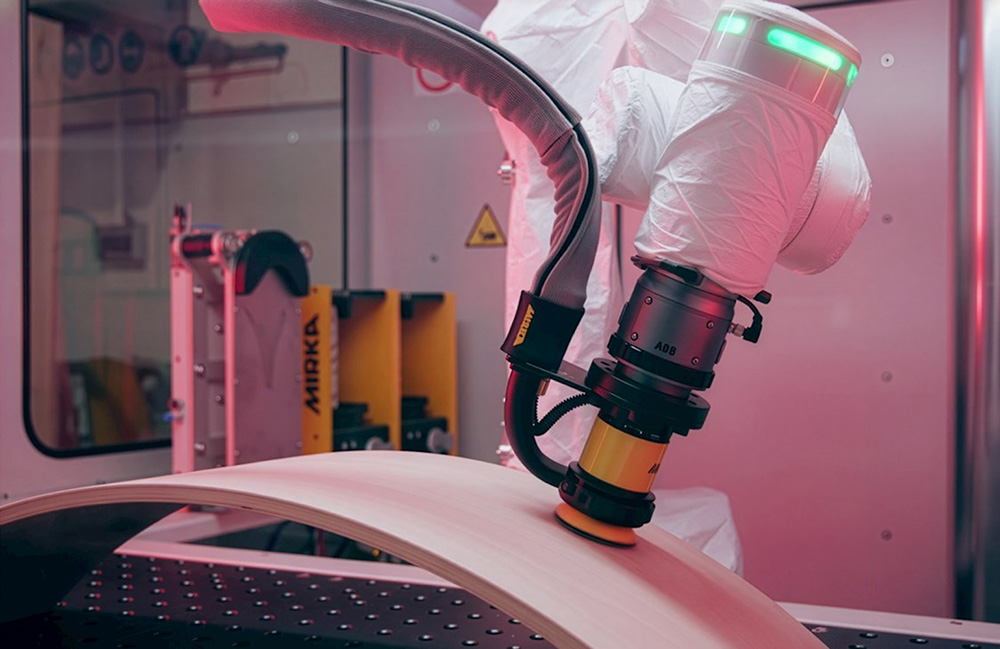
With the finishing cell, ABB said it hopes to bridge the gap between customized automation and entry-level tool kits. | Source: ABB Robotics
ABB Robotics last week launched its first fully automated sanding and polishing cell. The Zurich, Switzerland-based company said the OmniVance Collaborative Surface Finishing Cell can automate key surface finishing tasks, such as sanding and polishing.
Surface finishing is a critical step in manufacturing across virtually every industry. However, businesses are facing dual pressures of more complex production demands and a shortage of skilled labor. Deloitte and The Manufacturing Institute have predicted that 1.9 million manufacturing jobs will be unfilled by 2033.
“A growing number of companies are looking to automate processes such as sanding and polishing, but many smaller businesses lack in-house robotics expertise – so while they need to deliver perfect quality every time, until now, many have not had a solution that fits their needs,” said Craig McDonnell, managing director of business-line industries at ABB Robotics.
“Many businesses are wary of investing in complex, bespoke automation, while off-the-shelf tools lack the scalability and capability they require,” he adde.d “With our new OmniVance Collaborative Surface Finishing Cell, we’re introducing industrial-grade robotics in a simple, affordable, and scalable solution.”
OmniVance designed to be self-contained, easy to deploy
With the OmniVance Collaborative Surface Finishing Cell, ABB said it hopes to bridge the gap between customized automation and entry-level tool kits with its turnkey solution. It uses a GoFa cobot to execute high-quality, precision surface finishing.
The cell is entirely self-contained, delivered as a complete plug-and-play offering including GoFa and safety components. The fully CE-certified cell does not require any additional engineering to switch on and begin production, noted ABB. The company claimed that it is easy to add new tools and accessories, making the system highly adaptable for high-mix environments.
By automating repetitive sanding and polishing tasks, the cell can increase throughput and reduce traditional scrap and rework, saving time, effort, and costs, ABB said. Integrated dust extraction readiness helps maintain a clean, healthy work environment while further enhancing finished product quality. Automation also reduces physical strain and frees skilled workers to concentrate on more valuable tasks, said ABB Robotics.
The company said it developed its software to be intuitive for easy deployment and to govern the entire finishing process. A tablet-style interface is user-friendly for those without robotics expertise and needs no custom programming, according to ABB.
Features such as lead-through 3D path recording, 2D preset path creation, and intuitive path editing, integrated into Wizard Easy Programming blocks, can reduce programming time by up to 90%, it asserted.
Finishing cell joins growing ABB Robotics portfolio
ABB is one of the world’s leading producers of robots. The company‘s portfolio includes industrial automation, collaborative robots, and autonomous mobile robots (AMRs) for a range of industries, including automotive, electronics, and logistics.
In October 2025, ABB Group announced plans to sell its robotics unit to SoftBank Group for $5.3 billion. ABB Robotics has about 7,000 employees, and its U.S. headquarters and factory are in Auburn Hills, Mich.
Last month, ABB released its new PoWa family of force- and power-limited robots. PoWa extends ABB’s cobot capabilities with industrial-grade performance, including six different payload categories, from 7 to 30 kg (15.4 to 66.1 lb.), and it can reach a top speed of up to 5.8 m/s (13 mph).
 Register now and save on your pass to RoboBusiness 2026


Tell Us What You Think!