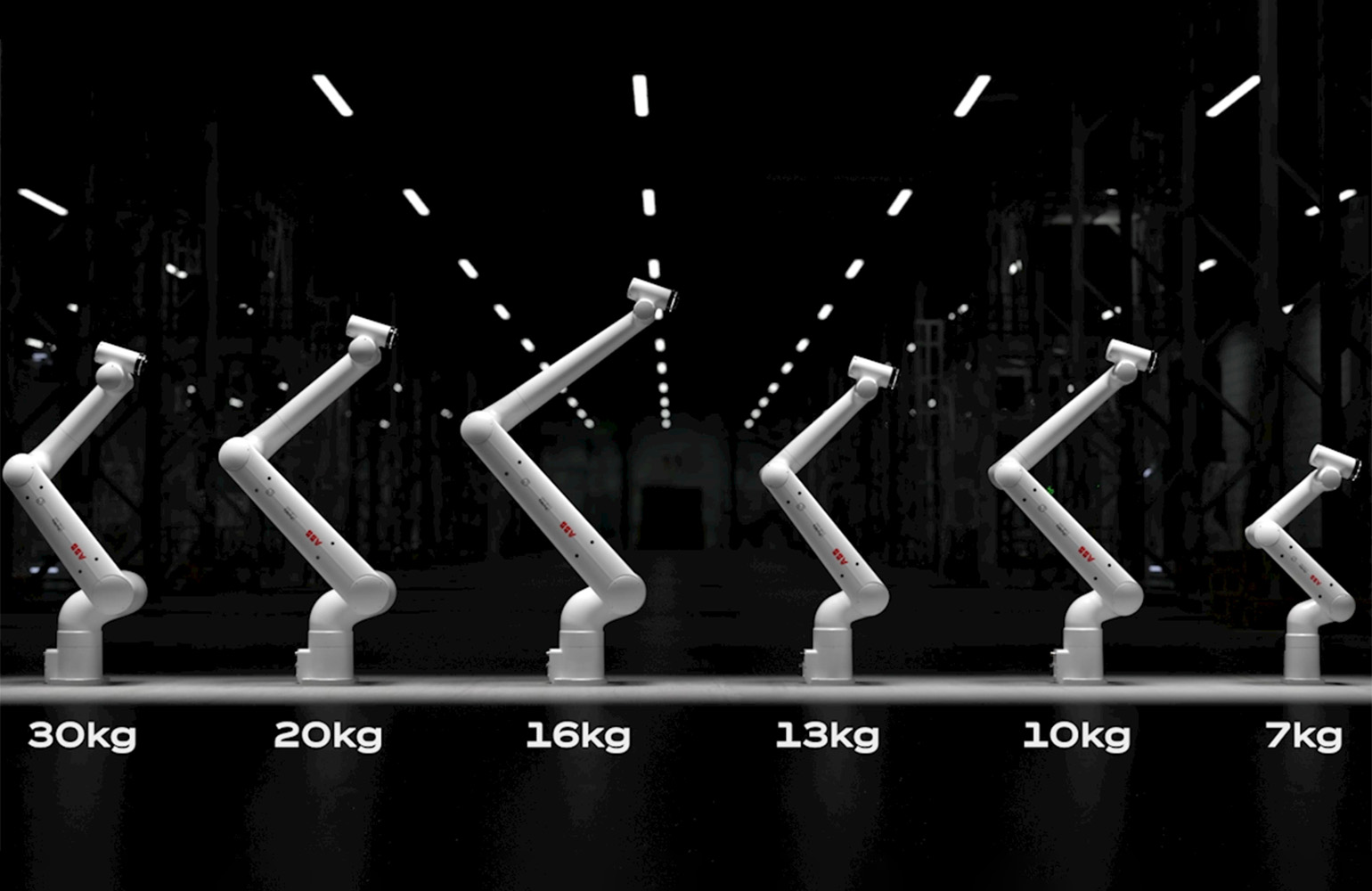
ABB Robotics’ new family of PoWa cobots includes six different categories with payloads ranging from 7-30 kg. | Source: ABB Robotics
ABB Robotics this week launched its new PoWa collaborative robot (cobot) family. The company said the new cobots have higher payloads and performance than its previous offerings.
ABB estimates that the global cobot market will grow by 20% annually through to 2028. The new PoWa family addresses a long‑standing gap in the market between traditional cobots. Traditional cobots, ABB said, often lack the speed and payload needed for industrial applications, while conventional industrial robots typically work best in specialized, large-scale automation environments.
“Cobots are growing significantly faster than traditional industrial robots, driven by demands from both small and midsized companies starting their automation journey as well as large enterprises,” said Andrea Cassoni, Head of Collaborative Robots at ABB Robotics. “These customers are seeking higher speeds and payloads, but also greater ease of use, and compact designs. Established manufacturers want to automate heavier, fast-cycle applications, without the complexity and operational rigidity of traditional industrial robots. We are meeting these needs with the global launch of our high-speed PoWa cobot family – a name that symbolizes its powerful, industrial-grade performance in a compact collaborative robot form.”
ABB Robotics is one of the world’s leading producers of robots. The company’s portfolio includes industrial robots, cobots, and autonomous mobile robots (AMRs) for a range of industries, including automotive, electronics, and logistics.
In October 2025, ABB Group announced plans to sell its robotics unit to SoftBank Group for $5.3 billion. ABB Robotics has about 7,000 employees, and its U.S. headquarters and factory are in Auburn Hills, Mich.
ABB built PoWa for high performance in compact environments
PoWa extends ABB Robotics’ cobot offering with industrial-grade performance, including six different payload categories, from 7 kg (15.4 lbs) to 30 kg (66.1 lbs), and can reach a top speed of up to 5.8 m/s (13 MPH).
The company purpose-built it for compact environments. ABB said the line is ideally suited for applications such as high-speed machine tending, palletizing, screwdriving, and arcwelding. PoWa enables manufacturers to automate heavier and faster processes while maintaining the flexibility, ease of use, and compact footprint of collaborative robotics.
ABB said the new cobots are easy to use through programmable buttons on the arm-side interface and no-code programming, and are compatible with an extensive ecosystem of third-party accessories. PoWa can be unboxed and operational within an hour, enabling plug-and-play with a wide range of tools. ABB said the family of cobots blends industrial-grade connectivity and performance with collaborative robot flexibility.
Powered by the ABB OmniCore controller platform, the new PoWa cobots deliver best-in-class motion control, speed, and precision and can be integrated with ABB Robotics’ expanding suite of AI-powered software, including RobotStudio and Wizard Easy Programming, enabling intuitive programming, fast deployment, and maximum uptime.
Last month, ABB announced that it is integrating NVIDIA Omniverse libraries into RobotStudio to enhance robot simulation and streamline real-world deployments. The capability will be released as the subscription-based RobotStudio HyperReality in the second half of 2026.




Tell Us What You Think!