The Robot Report

  • Home
  • News
  • Technologies
    • Batteries / Power Supplies
    • Cameras / Imaging / Vision
    • Controllers
    • End Effectors
    • Microprocessors / SoCs
    • Motion Control
    • Sensors
    • Soft Robotics
    • Software / Simulation
  • Development
    • Artificial Intelligence
    • Human Robot Interaction / Haptics
    • Mobility / Navigation
    • Research
  • Robots
    • AGVs
    • AMRs
    • Consumer
    • Collaborative Robots
    • Drones
    • Humanoids
    • Industrial
    • Self-Driving Vehicles
    • Unmanned Maritime Systems
  • Business
    • Financial
      • Investments
      • Mergers & Acquisitions
      • Earnings
    • Markets
      • Agriculture
      • Healthcare
      • Logistics
      • Manufacturing
      • Mining
      • Security
    • RBR50
      • RBR50 Winners 2025
      • RBR50 Winners 2024
      • RBR50 Winners 2023
      • RBR50 Winners 2022
      • RBR50 Winners 2021
  • Resources
    • Automated Warehouse Research Reports
    • Digital Issues
    • eBooks
    • Publications
      • Automated Warehouse
      • Collaborative Robotics Trends
    • Search Robotics Database
    • Videos
    • Webinars / Digital Events
  • Events
    • Robotics Summit & Expo West
    • Robotics Summit & Expo
    • DeviceTalks
    • R&D 100
    • Robotics Weeks
  • Podcast
    • Episodes
  • Advertisers
    • Advertise
    • PR Submissions
    • Eblast Submissions
  • Subscribe

Boston Dynamics adds wheels to Atlas humanoid to test whole-body control

By Mike Oitzman | November 9, 2026

Bridging the divide between deterministic physics-based control and policy-driven adaptation, Boston Dynamics released a video today showing its Atlas humanoid using wheels to move around. The “experiment” combined classical model-based motor control with whole-body reinforcement learning to maintain dynamic stability across unstructured, real-world terrain.

In the video, Andy Wu, controls engineer for Atlas at Boston Dynamics, highlights some recent experiments that he executed by attaching wheels to Atlas’ legs. Boston Dynamics said “a wheeled Atlas isn’t a product. It’s a research testbed.” Wu’s intention was to push the actuation to its limits.

Another goal of the experiment was to understand unstructured environment adaptability. Wu addresses the limitations of purely model-based control when navigating unpredictable, real-world conditions that are difficult to model or simulate.

Through a whole-body reinforcement learning (RL) policy, Atlas demonstrates that it can process real-time proprioceptive feedback and velocity commands. The experiment also outputs dynamic pose and force adjustments to mitigate unmodeled disturbances and non-ideal contact states.
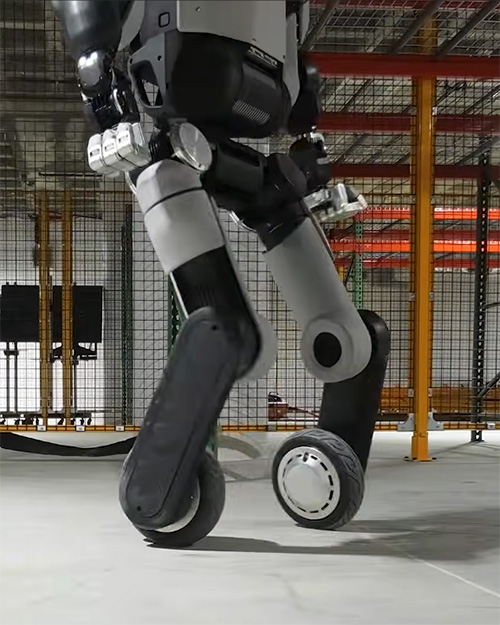
close up of the legs of boston dynamics atlas humanoid showing the wheels.

Boston Dynamics attached wheels to the feet of the Atlas humanoid for a set of controls engineering experiments. | Credit: Boston Dynamics

Atlas moves like a skater

In addition to learning how to move with wheels for feet, Atlas also performs pirouettes and various aggressive actuation maneuvers.

This demonstrates that Atlas can smoothly switch between fast rolling on flat terrain and articulated legged motion over obstacles or irregular surfaces.

Wu trained the system in sim. The system learned all of the behaviors in sim and executed them in real life, with surprising accuracy, according to Wu.

Wu said converting Atlas’ locomotion style was “wonderfully simple.” A single custom adapter mounts an off-the-shelf scooter rim onto Atlas’ existing ankle actuator, and that’s the only new part in the whole build. Because Atlas was designed from the start to be produced at high volume and to be easy to service, Wu said the retrofit was about as involved as swapping a wheel on a bicycle.

The software side was just as straightforward, he said. Each wheel is modeled as an “ankle” that can spin continuously, so all Wu had to do was take the baseline robot model and swap the feet out for wheels.

Real-world implications for humanoid operation

The next question that Wu intends to answer is the policy response to failed actuators. This is key to safety and to understanding how the system will respond to a system failure.

The primary takeaway for Wu and the controls engineering team at Boston Dynamics is to understand control synergy. The video demonstrates that merging classical motor controls (for baseline stability) with whole-body RL (for reactive adaptation) yields superior real-world agility compared to using either method alone.

Wheels vs. legs debate continues

Boston Dynamics’ latest Atlas experiment adds another interesting data point to the ongoing wheels-versus-legs debate in humanoid robotics. While many companies are developing wheeled humanoids, others are committed to legs for navigating environments designed for people.

Agility Robotics recently said it is also exploring wheeled robots as part of a broader family of human-centric, multipurpose platforms. Co-founder and Chief Robot Officer Jonathan Hurst said Digit likely won’t get wheels, but the company is exploring other wheeled configurations.

Again, Boston Dynamics said a wheeled Atlas is a research testbed, not a product. Still, experiments like this raise an interesting question about how much of the humanoid form factor needs to be human-like to be commercially useful. We’ll be watching to see where the industry goes next.

The experiments come as Boston Dynamics prepares to ramp up Atlas testing at Hyundai facilities and continues developing the humanoid’s capabilities, including its new four-fingered gripper. The Robot Report will be watching how these developments translate into real-world deployments.


Submissions open now for TRR50Submit your innovation now!


About The Author

Mike Oitzman

Mike Oitzman is a robotics industry veteran and Senior Editor of WTWH Media’s Robotics Group, covering automation for The Robot Report and co-hosting its podcast. With 25+ years of experience, including leadership roles at Adept Technology, Mike founded the Mobile Robot Guide (acquired by WTWH). He is a leading expert on Autonomous Mobile Robots (AMRs), physical AI, and RaaS business models, holding a Systems Engineering degree and an MBA. He can be reached at [email protected].

Tell Us What You Think! Cancel reply

This site uses Akismet to reduce spam. Learn how your comment data is processed.

Related Articles Read More >

A mobile robot between Wi-Fi access points. Wi-Fi connectivity needs to be reliable for real-time mobile robot management, says Synaptics.
How to minimize Wi-Fi roaming interruptions for autonomous mobile robots
The annual ARM Institute member meeting takes place in Pittsburgh.
ARM Institute consortium grows to more than 500 organizations
A demonstration of integrating laser marking systems with robotic control. Source: Telesis-Universal Robots.
Robot integration brings high-precision production to midmarket manufacturers
headshot of aaron nathan and podcast logo.
How Point One turned GPS accuracy into a robotics platform

RBR50 Innovation Awards

“2026”
“rr
EXPAND YOUR KNOWLEDGE AND STAY CONNECTED
Get the latest info on technologies, tools and strategies for Robotics Professionals.

Latest Episode of The Robot Report Podcast

Automated Warehouse Research Reports

Sponsored Content

  • LiberAI Unveils Liber-0, a World Action Model That Grounds Human Experience in Robot Action
  • 28 Zero-Day Findings in Less Than Two Days: What AI-Speed Discovery Means for Robotics
  • Solving the Interconnect Challenge in Modern Robotics: How 3M Is Engineering for Motion, Density, and Uptime
  • WorldOracle Tests Whether World Models Can Reliably Predict Real-World Executions
  • Vecna Robotics makes its systems in the U.S. and is not directly affected by the FCC restriction. Webinar to discuss how the FCC robotics ruling affects automation buyers
More Sponsored Content >
The Robot Report
  • Automated Warehouse
  • Robotics Summit & Expo West
  • Robotics Summit & Expo
  • About The Robot Report
  • Subscribe
  • Contact Us

Copyright © 2026 Arrowfly LLC. All Rights Reserved. The material on this site may not be reproduced, distributed, transmitted, cached or otherwise used, except with the prior written permission of Arrowfly
Privacy Policy | Advertising | About Us

Search The Robot Report

  • Home
  • News
  • Technologies
    • Batteries / Power Supplies
    • Cameras / Imaging / Vision
    • Controllers
    • End Effectors
    • Microprocessors / SoCs
    • Motion Control
    • Sensors
    • Soft Robotics
    • Software / Simulation
  • Development
    • Artificial Intelligence
    • Human Robot Interaction / Haptics
    • Mobility / Navigation
    • Research
  • Robots
    • AGVs
    • AMRs
    • Consumer
    • Collaborative Robots
    • Drones
    • Humanoids
    • Industrial
    • Self-Driving Vehicles
    • Unmanned Maritime Systems
  • Business
    • Financial
      • Investments
      • Mergers & Acquisitions
      • Earnings
    • Markets
      • Agriculture
      • Healthcare
      • Logistics
      • Manufacturing
      • Mining
      • Security
    • RBR50
      • RBR50 Winners 2025
      • RBR50 Winners 2024
      • RBR50 Winners 2023
      • RBR50 Winners 2022
      • RBR50 Winners 2021
  • Resources
    • Automated Warehouse Research Reports
    • Digital Issues
    • eBooks
    • Publications
      • Automated Warehouse
      • Collaborative Robotics Trends
    • Search Robotics Database
    • Videos
    • Webinars / Digital Events
  • Events
    • Robotics Summit & Expo West
    • Robotics Summit & Expo
    • DeviceTalks
    • R&D 100
    • Robotics Weeks
  • Podcast
    • Episodes
  • Advertisers
    • Advertise
    • PR Submissions
    • Eblast Submissions
  • Subscribe