
Wi-Fi connectivity needs to be reliable for real-time mobile robot management. Source: Synaptics
An autonomous mobile robot or AMR may cross dozens of Wi-Fi coverage zones during a single shift. Each transition creates a small but potentially consequential communications problem: How does the robot find its next access point without interrupting the connection it is already using?
The answer matters because AMRs, industrial inspection robots, warehouse automation, and healthcare service robots increasingly depend on continuous connectivity for sensor data, telemetry, and control.
In a conventional Wi-Fi architecture, the primary communication radio must periodically stop transmitting and receiving application traffic while it searches for alternative access points. That creates a tradeoff among connectivity, latency, power consumption, and roaming performance.
A dedicated scan architecture separates network discovery from application traffic. The robot can monitor its wireless environment continuously while the primary radio maintains the active connection.
One implementation, Synaptics Scan Core, uses a low-power wireless subsystem to monitor neighboring access points while the primary Wi-Fi radio remains dedicated to application traffic. This separation can support faster roaming decisions, lower latency, reduced packet loss, and more efficient scanning.
As robots become more mobile, roaming is mission-critical
Robots are becoming more connected and autonomous across manufacturing, logistics, healthcare, retail, and service environments. As they move through larger and more complex facilities, reliable wireless connectivity and fast roaming become core design requirements rather than secondary networking considerations.
Unlike stationary Wi-Fi devices, robots move continually between coverage areas while maintaining video, AI inference, telemetry, and fleet-management communications. These combined demands make mobile robotics a strong use case for dedicated scanning architectures.
Modern robots also support increasingly demanding wireless workloads, including HD and multi-camera video, simultaneous localization and mapping (SLAM), AI-assisted navigation, predictive maintenance, and remote operation.
Wireless connectivity has therefore evolved from a convenience into a critical operational subsystem.
 Submit your innovation now!
Mobility poses challenges
A mobile robot must maintain application traffic as it moves between Wi-Fi coverage zones. A warehouse robot may roam dozens or even hundreds of times during a shift. Each roaming event can introduce:
- Increased latency
- Packet loss
- Video disruption
- Delayed control responses
- Reduced productivity
Common performance targets for robotics deployments include:
| Requirement | Typical Target |
| Roaming latency | <80 ms |
| Sustained throughput | 20 Mbps |
| Packet loss during roaming | <2% |
For many autonomous systems, meeting these targets is important to safe and efficient operation.
Key requirements and pain points
Although stakeholders evaluate robotics systems differently, several wireless performance measures consistently emerge as critical.
Roaming latency
A typical roaming process includes the following steps:
- Network discovery
- Candidate evaluation
- Authentication
- Security key exchange
- Reassociation
Each step adds delay. In robotics applications, excessive roaming latency can affect navigation, fleet coordination, teleoperation, and machine-vision performance.
Packet loss
Even brief connectivity interruptions can affect AMR operations and data transfer. Robots often require communications performance that is consistent and predictable enough for real-time operation.
Power consumption
AMRs must continuously balance battery performance and energy efficiency. Aggressive scanning improves roaming responsiveness but typically increases power consumption.
Dense RF environments
Warehouses, factories, airports, and hospitals often contain many access points, multiple wireless protocols, and significant RF reflections. These conditions place additional demands on roaming algorithms.
Dedicated scanning can address mobile robot connectivity
Traditional Wi-Fi clients use the primary communication radio for both application traffic and network discovery. During a background scan, the radio temporarily leaves its serving channel to look for neighboring access points, interrupting active traffic and potentially adding delay or packet loss.
A dedicated scan architecture assigns continuous monitoring of the wireless environment to a separate low-power resource. The primary Wi-Fi radio can remain focused on application traffic while candidate access points are identified in advance.
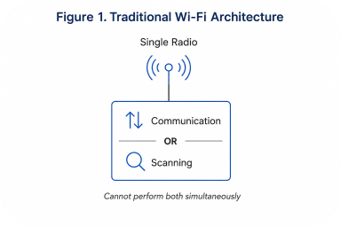
Source: Synaptics
Synaptics Scan Core is one implementation of this general architectural approach. A dedicated scan resource removes this contention between active communications and network discovery.
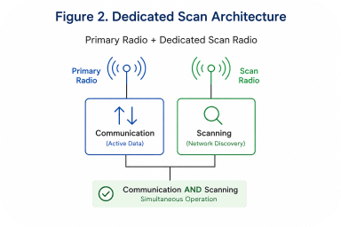
Source: Synaptics
Traditional Wi-Fi versus Scan Core
| Conventional Wi-Fi | Dedicated Scan Core |
| Main communication radio performs scanning | Dedicated Scan Core performs scanning |
| User traffic interrupted during scans | User traffic radio is not interrupted by scan operations |
| Reactive roaming | Proactive roaming |
| Higher scan power | Lower scan power |
| Longer roaming time | Faster roaming |
| Periodic access point discovery | Continuous AP discovery |
Key benefits
- Continuous network awareness: The scan radio continuously monitors neighboring channels while the primary radio remains connected.
- Faster roaming decisions: Candidate access points are discovered before signal quality degrades.
- Lower packet loss: Active communications continue during background scanning.
- More predictable performance: Roaming behavior becomes more consistent and predictable.
- Improved power efficiency: Background scanning can be optimized without disrupting active communications.
Instead of waiting for connectivity to deteriorate, the wireless subsystem can prepare for the next roaming event while application traffic continues on the primary radio.
Measured Scan Core benefits
Synaptics said its platform characterization measured substantial improvements in scanning efficiency:
| Metric | Improvement |
| Scan time | Up to 65% faster |
| Overall scan duration | Approximately 40% shorter |
| Scan power | Up to 75% lower |
| Scan current | Up to 77% lower |
Source: Synaptics robotics platform characterization
In a mobile robot, these improvements can contribute to faster roaming, lower scan energy, longer battery life, and steadier application traffic. Actual results will depend on the platform, network topology, traffic load, and RF environment.
Applying dedicated scanning to mobile robots
Commercial connectivity platforms are beginning to incorporate dedicated scanning. For instance, Synaptics offers an integrated platform combining Wi-Fi 7, dual Bluetooth 6.0, and IEEE 802.15.4, as well as multi-band operation across 2.4, 5, and 6 GHz.
Within that platform, Scan Core provides a dedicated scan resource that operates independently of the primary WLAN subsystem. This allows scanning and active communications to occur simultaneously rather than compete for the same radio.
Multi-band awareness
The platform evaluates candidate access points across multiple frequency bands, helping the robot maintain connectivity as it moves through a facility.
Fast channel switching
The architecture supports rapid transitions between the main and scan resources. On the Synaptics robotics validation platform, switching between resources was measured on the order of microseconds.
Roaming test results
Figure 3 summarizes the minimum and maximum measured roaming times across three representative scenarios. In Synaptics platform testing, all results remained below the 80 ms target while continuous 20 Mbps UDP traffic was maintained:
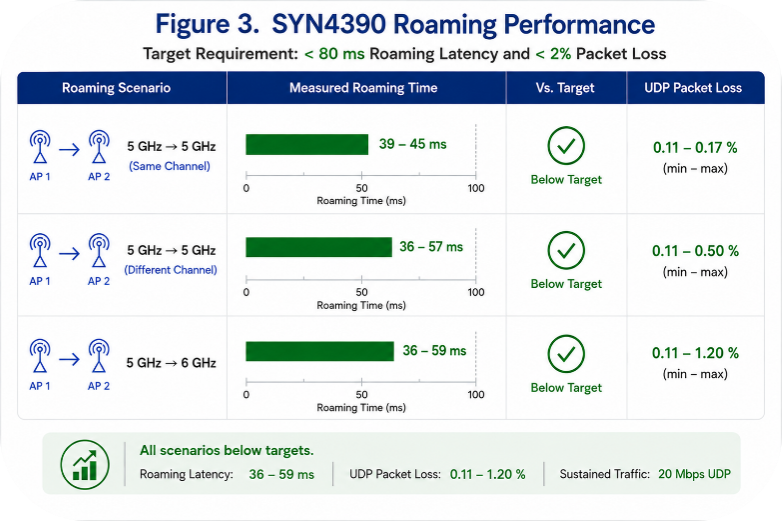
Source: Synaptics
Wireless mobility becomes part of robot performance
As AMRs take on more complex workloads and operate across larger, denser environments, wireless mobility becomes part of the robot’s performance envelope. Roaming affects productivity, fleet efficiency, the user experience, and, in some applications, safe operation.
Conventional Wi-Fi makes the communication radio divide its time between application traffic and network discovery. A dedicated scan architecture separates those functions, allowing the robot to identify its next connection without interrupting the one it is already using.
Dedicated scanning and Wi-Fi 7 enhanced Multi-Link Single Radio (eMLSR) address different parts of wireless mobility. Dedicated scanning improves awareness of nearby access points; eMLSR improves how the device uses multiple links. Together, they can make roaming faster and more predictable without forcing designers to trade application performance against network awareness.
In Synaptics internal validation, eMLSR delivered up to a 10x latency improvement over single-link operation under congested conditions. Results vary with network topology, traffic load, and RF conditions. eMLSR can provide many multi-link operation latency benefits without requiring multiple fully active radios.
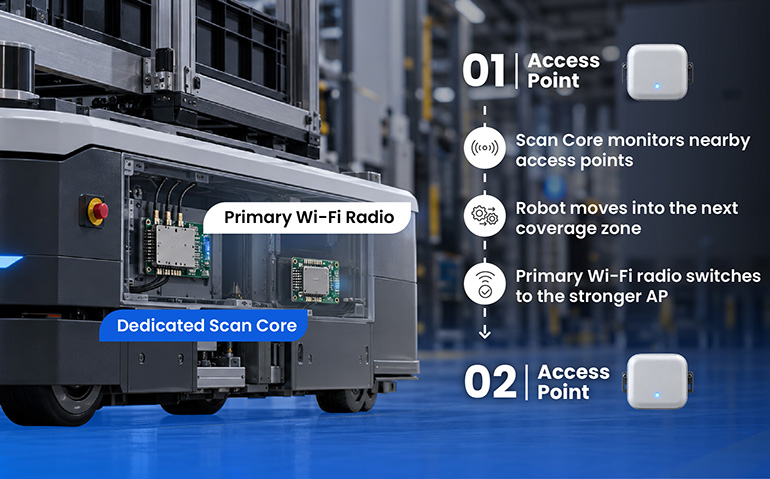
Synaptics says Scan Core can help mobile robots maintain coverage. Source: Synaptics
Glossary
| Autonomous mobile robot | An AMR can navigating and performing tasks using sensors, AI, and wireless connectivity without requiring fixed guidance infrastructure or direct human control. |
| Access point | An AP is a wireless networking device that provides Wi-Fi connectivity to client devices within a coverage area. |
| Enhanced Multi-Link Single Radio | eMLSR is a Wi-Fi 7 capability that enables a single radio to intelligently utilize multiple wireless links, improving latency, reliability, and power efficiency. |
| Fleet management | Software and network infrastructure used to monitor, coordinate, and manage multiple AMRs operating within the same environment. |
| Latency | The time required for data to travel between devices. Low and predictable latency is critical for real-time robotics applications. |
| Multi-Link Operation | MLO is a Wi-Fi 7 feature that allows communication over multiple wireless links, improving throughput, reliability, and network efficiency. |
| Packet loss | Data packets that fail to reach their destination. Excessive packet loss can interrupt video, telemetry, and real-time control. |
| Roaming | The process by which a Wi-Fi client transitions from one access point to another while maintaining network connectivity. |
| Scan Core | A dedicated low-power wireless receive subsystem that continuously monitors the wireless environment while the primary Wi-Fi radio remains dedicated to application traffic. By separating network awareness from communications, Scan Core enables faster roaming, lower latency, reduced packet loss, and improved power efficiency, according to Synaptics. |
| Simultaneous Localization and Mapping | SLAM is a navigation technique that enables a robot to build a map of its environment while simultaneously determining its own position within that map. |
| Simultaneous Transmit and Receive | STR is a Wi-Fi 7 Multi-Link Operation mode that enables simultaneous transmission and reception over multiple wireless links, maximizing throughput and reducing latency. |
| User Datagram Protocol | UDP is a lightweight transport protocol used for real-time applications such as video streaming, voice, gaming, and telemetry. Unlike TCP, UDP does not retransmit lost packets, making it well suited for measuring network latency, packet loss, and roaming performance in wireless systems. |
| Wi-Fi 7 | The latest generation of Wi-Fi technology (IEEE 802.11be) introduced features such as MLO, wider channel bandwidths, lower latency, and improved efficiency in dense wireless environments. |
 About the author
Mikko Niemi is a product manager for wireless products at Synaptics Inc. He has more than 15 years of experience across industrial Internet of Things (IIoT), semiconductor, and software-as-a-service (SaaS) sectors. Niemi specializes in building and scaling intelligent, data-driven platforms that power connected infrastructure, smart energy systems, and next-generation industrial applications.
He previously worked at Lantronix, where he led a portfolio that included industrial IoT gateways, cloud-based, SaaS device management platforms, and global connectivity services—delivering edge-to-cloud systems that integrate real-time telemetry, AI/machine learning analytics, and robust security at scale. Niemi previosly held management roles at Silicon Labs and Landis+Gyr. He holds an MBA and a Master’s in electronics engineering.




Tell Us What You Think!