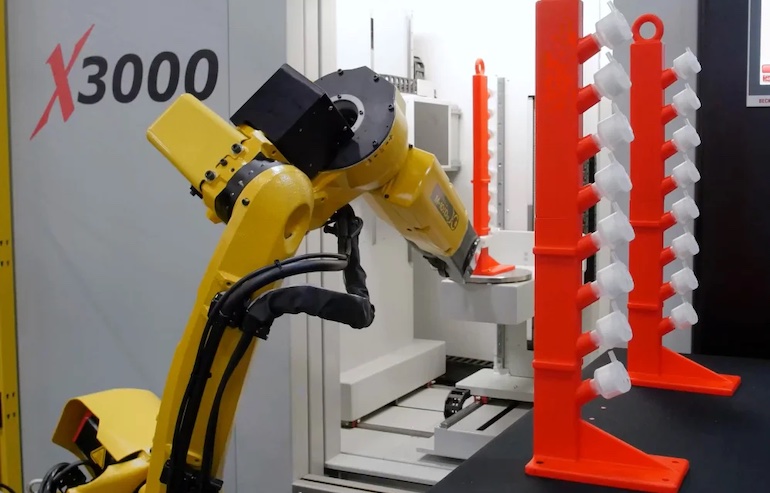
Modern CNC machine tending involves multiple operations. Source: FANUC America
Robotic arms and CNC machines have always operated in the same facilities, but they’re now working in direct coordination, effectively changing what manufacturers can accomplish. What started as simple, single-task automation has grown into full production integration.
Robots can support and actively extend the capabilities of CNC machines, including longer runtimes, higher production, and requiring far less human intervention.
The driving forces behind a new era of CNC machine tending
For years, automation in CNC environments meant a dedicated unit performing one task. Modern integrations look different. A robotic arm now loads a raw blank, transfers it between machines, inspects the finished part, and routes it downstream — all without human involvement.
A Deloitte study showed that up to 1.9 million of the 3.8 million manufacturing positions that need to be filled by 2033 could go unfilled due to skills gaps. That labor pressure is among the clearest reasons manufacturers are turning to robotic machine tending.
A single robotic arm can now manage part orientation, in-process inspection, deburring, and inter-machine transfer within the same automated cell. This capability removes entire labor-dependent process segments from the production chain. It is an incremental workflow improvement and a rearchitecting of the production model itself.
CNC machines are major capital investments that routinely sit idle outside of staffed shifts when tended manually. Robotic arms can enable lights-out manufacturing, running material changes autonomously overnight and through weekends.
This powerful integration also eliminates the variability of manual loading. Operator fatigue, inconsistent grip, and minor misalignments accumulate over a shift and surface as scrap or rework. Robotic arms place every part into a chuck or fixture with the same orientation and force, every time, allowing CNC machines to operate consistently at their designed capability.
How industry leaders are using robotic CNC integration
Manufacturers are moving from pilot programs to full-scale deployment, and the companies leading that charge offer a clear picture of where robotic CNC integration stands today. From turnkey hardware solutions to brand-agnostic software platforms, here are five industry leaders putting robotic arms to work alongside CNC machines.
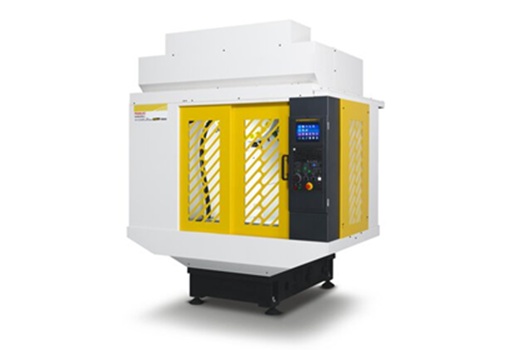
The ROBODRILL vertical machining center, with five-axis integrated technology. Source: FANUC
FANUC’s turnkey systems for ROBODRILL machines
FANUC designs robotic arms to work with its own ROBODRILL vertical machining centers. In 2024, the company unveiled the ROBODRILL α-D28LiB5ADV Plus Y500 with the R-50iA controller, which features an embedded vision system for part recognition and placement verification.
A case study from APT Manufacturing Solutions also documented a 33% efficiency gain on a FANUC-tended ROBODRILL line. Output climbed from 100 to more than 150 parts per eight-hour shift, with return on investment (ROI) achieved in 33 weeks.
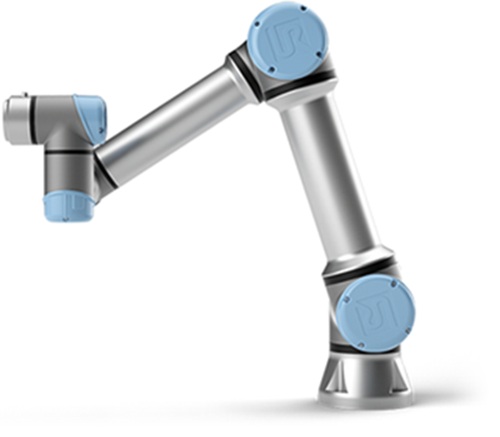
Toolcraft used the UR5e cobot to improve medical device production. Source: Universal Robots
Universal Robots and collaborative machine tending
Universal Robots built its cobot lineup specifically to work alongside people without safety caging. This is a critical factor for small-to-midsize shops with limited floor space. Toolcraft, a Seattle machine shop, deployed the UR5e cobot on a three-operation CNC task for a medical device component.
The UR5e’s 30-micron repeatability enabled multi-threaded parts to be accurately placed across three sequential fixtures, delivering a 23% reduction in production costs and a 43% increase in throughput.
KUKA’s approach to high-precision operations
KUKA has built its reputation on high-payload, high-precision systems for demanding industrial environments. Its KUKA.CNC software allows robots to be programmed in G-code, which is the same language CNC operators already know. The KR Quantec Nano has been deployed in CNC tending cells that use automated tool changers, probes, and 3D scanners for in-process measurement.
In aerospace and defense, these capabilities are nonnegotiable. When a KUKA robot repositions components between operations, precision must match machining precision. Any deviation in placement propagates directly into dimensional error in the finished part.
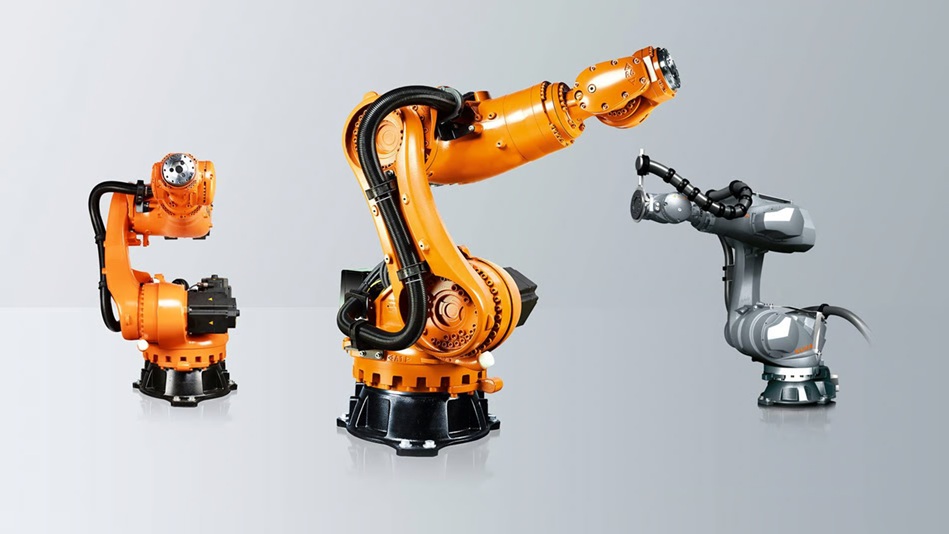
The KR Quantec Nano is compatible with the KUKA.CNC software. Source: KUKA
ABB and the rise of standardized flex loading
Deployment complexity has been one of the biggest barriers to robotic CNC integration. ABB‘s FlexLoader M is a pre-engineered, modular tending cell available in six configurations for lathes, mills and machining centers. Installation averages one to two days.
A built-in wizard introduces new workpieces in under five minutes, and changeover between programmed parts takes under one minute. ABB reports machine utilization exceeding 97% with the FlexLoader M, versus 40% to 60% in manually operated environments.
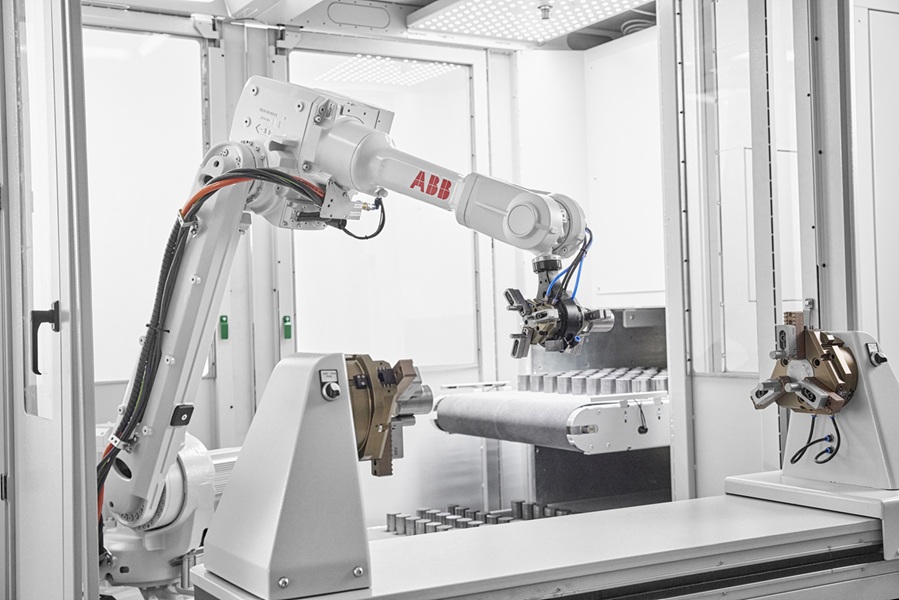
An ABB Flexloader displays its modular and customizable uses. Source: ABB
RoboDK’s simulation and offline programming
Every major robot manufacturer uses a different proprietary programming language, which historically forced shops to maintain separate skill sets for each brand they operated. RoboDK resolves this by providing a manufacturer-agnostic platform that supports over 1,200 robots from more than 50 manufacturers.
It generates native programs for ABB RAPID, FANUC LS, KUKA KRC, and Universal Robots from a single interface. Then it converts five-axis G-code directly into robot programs, enabling robotic arms to perform machining tasks that previously required dedicated CNC equipment.
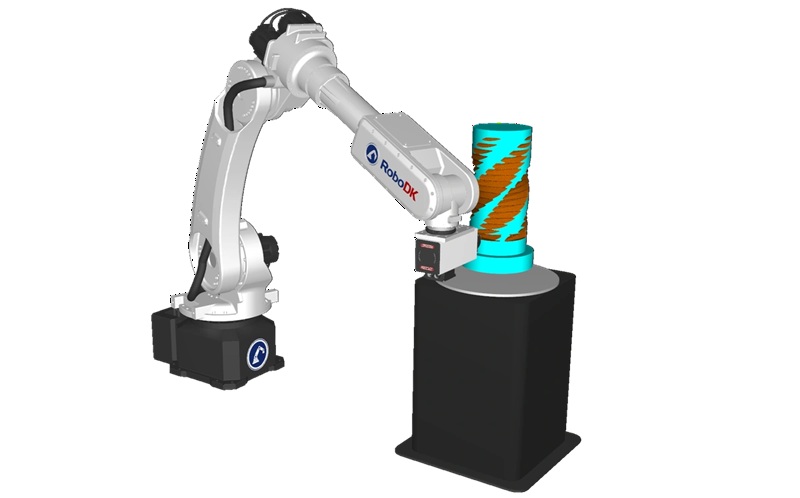
A visualization screen from RoboDK’s innovative CAM software platform. Source: RoboDK
The future of CNC machining is autonomous
The infrastructure being built today by FANUC, Universal Robots, KUKA, ABB and RoboDK is already functional. What remains an open question is how much further the role of the robot expands as artificial intelligence matures.
A robot that loads a part today follows fixed logic. But one that monitors spindle load, detects tool wear in real time and decides autonomously whether a part passes inspection is an entirely different kind of participant in the manufacturing process.
 About the author
Lou Farrell, a senior editor at Revolutionized, has written on the topics of robotics, computing, and technology for years. He has a great passion for the stories he covers and for writing in general.
This article is posted with permission.

As best as our market research can tell, we are the North American leader in placements of machine tending robots. We deliver a complete, plug&play package for CNC mills, Lathes, and some other CNC equipment.
I believe you missed that in your article. Can you post a correction?
Zac Bogart
President
Productive Robotics, LLC