The Robot Report

  • Home
  • News
  • Technologies
    • Batteries / Power Supplies
    • Cameras / Imaging / Vision
    • Controllers
    • End Effectors
    • Microprocessors / SoCs
    • Motion Control
    • Sensors
    • Soft Robotics
    • Software / Simulation
  • Development
    • Artificial Intelligence
    • Human Robot Interaction / Haptics
    • Mobility / Navigation
    • Research
  • Robots
    • AGVs
    • AMRs
    • Consumer
    • Collaborative Robots
    • Drones
    • Humanoids
    • Industrial
    • Self-Driving Vehicles
    • Unmanned Maritime Systems
  • Business
    • Financial
      • Investments
      • Mergers & Acquisitions
      • Earnings
    • Markets
      • Agriculture
      • Healthcare
      • Logistics
      • Manufacturing
      • Mining
      • Security
    • RBR50
      • RBR50 Winners 2025
      • RBR50 Winners 2024
      • RBR50 Winners 2023
      • RBR50 Winners 2022
      • RBR50 Winners 2021
  • Resources
    • Automated Warehouse Research Reports
    • Digital Issues
    • eBooks
    • Publications
      • Automated Warehouse
      • Collaborative Robotics Trends
    • Search Robotics Database
    • Videos
    • Webinars / Digital Events
  • Events
    • RoboBusiness
    • Robotics Summit & Expo
    • DeviceTalks
    • R&D 100
    • Robotics Weeks
  • Podcast
    • Episodes
  • Advertise
  • Subscribe

University of Waterloo researchers develop robots to directly treat kidney stones

By The Robot Report Staff | August 16, 2025

Dr. Veronika Magdanz (left) and researcher Afarin Khabbazian use a robotic arm, miniature robots and 3D-printed models of the human urinary tract to develop new technology to dissolve kidney stones at the University of Waterloo.

Dr. Veronika Magdanz (left) and researcher Afarin Khabbazian use a robotic arm, miniature robots, and 3D-printed models of the human urinary tract to develop new technology to dissolve kidney stones. Source: University of Waterloo

An international research team led by the University of Waterloo in Ontario, Canada, is developing technology to dissolve painful kidney stones in the urinary tract using tiny robots.

Kidney stones, which are solid deposits that form inside the urinary tract like small rocks, affect about 12% of people and frequently recur, resulting in prolonged drug treatment and repeated surgeries that increase patient suffering and tax healthcare systems.

“There is currently no good treatment method available for this type of kidney stone,” said Dr. Veronika Magdanz, a professor of systems design engineering at the University of Waterloo.

“Patients are typically prescribed painkillers and oral dissolving medication that provides slow relief over the course of weeks or months,” she added. “And in urgent cases, when stones block the urine flow, they must be surgically removed.”

Waterloo robots magnetically move strips in kidney
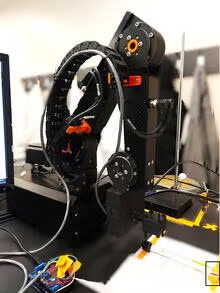
A robot arm magnetically moves strips in kidney stone treatment developed at the University of Waterloo.

A robot arm magnetically moves strips in kidney stone treatment. Source: University of Waterloo

The new technique, tested in a life-size, 3D-printed model, features thin, spaghetti-like strips fitted with magnets that can be moved into place near uric acid kidney stones with a robotic arm operated by doctors.

The soft, flexible robot strips are about 1 cm (0.3 in.) long and contain an enzyme called urease. Once in place, the urease reduces the acidity of the surrounding urine, thereby dissolving stones until they are small enough to pass naturally in just a few days.

Magdanz said researchers are optimistic their minimally invasive treatment system will be particularly beneficial for people known as recurring stone formers who don’t tolerate oral medication well or can’t undergo surgery due to risk factors such as chronic infections.

“Our goal is to provide an effective alternative to existing treatment methods,” said Magdanz, who is also director of the Medical Microrobotics Lab at Waterloo. “We hope accelerated stone dissolution will relieve the pain faster and help patients pass stones quicker.”
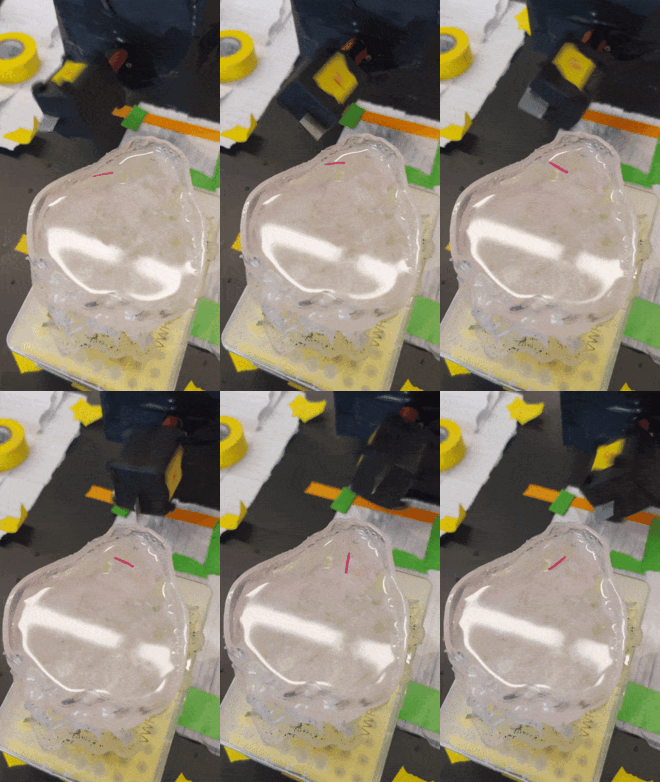
University of Waterloo researchers guide a miniature robot (in pink) through a 3D-printed model of a urinary tract using a revolving magnet on a robotic arm.

Researchers guide a miniature robot (in pink) through a 3D-printed model of a urinary tract using a revolving magnet on a robotic arm. Source: University of Waterloo

Researchers prepare for next steps

The university team said its next steps in the development process include studies with large animals and refinement of the control system. It includes a motorized magnet on a robotic arm and real-time ultrasound imaging that enables doctors to precisely manipulate robots into place near stones.

The research team at Waterloo also included Dr. Alfred Yu, a professor of electrical and computer engineering, and Dr. Mir Behrad Khamesee, a professor of mechanical and mechatronics engineering.

Their international collaborators included researchers and doctors at universities and hospitals in Spain and Germany.

A paper on the work, “Kidney Stone Dissolution By Tetherless, Enzyme-Loaded, Soft Magnetic Miniature Robots,” recently appeared in Advanced Healthcare Materials.


SITE AD for the 2026 Robotics Summit save the date.

Comments

  1. Dale Schneider says

    August 25, 2025 at 6:56 pm

    As a chronic producer of kidney stones for the last 46 years, most either removed by lithotripsy, extraction or passing with discomfort, I welcome any new technology that could assist in alleviating the anxiety and pain that often accompanies this nuisance of unforeseeable misery.
    I would gladly be a ‘guinea pig’ for science when the time comes the robot could be used on humans. I’m a 73 yr. Male

    Reply

Tell Us What You Think! Cancel reply

This site uses Akismet to reduce spam. Learn how your comment data is processed.

Related Articles Read More >

MMI's portfolio of NanoWrist instruments.
MMI earns FDA clearance for robotic soft tissue dissection tools
A collaborative robot working in a lab.
IEEE survey sheds light on how AI and humanoids will affect robotics in 2026
surgical robotics is set to double over the next decade.
Surgical robotics market to double by 2029
Sovato Health’s robotic surgery and procedure telesurgery platform is device-agnostic.
Sovato CEO says big telesurgery advances are coming soon

RBR50 Innovation Awards

“rr
EXPAND YOUR KNOWLEDGE AND STAY CONNECTED
Get the latest info on technologies, tools and strategies for Robotics Professionals.

Latest Episode of The Robot Report Podcast

Automated Warehouse Research Reports

Sponsored Content

  • Supporting the future of medical robotics with smarter motor solutions
  • YUAN Unveils Next-Gen AI Robotics Powered by NVIDIA for Land, Sea & Air
  • ASMPT chooses Renishaw for high-quality motion control
  • Revolutionizing Manufacturing with Smart Factories
  • How to Set Up a Planetary Gear Motion with SOLIDWORKS
The Robot Report
  • Automated Warehouse
  • RoboBusiness Event
  • Robotics Summit & Expo
  • About The Robot Report
  • Subscribe
  • Contact Us

Copyright © 2025 WTWH Media LLC. All Rights Reserved. The material on this site may not be reproduced, distributed, transmitted, cached or otherwise used, except with the prior written permission of WTWH Media
Privacy Policy | Advertising | About Us

Search The Robot Report

  • Home
  • News
  • Technologies
    • Batteries / Power Supplies
    • Cameras / Imaging / Vision
    • Controllers
    • End Effectors
    • Microprocessors / SoCs
    • Motion Control
    • Sensors
    • Soft Robotics
    • Software / Simulation
  • Development
    • Artificial Intelligence
    • Human Robot Interaction / Haptics
    • Mobility / Navigation
    • Research
  • Robots
    • AGVs
    • AMRs
    • Consumer
    • Collaborative Robots
    • Drones
    • Humanoids
    • Industrial
    • Self-Driving Vehicles
    • Unmanned Maritime Systems
  • Business
    • Financial
      • Investments
      • Mergers & Acquisitions
      • Earnings
    • Markets
      • Agriculture
      • Healthcare
      • Logistics
      • Manufacturing
      • Mining
      • Security
    • RBR50
      • RBR50 Winners 2025
      • RBR50 Winners 2024
      • RBR50 Winners 2023
      • RBR50 Winners 2022
      • RBR50 Winners 2021
  • Resources
    • Automated Warehouse Research Reports
    • Digital Issues
    • eBooks
    • Publications
      • Automated Warehouse
      • Collaborative Robotics Trends
    • Search Robotics Database
    • Videos
    • Webinars / Digital Events
  • Events
    • RoboBusiness
    • Robotics Summit & Expo
    • DeviceTalks
    • R&D 100
    • Robotics Weeks
  • Podcast
    • Episodes
  • Advertise
  • Subscribe