NVIDIA is offering AI agent tools to robotics and autonomous vehicle developers.
At GTC Taipei and Computex today, NVIDIA Corp. revealed several open-source physical AI skills and tools to help developers of robotics, autonomous vehicles, visual AI, and industrial digital twins. The company claimed that they can help reduce the costs, time, and complexity of building physical AI workflows at scale.
Available as part of the NVIDIA Agent Toolkit, the new skills will let AI agents speed the data generation, simulation, training, evaluation, and deployment pipelines behind robots, autonomous vehicles (AVs), factories, and laboratories, said the company.
“AI agents are revolutionizing software development, and that shift is now coming to physical AI, extending into the systems that will transform transportation, manufacturing, healthcare, and robotics,” said Jensen Huang, founder and CEO of NVIDIA, at GTC Taipei. “When agents can directly use NVIDIA libraries, models and frameworks, physical AI development will move faster, enabling developers to build the robots, autonomous vehicles, and industrial systems of the future at an incredible pace.”
“Physical AI requires massive amounts of training data in diverse environments,” noted Rev Lebaredian, vice president for physical AI simulation at NVIDIA. “Teleoperation, simulation, and internet-scale data lead to world foundation models for an infinite diversity of use cases.”
NVIDIA makes physical AI stack agent-ready
NVIDIA said it is optimizing its entire physical AI stack for agents by turning libraries, models, and frameworks into agent-callable tools. This includes:
- NVIDIA Cosmos 3 world foundation models for physical world reasoning and generation
- NVIDIA Omniverse libraries for simulation and digital twins
- NVIDIA Isaac for robotics simulation and robot learning
- NVIDIA Metropolis for vision AI
- NVIDIA Alpamayo for autonomous driving
- NVIDIA Jetson platform for edge AI development
“Cosmos 3 is the frontier foundation model for physical AI,” Lebaredian said. “It understands videos and text and can flag what matters. Cosmos is a physically accurate simulation and is able to predict what happens next and generate actions.”
To help apply these tools, NVIDIA is launching new skills to turn physical AI development processes into repeatable instructions that coding agents can follow. This includes which tools to call, what outputs to produce, and how developers can validate results.
Developers can also safely build and deploy autonomous agents using these skills with the NVIDIA NemoClaw blueprint and the NVIDIA OpenShell runtime, which provides policy-based security and privacy governance on local or cloud hardware. The agents will run on the edge in Jetson and have already demonstrated improvements in uptime, said Lebaredian.
NVIDIA said its physical AI skills and tools are accelerating agentic development across:
- Robotics and edge AI: Robot developers can use skills to accelerate the entire robotics development pipeline, from generating perception and mobility training data to simulation, automating navigation training, advancing robot learning, and tuning Jetson-based edge systems for deployment.
- Autonomous vehicles: For AV developers, skills can direct agents to reconstruct data captured by fleets into simulation environments, generate photorealistic driving scenarios at scale, and run closed-loop reinforcement learning to expand training and evaluation coverage.
- Real-time vision AI agents: For automated inspection and video intelligence, NVIDIA said its agent skills can help teams generate synthetic training data, fine-tune models, automate labeling, and build video AI agents that search, summarize, and analyze live or recorded video.
- Industrial AI: Industrial software developers can use these skills to convert engineering data into computer-aided design (CAD) assets for digital twin simulation, optimizing large OpenUSD scenes with less manual setup.
- Healthcare: Before deploying automation in clinical environments, healthcare teams can guide agents through creation of digital twins of hospital environments, sim-to-real data generation, and software-in-the-loop policy testing.
The skills can be combined and integrated into larger agentic systems, according to NVIDIA. This enables developers to orchestrate and automate complex workflows such as data generation, simulation, optimization, inference tuning, continuous evaluation, and more.
Robotics developers pick up physical AI stack
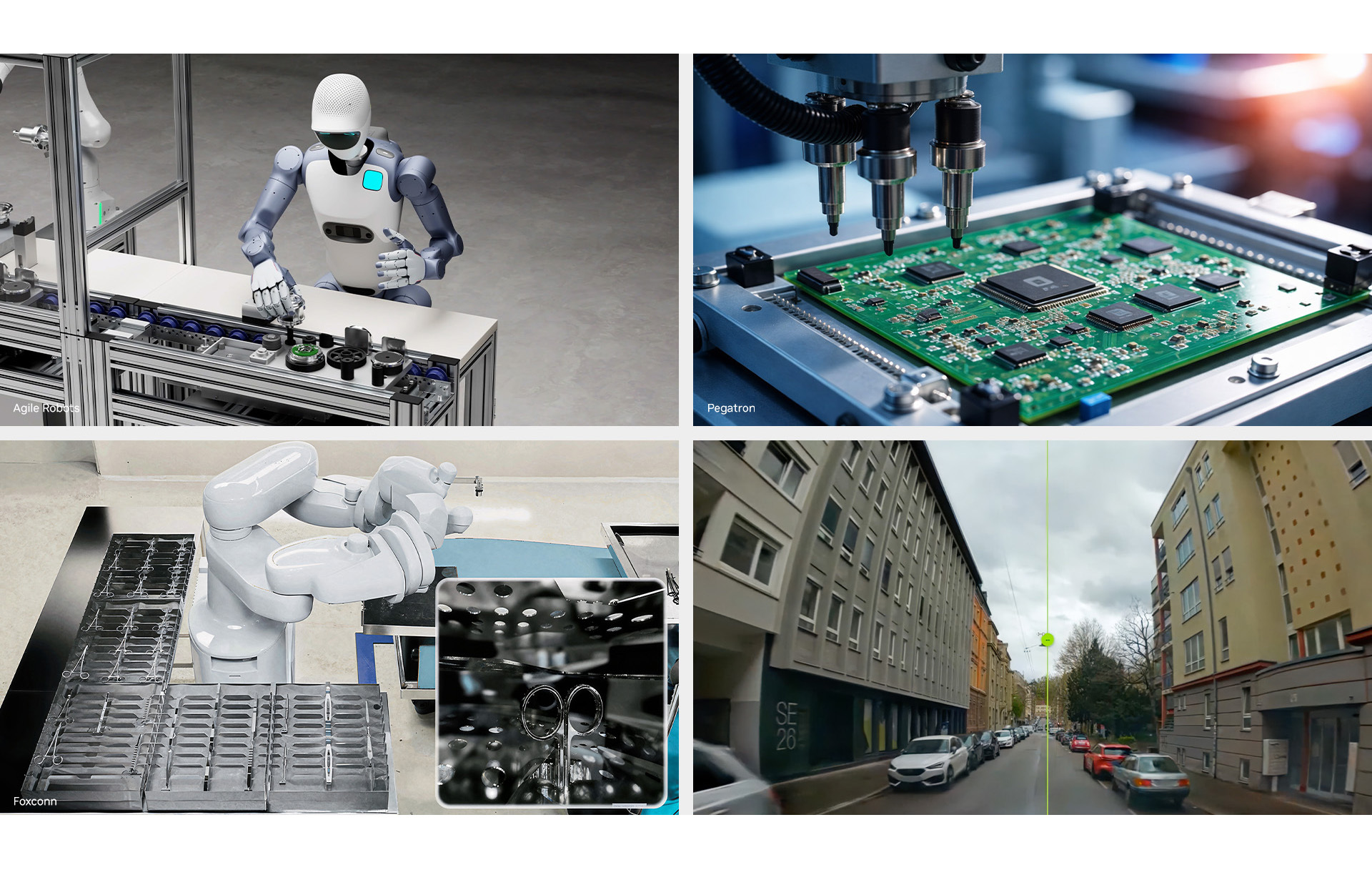
1X Technologies, Agile Robots, Agility, FieldAI, Hexagon Robotics, NEURA Robotics, Skild AI, and Universal Robots are among the robotics companies already using NVIDIA’s agent-ready physical AI stack.
“With stack updates in NVIDIA Isaac GR00T, new end-to-end workflows can be set up in hours versus weeks,” said Lebaredian. “‘Omni-modal’ means it works with different modes — video, sensors, text, and sound for action inputs and outputs.”
In addition, Foxconn and Compal are using NVIDIA Isaac for Healthcare to accelerate hospital robotics. Compal is advancing the development process of its PolyMedX robot toward a hospital-wide orchestration platform, integrating simulation, AI and real-world operations.
Foxconn is scaling Nurabot across several hospitals and long-term care environments, bringing AI-powered robotics to patient care, as well as introducing its new Scrub Nurse Collaborative Robot to help optimize operating room workflows.
Industry leaders build with NVIDIA technologies
NVIDIA partners and customers across manufacturing, transportation, healthcare, and industrial software are using its physical AI libraries to advance the development of autonomous systems and industrial AI.
As these libraries become agent-ready, developers can use NVIDIA skills to help agents automate setup, execution and iteration across complex physical AI workflows.
In electronics manufacturing, TSMC and Pegatron are fine-tuning visual inspection models. Pegatron reportedly reduced model training and deployment time by 67% using synthetic data generated from the Defect Image Generation skill.
Delta Electronics generated synthetic defect data and used the skill to catch excess soldering on metal busbars, improving detection rate by 17%. Inventec developed its Observation Agent visual inspection pipeline by integrating the Defect Image Generation skill, reducing defect data collection effort for laptop chassis manufacturing by 30%.
Foxconn, working with DeepHow, used the skill to improve manufacturing efficiency by catching errors early, boosting first pass yield by about 3%.
In industrial AI, Cadence, Dassault Systèmes, Siemens and Synopsys are using NVIDIA Omniverse libraries and skills for engineering data inspection, simulation, and interactive digital twins. PTC, MetAI and Lightwheel are tapping the NVIDIA Isaac Sim framework and OpenUSD-based workflows to transform CAD data into simulation-ready assets and environments.
As part of its “Autonomous Fab 2030” roadmap, SK hynix is implementing semiconductor fab digital twins using NVIDIA Omniverse. The chipmaker is also collaborating with NVIDIA and SK Telecom to validate NVIDIA Agent Toolkit for manufacturing-specific physical AI.
Self-driving developers Li Auto, Afari, and DeepRoute.ai are using NVIDIA Omniverse NuRec models for neural scene reconstruction and rendering. They have generated more than 1,000 reconstructions and more than 300,000 renders and simulations per day.
In addition, the AV companies are using the new agent skills repository to accelerate and enhance their development of safer, more capable autonomous driving systems. Foxconn, VinFast, Uber, and HUMAIN have joined the NVIDIA DRIVE Hyperion ecosystem to develop and deploy SAE Level 4 robotaxis.
Alpamayo 2 Super has already been downloaded over 500,000 times and was named “Best Technology” at Computex, said Spencer Huang, director of product for robotics at NVIDIA.
Physical AI agent tools are now available
NVIDIA said its physical AI agent tools and skills are available through GitHub and skills.sh for use with any coding agent.
Agent skills and tools for synthetic data generation — Neural Reconstruction, Video Augmentation, Defect Image Generation — are also available on NVIDIA Brev as Physical AI Launchables, preconfigured environments that bundle agent skills and tools for faster synthetic data generation and evaluation.
Microsoft, CoreWeave, and Nebius are integrating these agent skills and tools with their cloud services to enable developers to streamline and scale synthetic data generation and deployment.
Unitree humanoid the reference for NVIDIA Isaac GR00T
NVIDIA also announced the NVIDIA Isaac GR00T Reference Humanoid Robot, an open humanoid robot reference design built on NVIDIA Jetson Thor and the NVIDIA Isaac GR00T development platform. The company said this will help democratize access to advanced hardware and software without requiring expensive, proprietary platforms as interest in general-purpose humanoids increases.
NVIDIA combined a full-size robot body with dexterous manipulation, sensing, control, and onboard AI compute:
- Unitree H2 humanoid chassis, standing nearly 6 ft. (1.8 m) tall and weighing 150 lb. (68 kg), with 31 degrees of freedom for human-scale testing.
- Dual Sharpa Wave tactile five-finger hands, enabling dexterous manipulation with 22 degrees of freedom and bringing the robot to 75 degrees of freedom across the body and hands.
- Multi-view sensing, including a head-mounted stereo camera with wide field of view (140 degrees horizontal, 102 degrees vertical), wrist cameras for close-range manipulation and an inertia measurement unit for motion tracking.
- Whole-body control, with arm torque of up to 120 Newton-meters, leg torque of up to 360 Newton-meters, a rated arm payload of 7 kg (15.4 lb.) and peak payload of 15 kg (33 lb.), unlocking more capable lifting and reach.
- NVIDIA Jetson AGX Thor T5000 onboard compute, featuring an NVIDIA Blackwell GPU with 2,070 FP4 teraflops of AI performance, a 14-core Arm CPU, 128GB of unified memory and a configurable 40- to 130-watt power range for real-time sensor processing and robot inference.
- Connectivity across Ethernet, Wi-Fi 6, Bluetooth 5.2, USB and an array of microphones and speakers for voice interaction.
- Battery for extended operation, with a 15Ah, 0.972kWh capacity and about three hours of life.
- On-remote emergency stop function for quickly disengaging the robot safely.
The Isaac GR00T platform includes:
- NVIDIA Isaac Teleop to capture high-quality robot demonstration data for training and policy development.
- NVIDIA Isaac GR00T open foundation models to support humanoid reasoning, learning and multitask behavior.
- NVIDIA Isaac Sim and Isaac Lab to simulate, train, test and evaluate robot policies before real-world deployment.
- Accelerated NVIDIA Isaac ROS middleware to move trained policies onto robots.
- NVIDIA Jetson Thor to run real-time, on-robot inference and control.
The system is designed to be modular, so robotics teams can use the full platform or integrate selected capabilities into existing development pipelines, helping them scale humanoid development without rebuilding the same infrastructure for each robot or task.
Leading research institutions including Ai2, ETH Zurich, Stanford Robotics Center, and UC San Diego’s Advanced Robotics and Controls Laboratory plan to use this reference design to advance humanoid robotics research.
“To make progress toward general-purpose robots, researchers need platforms that are both capable and broadly accessible,” said Deepak Pathak, co-founder and CEO of Skild AI. “A reference design lets more researchers participate in frontier humanoid research and move from ideas to experiments faster. This helps push the whole robotics research ecosystem forward.”
NVIDIA Research will also use this reference design to advance Isaac GR00T open models, frameworks, and hardware. The NVIDIA Isaac GR00T Reference Humanoid Robot will be available from Unitree in late 2026.

Tell Us What You Think!